
Taiwan's Atemoya Exports Highlight Beijing's Economic Leverage in Cross-Strait Relations
Taiwan's Atemoya Exports Highlight Beijing's Economic Leverage in Cross-Strait Relations The Atemoya Trade and Recent Chinese Pledges The atemoya, a hybrid custard apple variety cultivated primarily in Taiwan's Taitung county, has emerged as a focal point in ongoing economic interactions across the Taiwan Strait. Chinese companies recently pledged increased purchases of the fru
The Atemoya Trade and Recent Chinese Pledges
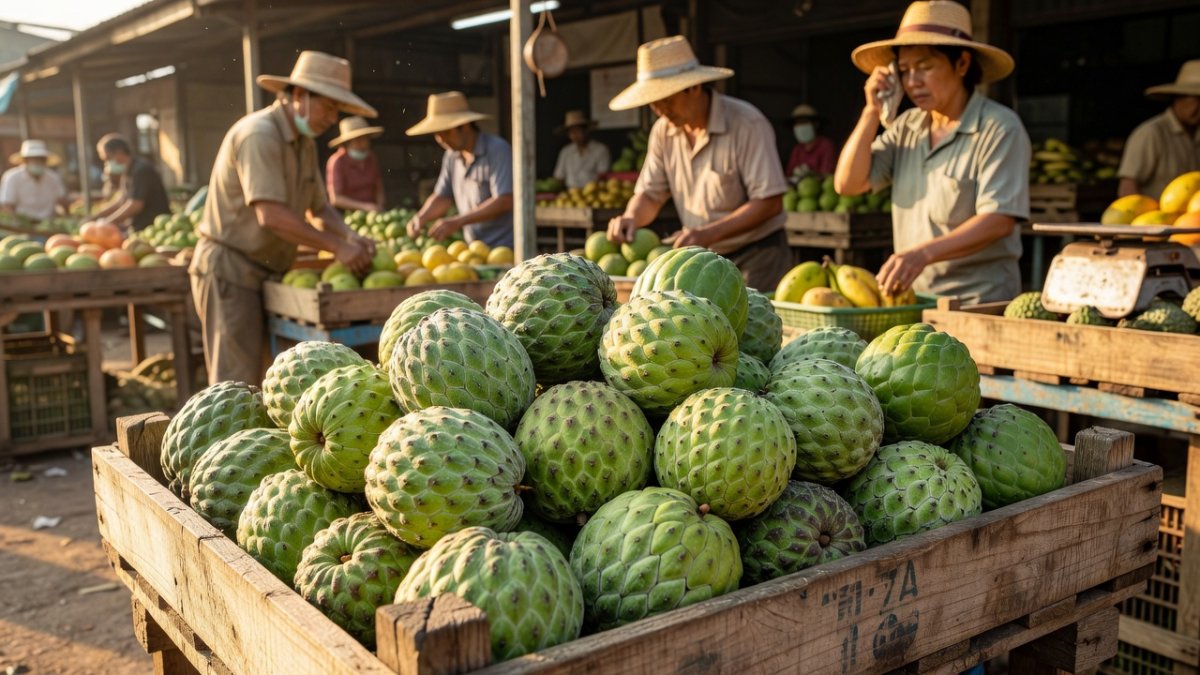
The atemoya, a hybrid custard apple variety cultivated primarily in Taiwan's Taitung county, has emerged as a focal point in ongoing economic interactions across the Taiwan Strait. Chinese companies recently pledged increased purchases of the fruit during a forum held in Xiamen, framing the commitments as part of wider efforts to expand imports of Taiwanese agricultural goods including fish and tea. Taiwan's agriculture ministry responded with a detailed press release cautioning farmers about potential instability arising from such overtures.
Patterns of Market Dependence and Sudden Restrictions
Taiwan's agriculture ministry described the sequence as a recurring "raise, trap, kill" approach. Initial large-scale purchases encourage expanded cultivation, after which unilateral measures such as import suspensions or new taxes are introduced without prior consultation. The ministry noted that imports of atemoyas were suspended in 2021 on phytosanitary grounds, partially resumed in 2023, and then subjected to additional taxes in 2024. These steps have created significant uncertainty for producers who expanded acreage in response to earlier demand signals. The ministry further observed that parallel expansion of atemoya cultivation inside China itself adds competitive pressure on Taiwan's domestic industry.
Precedents from Earlier Agricultural Disputes
Similar dynamics appeared in 2021 when imports of Taiwanese pineapples were halted, prompting widespread disruption for growers and spurring a domestic consumption campaign within Taiwan. Observers have drawn direct parallels between that episode and current developments surrounding atemoyas. In both cases, the absence of advance notice and the invocation of technical standards have left producers exposed to abrupt shifts in market access. Taiwan's authorities have responded by promoting diversification measures, including processing into frozen products, puree, and wines, to reduce reliance on any single export destination.
Political Divisions Within Taiwan
Reactions inside Taiwan have exposed partisan fault lines. The Mainland Affairs Council issued warnings that officials attending the Xiamen forum could face investigation, citing an official prohibition on central government participation. Opposition figures from the Kuomintang have countered that such statements politicise an agricultural sector and risk harming farmers' livelihoods. Taipei Mayor Chiang Wan-an publicly characterised the atemoya as Taiwan's equivalent of TSMC in the fruit sector, emphasising its unique quality and arguing that external political considerations should not constrain export opportunities.
Strategic Context of Cross-Strait Economic Instruments
Beijing maintains its longstanding position that Taiwan forms an inalienable part of Chinese territory and has not ruled out the use of force. Alongside intensified military exercises near the island, including simulations of blockades, economic measures have served as supplementary instruments of pressure. Agricultural trade represents one accessible channel because of its visibility to rural constituencies and its limited capacity to trigger immediate international retaliation. The pattern of initial market opening followed by restriction aligns with broader objectives of demonstrating leverage while avoiding direct military confrontation.
Implications for Regional Economic Resilience
The atemoya episode illustrates the second-order effects that such tactics can generate beyond bilateral trade flows. Neighbouring economies in ASEAN and partners in the Global South may observe the risks of concentrated export dependence and accelerate efforts toward market diversification. Within Taiwan, the episode reinforces ongoing policy emphasis on technological self-sufficiency and supply-chain resilience, extending the logic already applied to semiconductors into agricultural planning. For the European Union and other external actors, the case supplies additional evidence of non-military coercion tools that warrant monitoring in future trade agreements and investment screening mechanisms. Over time, repeated cycles of this nature could erode trust in commercial commitments and encourage both sides to develop more insulated domestic production capacities, thereby reshaping the economic foundations of cross-strait stability.
By Prof. Marcus Chen, Staff WriterThis article was produced with AI-assisted research and editorial support. Reporting is based on sources cited in the article.
What's Your Reaction?
 Like
1
Like
1
 Dislike
0
Dislike
0
 Love
0
Love
0
 Funny
0
Funny
0
 Wow
0
Wow
0
 Sad
0
Sad
0
 Angry
0
Angry
0

World Politics Analyst at Global1.News. Based in Beijing, covering US-China relations, global trade, and geopolitical strategy. Brings deep analytical perspective to the power dynamics shaping international affairs.













Comments (0)