
Putin's Fuel Crisis Exposes Russia's Energy Paradox
Russia's fuel crisis has escalated sharply since August 2025, as Ukrainian drone strikes cripple domestic refineries and expose a structural weakness in the country's energy sector. Long queues at petrol stations now stretch across Moscow, St Petersburg and regional cities, while farmers and transport operators warn of cascading disruptions to harvests and daily services. The shortages test the Kremlin's long-standing strategy of insulating ordinary citizens from the war's economic costs.
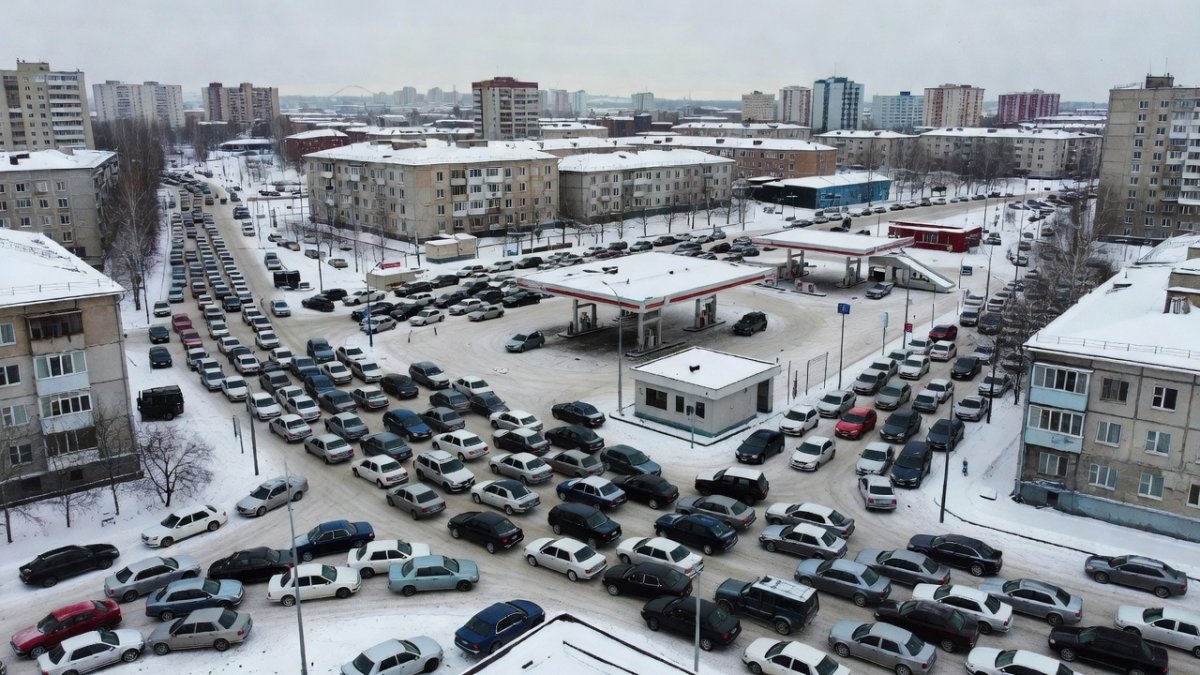
Russia's fuel crisis has escalated sharply since August 2025, as Ukrainian drone strikes cripple domestic refineries and expose a structural weakness in the country's energy sector. Long queues at petrol stations now stretch across Moscow, St Petersburg and regional cities, while farmers and transport operators warn of cascading disruptions to harvests and daily services. The shortages test the Kremlin's long-standing strategy of insulating ordinary citizens from the war's economic costs.
Putin's Fuel Crisis Exposes Russia's Energy Paradox
Moscow, Russia — Russia's fuel crisis, which began in August 2025, has reached critical levels as Ukrainian drone attacks continue to damage oil refineries. The country, one of the world's top oil producers, now struggles to meet domestic demand for refined products. Long queues form at petrol stations in Moscow, with many outlets closed entirely or limiting sales. This situation stems directly from repeated strikes on refining infrastructure near Moscow and St Petersburg.
The Unprecedented Fuel Shortages Gripping Russia
Russia exports approximately 7 million barrels per day of crude oil but lacks sufficient domestic refining capacity to process its own oil for domestic use. This paradox — the country is simultaneously the world's third-largest oil producer and unable to guarantee fuel for its own citizens — has deep structural roots in the post-Soviet privatization of refineries and decades of underinvestment in modernization.
Daily Life Disrupted Across Major Cities
In Moscow, residents report spending hours waiting for fuel amid rising prices. Yekaterina described the mood as one of panic, noting that people fear supplies will run out completely. Elmar called the shortages very bad and highlighted the time wasted filling tanks. Valery expressed disbelief at the need to queue in an oil-producing nation. In Anapa on the Black Sea, local authorities deployed Cossacks to maintain order at stations, while rationing measures prohibit jerry cans in many regions. A mayor in Siberia has arranged portable toilets for drivers in extended tailbacks where fights have broken out.
Andrei's comment about surviving the 1990s carries specific weight. For older Russians, the queues at petrol stations evoke memories of Soviet-era shortages, when rationing and black markets defined daily life. The current generation has never experienced this. The psychological impact of seeing familiar Soviet-era scarcity patterns return could be significant.
Agricultural and Service Sector Impacts
Farmers across Russia express concern that fuel shortages will threaten the summer harvest. Reduced bus services and curtailed rubbish collections already affect several areas, compounding everyday hardships. These disruptions tie into broader energy constraints that limit transport and logistics essential for both urban and rural economies.
The Role of Ukrainian Strikes in the Crisis
Ukrainian drone attacks have targeted refineries with increasing effect since August 2025, reducing Russia's refining capacity. Strikes continue near major population centers, directly limiting fuel availability for domestic use. This pressure on energy infrastructure forms part of Kyiv's strategy to impose economic costs on Moscow's military operations.
How Ukrainian Drone Strikes Caused the Crisis
One might interpret the sequence of Ukrainian drone operations beginning in August 2025 as having progressively narrowed Russia's operational refining margin, with repeated impacts on facilities serving the Moscow and St Petersburg corridors. The cumulative effect appears to have reduced throughput at a time when seasonal demand normally rises, forcing authorities to manage allocation across wider regions. Technical assessments circulating among energy specialists suggest that restoring distillation units and catalytic crackers requires extended periods of stable access, a condition that ongoing strikes near population centers continue to complicate.
Repair crews face logistical constraints when components must be sourced under restricted transport conditions and when repeated alerts interrupt welding and testing phases. Industry observers note that even partial restarts at affected sites have not yet restored pre-August output levels, leaving domestic supply chains exposed to further shortfalls. The resulting pressure on Russia's energy balance is visible in the need to divert volumes from export terminals, an adjustment that carries its own revenue implications for federal and regional budgets.
Whether sustained reconstruction can proceed while strikes remain a recurring factor remains an open question among analysts. Some interpret the pattern as indicating that incremental repairs may only offset a fraction of lost capacity unless the frequency of attacks diminishes, while others point to the possibility of accelerated modular replacements if supply routes can be secured. In either reading, the economic strain on the refining sector appears tied directly to the persistence of these operational disruptions.
Kremlin Measures and Public Sentiment
The Kremlin has responded by restricting internet access in affected regions to control information flow. Official statements attribute difficulties to external factors, yet public frustration surfaces in social media reports of confrontations at fuel lines. Andrei pointed to geopolitics as the cause while noting that Russians had endured the hardships of the 1990s. These measures reflect efforts by the Defense Ministry and energy sector officials to stabilize supplies amid ongoing refinery damage.
The Kremlin's Political Calculations
Putin's position can be read as one in which long-standing efforts to shield domestic audiences from direct war costs now confront visible price and availability signals at filling stations. Throughout the war, Putin has maintained high approval ratings by shielding ordinary Russians from its worst effects — generous military payments, controlled inflation, maintained social services. The fuel crisis breaks through this insulation because it affects everyone, not just those directly involved in the conflict.
Igor Sechin's role at Rosneft places him at the intersection of these pressures, where decisions on allocation and maintenance intersect with broader state messaging. Some Kremlin watchers interpret recent restrictions on information flows as an attempt to limit the spread of visible discontent rather than a long-term solution. The timing of the NATO gathering in Ankara introduces an additional variable, as any perception of domestic strain could influence the tone of allied discussions on further assistance to Kyiv.
The NATO summit in Ankara this week is not just about weapons deliveries — alliance leaders are also discussing the economic dimension of the war. The fuel crisis inside Russia gives Western diplomats a new argument for sustained sanctions pressure. NATO Secretary General has noted that Russia's refining vulnerability represents a strategic weakness that Ukraine has successfully exploited.
Whether these converging factors alter the Kremlin's threshold for negotiation or instead reinforce a preference for control remains subject to interpretation. The leadership's public framing continues to emphasize external causes, yet the practical requirement to address fuel distribution suggests that economic feedback is now reaching decision-makers more directly than in previous periods.
Implications for the Conflict in Ukraine
The fuel shortages coincide with NATO leaders meeting in Ankara this week to discuss support for Ukraine. Kyiv views the domestic pressure as a potential factor that could encourage Russian citizens to push for an end to the war. EU and NATO perspectives emphasize that sustained strikes on energy assets increase the costs of continued military engagement for the Kremlin. This dynamic connects to post-Soviet energy politics, where control over oil and gas remains central to Moscow's power structures.
What Comes Next — Scenarios
One interpretive path envisions mounting domestic costs gradually opening space for exploratory diplomatic contacts, particularly if regional authorities report sustained difficulties in maintaining agricultural and transport schedules. In this reading, economic signals could encourage discreet channels that test whether reduced refinery pressure might accompany a pause in certain military activities, though the precise linkage would depend on how both sides assess their leverage.
An alternative scenario centers on reciprocal targeting of Ukrainian energy assets, framed by Moscow as a necessary response to restore symmetry. Such an approach might aim to demonstrate resolve while seeking to deter further strikes on Russian territory, yet it would also risk extending the cycle of infrastructure damage and complicating any near-term supply stabilization efforts on either side.
A third line of analysis considers whether prolonged shortages could feed into localized expressions of frustration that test the cohesion of regional administrations. Observers note that visible disruptions in daily logistics have already produced scattered confrontations at fuel points, and some interpret these as potential indicators of wider political strain if the underlying capacity issues remain unaddressed over an extended period. Each of these possibilities is understood as contingent on evolving military and economic conditions rather than predetermined outcomes.
By Irina Volkov, Staff WriterThis article was produced with AI-assisted research and editorial support. Reporting is based on sources cited in the article.
What's Your Reaction?
 Like
0
Like
0
 Dislike
0
Dislike
0
 Love
0
Love
0
 Funny
0
Funny
0
 Wow
0
Wow
0
 Sad
0
Sad
0
 Angry
0
Angry
0
Russia/Eastern Europe Correspondent at Global1.News. Covering Russian politics, energy, security, and the shifting dynamics of the post-Soviet space. Provides clear-eyed analysis on one of the world's most opaque regions.









Comments (0)