
South African president mounts legal challenge against report that could lead to impeachment
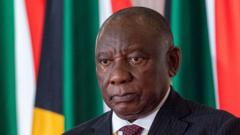
South African President Mounts Legal Challenge Against Report That Could Lead to Impeachment
In a move that has sent ripples across the African continent, South African President Cyril Ramaphosa has launched a legal challenge against a parliamentary report that recommends he face impeachment proceedings. The president contends that the panel of legal experts “misconceived” their mandate when they investigated allegations surrounding the theft of foreign currency from his Phala Phala game farm in 2020.
The Heart of the Matter: A Farm, Foreign Currency, and National Trust
At the centre of this storm lies Phala Phala, Ramaphosa’s sprawling game farm in Limpopo province. In June 2020, approximately $580,000 in US dollars was stolen from a sofa in the farmhouse. The money, according to the president, came from the sale of 20 buffaloes to a Sudanese businessman. What followed was a complex web of investigations, cover-up allegations, and political manoeuvring that has now reached the highest court in the land.
Ramaphosa’s legal team filed papers in the Western Cape High Court this week, arguing that the independent panel appointed by the National Assembly exceeded its terms of reference. The panel, chaired by retired Constitutional Court Justice Sandile Ngcobo, concluded in December that there was sufficient evidence to warrant further investigation into whether the president had violated his oath of office.
• June 2020: Alleged theft at Phala Phala
• February 2022: Allegations surface publicly
• September 2022: National Assembly appoints panel
• December 2023: Panel recommends impeachment inquiry
• March 2024: Ramaphosa launches court challenge
A Pan-African Lens on Accountability
From my vantage point in Dakar, where the echoes of Senegal’s own democratic struggles still resonate, this case feels deeply personal to many of us across the continent. South Africa has long been viewed as a beacon of constitutional democracy in Africa. When its institutions are tested, the reverberations reach every corner of our shared African story.
Community elders in Dakar’s Medina neighbourhood often remind us that leadership is not just about power, but about the trust placed in one’s hands by the people. Ramaphosa’s challenge is not merely a legal manoeuvre; it is a test of how African nations balance executive authority with the demand for transparency.
Expert Perspectives from Across the Continent
Professor Fatima Diallo, a constitutional law scholar at Cheikh Anta Diop University in Dakar, believes the case carries lessons beyond South Africa’s borders. “When a president questions the very mandate given to an oversight body, we must ask whether we are protecting the constitution or protecting the individual,” she told Global1 News. “The ‘misconceived mandate’ argument is clever, but it risks undermining the very mechanism designed to hold leaders accountable.”
In Johannesburg, political analyst Dr. Thabo Molefe sees the legal challenge as a calculated risk. “Ramaphosa is betting that the courts will side with a narrow interpretation of parliamentary procedure. If he wins, it strengthens the executive. If he loses, it could accelerate the impeachment process,” Molefe explained during a video call from his office overlooking Constitution Hill.
Meanwhile, civil society voices in Cape Town have been vocal. The Council for the Advancement of the South African Constitution (CASAC) described the court application as “an attempt to frustrate the will of Parliament.”
Implications for South Africa’s Political Landscape
The stakes extend far beyond one man’s political survival. South Africa heads to national elections in May, and the African National Congress (ANC) is facing its most serious challenge since 1994. A drawn-out legal battle could further erode public confidence in institutions already strained by years of state capture revelations and economic hardship.
Youth organisations in townships around Johannesburg have begun framing the issue as yet another example of elite self-preservation. “Our elders fought for a constitution that would protect ordinary people,” said 24-year-old activist Lerato Mokoena. “Now we watch the same constitution being used as a shield.”
The Cultural Dimension: Leadership and Ubuntu
In many African traditions, leadership is understood through the lens of ubuntu — the belief that a person is a person through other people. Ramaphosa himself has often invoked this philosophy. Yet the current legal battle raises uncomfortable questions about whether ubuntu extends to accepting scrutiny, even when it is uncomfortable.
Senegal’s recent peaceful transfer of power after contentious elections offers a contrasting model. Here in Dakar, citizens took to the streets demanding transparency, but always within the bounds of constitutional order. The South African situation reminds us that democratic maturity is measured not by the absence of crises, but by how institutions respond when power is questioned.
Looking Ahead: What This Means for the Continent
Should Ramaphosa succeed in having the report set aside, it may set a precedent that other African leaders could seek to exploit. Conversely, if the courts uphold the panel’s work, it could reinforce the principle that no one is above accountability — a powerful message across a continent still wrestling with the legacies of authoritarianism.
As the case moves through the courts, ordinary South Africans continue to face daily realities of load-shedding, unemployment, and inequality. The political drama unfolding in Pretoria feels distant to many in the townships, yet its outcome will shape the kind of democracy their children inherit.
From Dakar, we watch with cautious hope. Africa’s story is still being written, and every chapter of accountability strengthens the whole.
This is Amara Diop for Global1 News, reporting from Dakar. 🇸🇳
This article was produced with AI-assisted research and editorial support. Reporting is based on sources cited in the article.
What's Your Reaction?
 Like
0
Like
0
 Dislike
0
Dislike
0
 Love
0
Love
0
 Funny
0
Funny
0
 Wow
0
Wow
0
 Sad
0
Sad
0
 Angry
0
Angry
0

West Africa/Sahel Correspondent at Global1.News. Dakar-based journalist covering politics, security, climate, and development across Francophone and Anglophone West Africa. Tells the stories of a region undergoing profound transformation.










Comments (0)