
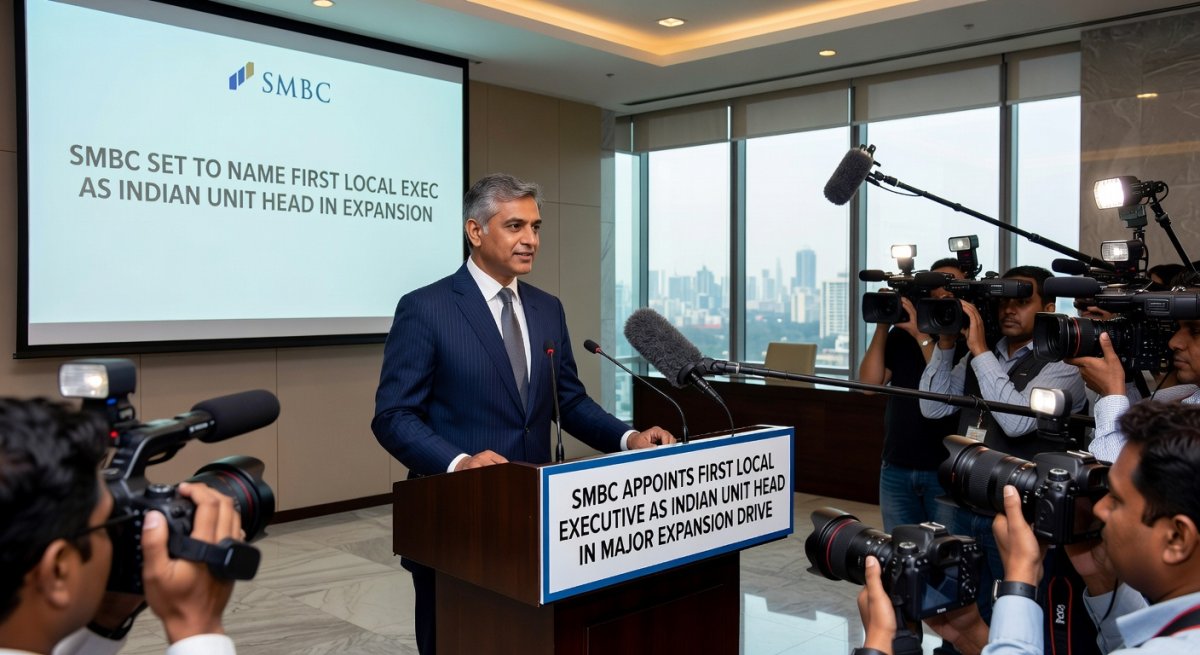
SMBC set to name first local exec as Indian unit head in expansion
Tokyo — June 3, 2026 The Appointment Signals a Shift in SMBC India Leadership Sumitomo Mitsui Banking Corporation is preparing to appoint its first locally hired executive to lead the Indian operations, marking a departure from the practice of assigning Japanese nationals to the top post. The move forms part of a wider leadership realignment covering both banking and non-bankin
The Appointment Signals a Shift in SMBC India Leadership
Sumitomo Mitsui Banking Corporation is preparing to appoint its first locally hired executive to lead the Indian operations, marking a departure from the practice of assigning Japanese nationals to the top post. The move forms part of a wider leadership realignment covering both banking and non-banking units under the Sumitomo Mitsui Financial Group umbrella in India. Industry observers note that the decision aligns with SMFG’s stated goal of deepening its footprint in one of Asia’s fastest-growing economies while adapting management structures to local market conditions.
SMFG’s Existing Footprint in the Indian Market
SMFG has maintained a presence in India since the early 2010s through its core banking subsidiary and later through leasing and investment banking arms. The group operates branches in Mumbai, Delhi, and Bengaluru, focusing on corporate lending, project finance for infrastructure, and advisory services for Japanese companies entering the Indian market. Although exact asset figures remain limited in public disclosures, SMFG’s India-related exposure has grown steadily as Japanese manufacturers and trading houses expand manufacturing bases in states such as Gujarat and Tamil Nadu. The upcoming leadership change is expected to accelerate decision-making on local-currency lending and partnership arrangements with Indian financial institutions.
Japan’s Broader Banking Strategy Across South and Southeast Asia
Japanese megabanks have pursued a coordinated regional approach in recent years, targeting markets where Japanese corporates maintain supply-chain investments. SMFG’s India initiative parallels steps taken by peers such as Mitsubishi UFJ Financial Group in Vietnam and Mizuho Financial Group in Indonesia. These efforts emphasize longer-term commitments rather than short-term returns, with an emphasis on project finance for energy, transportation, and digital infrastructure. In South Asia specifically, Japanese banks have increased their participation in syndicated loans arranged by Indian public-sector banks, reflecting Tokyo’s policy priority of supporting quality infrastructure under the Partnership for Quality Infrastructure framework. The SMBC appointment of a local executive may serve as a template for similar localization moves in other ASEAN markets where regulatory expectations favor greater involvement of domestic talent.
Details of the Leadership Reshuffle Across Banking and Non-Banking Units
The planned changes extend beyond the banking subsidiary to include SMFG’s leasing and securities operations in India. While the identity of the incoming local executive has not yet been confirmed, sources close to the matter indicate the individual currently holds a senior position within the Mumbai branch and possesses extensive experience in cross-border project finance. Concurrently, several Japanese secondees are scheduled to rotate back to Tokyo or other regional offices, reducing the proportion of expatriate staff in senior roles. This reshuffle is described internally as an effort to improve responsiveness to Indian regulatory developments, including updates to the Reserve Bank of India’s foreign-bank branch guidelines and evolving insolvency procedures.
Implications for Japanese Corporate Clients and Bilateral Economic Ties
Japanese manufacturers operating in India have long cited the need for faster local credit approvals and deeper understanding of state-level industrial policies. A locally led SMBC India unit could shorten turnaround times on rupee-denominated facilities and strengthen relationships with Indian state-owned enterprises involved in public-private partnership projects. From a bilateral perspective, the change coincides with ongoing negotiations between Tokyo and New Delhi on enhancing the Japan-India Comprehensive Economic Partnership Agreement. smoother financial intermediation may support increased Japanese foreign direct investment in sectors such as semiconductors, electric vehicles, and green hydrogen, where Indian state governments are offering targeted incentives. Japanese trading houses active in these areas are expected to benefit from more integrated advisory services spanning both debt and equity solutions.
Forward-Looking Insight on Regional Expansion
Over the coming years, SMFG’s India localization experiment will be closely watched by other Japanese financial institutions considering similar adjustments in South and Southeast Asia. If the model delivers measurable improvements in client retention and deal flow, it could encourage further decentralization of decision-making authority away from Tokyo headquarters. At the same time, the group will need to balance local autonomy with group-wide risk-management standards, particularly in areas such as environmental and social governance screening for large infrastructure transactions. The outcome in India may therefore influence how Japanese banks calibrate their presence across the wider Indo-Pacific region, where demographic trends and infrastructure demand continue to outpace those in domestic markets.
By Kenji Tanaka, Staff WriterThis article was produced with AI-assisted research and editorial support. Reporting is based on sources cited in the article.
What's Your Reaction?
 Like
0
Like
0
 Dislike
0
Dislike
0
 Love
0
Love
0
 Funny
0
Funny
0
 Wow
0
Wow
0
 Sad
0
Sad
0
 Angry
0
Angry
0

Japan Correspondent at Global1.News. Tokyo-based voice covering Japanese politics, technology, economy, and culture. Tracks the intersection of tradition and innovation in one of the world's most dynamic societies.















Comments (0)