
Shifting US Priorities Threaten AI Lead Over China
The Trump administration's FY2026 budget proposal calls for sharp reductions in federal science funding, redirecting resources toward space initiatives while imposing deep cuts on agencies that support artificial intelligence and quantum research. The plan has drawn warnings from scientific organizations that the United States could lose ground to China in critical technology f
The Trump administration's FY2026 budget proposal calls for sharp reductions in federal science funding, redirecting resources toward space initiatives while imposing deep cuts on agencies that support artificial intelligence and quantum research. The plan has drawn warnings from scientific organizations that the United States could lose ground to China in critical technology fields.
Shifting US Priorities Threaten AI Lead Over China
Tokyo, Japan – June 5, 2026 — The proposed federal budget for fiscal year 2026, advanced by the White House Office of Management and Budget, requests a 57 percent reduction to the National Science Foundation (NSF) and a 25 percent cut to NASA. If enacted, the cuts would represent the most severe retrenchment in American federal science funding in decades, with direct implications for artificial intelligence research, quantum information science, and the broader technological competition between the United States and China.

Proposed Reductions Target Core Research Agencies
The budget requests a 57 percent cut to the National Science Foundation, lowering its allocation from approximately $9 billion. Within that reduced total, programs supporting AI and quantum information science — areas the NSF had identified as priority domains in its 2024 strategic plan — would face especially severe reductions. NASA would see a 25 percent decrease, from $24.9 billion to $18.8 billion. When adjusted for inflation, the NASA figure would represent the lowest level since 1961, according to Casey Dreier, chief of space policy at the Planetary Society.
The proposal was advanced by Office of Management and Budget Director Russ Vought, who has sought to reorient federal spending toward what the administration describes as "headline-grabbing" space projects. The budget still requires Congressional approval and is already encountering strong opposition from lawmakers in both parties.
Warnings from Scientific Community on Long-Term Damage
Mr. Dreier described the cuts as "a profound, generational threat to scientific leadership in the United States" in comments to Scientific American. An official with the American Astronomical Society warned of "punching a generation-size hole, maybe a multigenerational hole, in the scientific and technical workforce." The director of the NSF-funded National Radio Astronomy Observatory noted the contradiction between public statements about China advancing and simultaneous decisions to reduce funding for the very research that could maintain competitiveness. "On the one side we're saying, 'Well, China's kicking our ass, and we need to do something about that.' But then we're not going to give any money to anything that might actually do that," the director said.
The cuts would affect not only space-based observatories such as the James Webb Space Telescope and the Hubble Space Telescope, but also ground-based facilities including the Laser Interferometer Gravitational-Wave Observatory (LIGO) and globe-spanning radio telescope arrays. NASA science programs face a nearly 50 percent reduction within the constrained budget, with dozens of missions potentially canceled or placed on minimal operations.
China's Expanding Technology and Space Ambitions
China continues to advance its own AI and quantum programs while pursuing an independent space roadmap. Beijing aims to complete a fully operational lunar base by 2035 in partnership with Russia. A report published by the Commercial Space Federation, titled "Redshift," indicates that current trends could allow China to surpass the United States as the leading space-faring nation within five to ten years. The report details how China's space infrastructure and exploration capabilities have grown rapidly over the last decade, with improvements showing no signs of slowing.
These developments occur against a backdrop of sustained Chinese investment in foundational technologies that directly support next-generation computing, communications, and semiconductor manufacturing systems. China's national AI strategy, published in 2017, set a target of becoming the world leader in artificial intelligence by 2030 — a target that analysts say now appears increasingly achievable given US funding trajectories.
Relevance to Japan's Technology Strategy
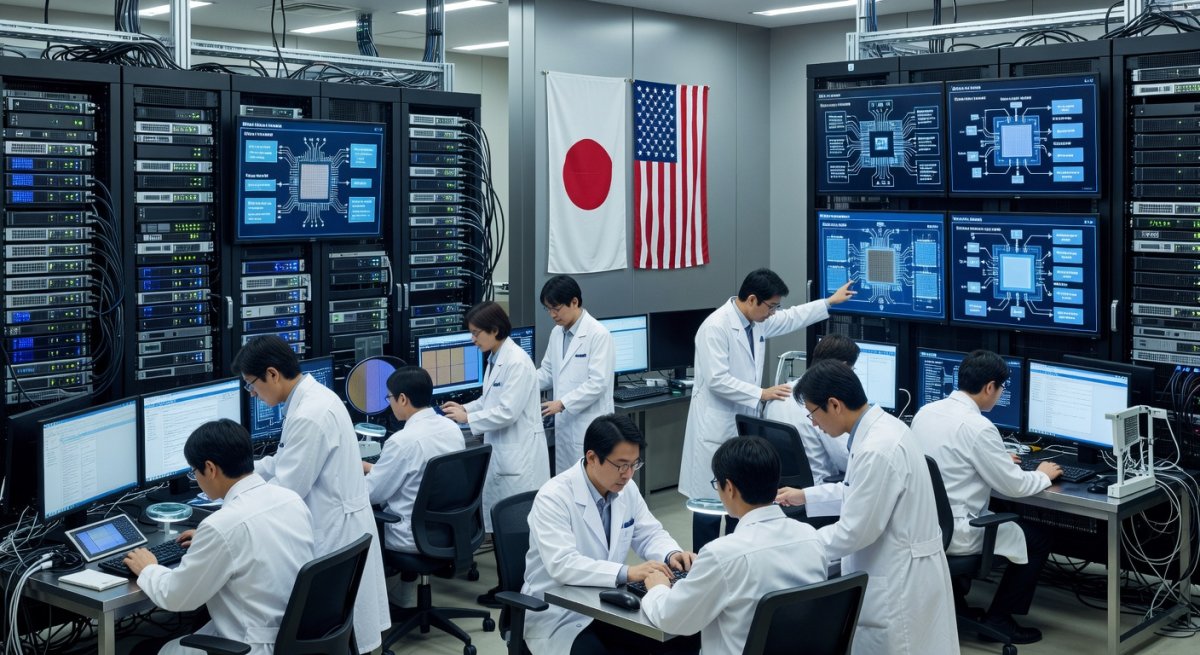
Japan's Society 5.0 vision, promoted by the Cabinet Office, relies on advanced AI integration across industry, healthcare, infrastructure, and public services. The Ministry of Economy, Trade and Industry (METI) has placed AI and semiconductor development at the center of its industrial policy through initiatives such as the Semiconductor Strategy Council and the expansion of domestic chip fabrication subsidies under the Green Transformation (GX) framework.
Reduced US federal support for basic research could slow collaborative projects under existing US-Japan technology agreements, particularly in quantum sensing, secure communications, and next-generation semiconductor architectures. Japanese firms including Tokyo Electron, Advantest, and Rapidus have increased joint research with US counterparts, partly to diversify supply chains away from single-country dependence and to secure access to advanced chip design capabilities.
Effects on Broader US-Japan Technology Cooperation
US-Japan cooperation extends to export controls on advanced semiconductor manufacturing equipment and joint efforts to secure critical mineral supplies for electronics manufacturing. If NSF-supported AI research contracts, Japanese technology companies and research institutions may need to increase domestic funding or seek additional partnerships with European and Asian research networks to maintain momentum in Society 5.0 implementation.
METI officials have already signaled willingness to expand trilateral semiconductor initiatives with the United States and like-minded partners in the Indo-Pacific region should bilateral basic-research capacity decline. The Japanese government's own AI strategy, updated in 2025, emphasizes the importance of international research collaboration, and any weakening of American university research pipelines would directly affect these shared programs.
Expert Perspectives on Japan's Position
Industry analysts at the Japan Center for Economic Research have noted that Japanese firms may face a dual challenge: maintaining access to US-origin foundational AI research while simultaneously deepening ties with alternative research ecosystems in Europe and Southeast Asia. The Research Association of High-Efficiency AI Chips (AHC), a Japanese industry consortium, has been exploring partnerships with Taiwanese and South Korean semiconductor foundries to ensure continued access to advanced fabrication processes.
"Japan has long relied on the United States as the primary source of fundamental AI research breakthroughs," said a senior researcher at the National Institute of Advanced Industrial Science and Technology (AIST), speaking on condition of anonymity due to the sensitivity of bilateral relations. "If those research pipelines narrow, Japan will need to accelerate its own basic research investment or risk falling behind in the global AI race."
What to Watch For
The budget proposal remains subject to Congressional review, where appropriations committees have historically restored funding for NSF and NASA programs. Lawmakers from both parties have cited national-security concerns and the need to maintain technological parity with China as reasons for protecting research accounts. Markup sessions in the House and Senate are expected to begin in late June, with a final appropriations bill anticipated by September 2026.
The nomination process for NASA leadership has also encountered complications, with the Trump administration's initial nominee, Jared Isaacman, withdrawn from consideration after a campaign donation controversy emerged. The agency continues to operate under acting leadership, further complicating the timeline for any major strategic shifts.
Japanese policymakers are monitoring the appropriations process closely, recognizing that the outcome will influence the pace of shared AI and semiconductor projects over the coming decade. For Japan, the stakes extend beyond bilateral cooperation — the trajectory of US science funding will shape the global balance of technological power and determine whether the current US-China AI competition narrows or widens in the years ahead.
By Kenji Tanaka, Staff Writer
This article was produced with AI-assisted research and editorial support. Reporting is based on sources cited in the article.
What's Your Reaction?
 Like
0
Like
0
 Dislike
0
Dislike
0
 Love
0
Love
0
 Funny
0
Funny
0
 Wow
0
Wow
0
 Sad
0
Sad
0
 Angry
0
Angry
0

Japan Correspondent at Global1.News. Tokyo-based voice covering Japanese politics, technology, economy, and culture. Tracks the intersection of tradition and innovation in one of the world's most dynamic societies.















Comments (0)