
U.S. Strikes Iran in Two Waves as Tehran Declares 'Existential War' — Strait of Hormuz Crisis Deepens
The U.S. launched two waves of strikes against Iranian coastal defenses and missile sites as Tehran declared an 'existential war' and threatened to expand shipping disruptions. Brent crude hit 4.95 with the Strait of Hormuz closed and no clear diplomatic off-ramp in sight.
U.S. Strikes Iran in Two Waves as Tehran Declares 'Existential War' — Strait of Hormuz Crisis Deepens
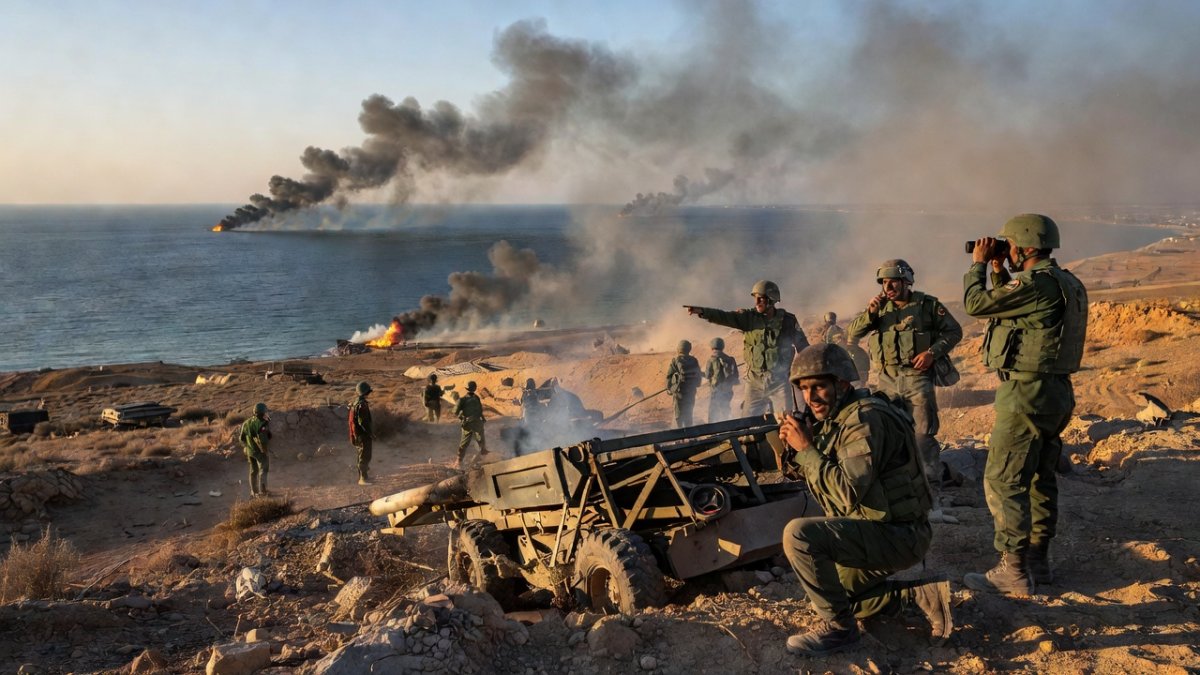
The United States military launched a second wave of strikes against Iranian coastal defenses and missile sites on Wednesday, hours after completing an initial round of attacks that targeted Iran's Greater Tunb Island in the Persian Gulf. Iran responded by declaring it is engaged in an "existential war" with America, threatening to shut off additional regional energy export routes as the crisis over the Strait of Hormuz enters its most dangerous phase yet.
The escalation marks the fifth consecutive day of U.S. military operations against Iranian positions, after a fragile truce collapsed over the weekend when Iran announced it had closed the Strait of Hormuz — the world's most strategically important oil and gas chokepoint. Brent crude oil surged to a one-month high of $84.95 per barrel on Wednesday as markets priced in the growing risk of a prolonged conflict that could disrupt global energy supplies.
A Second Wave in Under 12 Hours
U.S. Central Command announced the first wave of strikes began around 6 a.m. Eastern Daylight Time on Wednesday, targeting coastal defense systems and cruise missile storage and launch sites on Iran's Greater Tunb Island, a small but strategically vital Iranian territory in the eastern Persian Gulf. CENTCOM said the operation was completed within approximately 90 minutes.
But just nine hours later, at around 3 p.m. EDT, the Pentagon announced a second wave of strikes. "The strikes are targeting Iranian military capabilities used to threaten vessels freely transiting through the Strait of Hormuz, an international waterway vital to global commerce," Central Command said in a statement. "The U.S. military is holding Iran accountable at the Commander in Chief's direction."
Three U.S. officials told Reuters that the strikes are also designed to degrade Iranian military capabilities that Washington would need to neutralize before executing even more complex operations aimed at forcing the strait open by military means.
Iran's Response: 'Existential War' and Threats to Wider Shipping Lanes
Tehran did not hold back in its response. Iranian officials declared the country was now fighting an "existential war" with the United States, vowing to expand its campaign of maritime disruption beyond the Strait of Hormuz to additional regional energy export routes. Iran's Mehr news agency reported that four locations around the city of Ahvaz — just inland from the northern end of the Persian Gulf — came under attack, along with Bandar Abbas, Iran's principal port city on the Strait of Hormuz itself. Iran's Tasnim news agency also reported explosions in the city of Konarak, at the southern end of Iran's coastline.
In a further sign of the widening conflict, Iran claimed it had struck U.S. bases in Bahrain, Kuwait, and Jordan in response to the American bombardment. The claims could not be independently verified, but they underscore how the fighting is no longer contained to Iranian territory and is spreading across the Gulf region.
President Donald Trump warned earlier this week that the United States would "knock out" all of Iran's power plants and bridges unless Tehran "gets to the table and negotiate." His administration has also reimposed a naval blockade of Iranian ports, with the U.S. military reporting that it disabled an unladen oil tanker attempting to sail toward Iran's Kharg Island after it ignored multiple warnings — firing Hellfire missiles into the ship's smokestack to force it to stop.
The Strait of Hormuz: A Global Chokepoint Under Siege
The Strait of Hormuz, a narrow 21-mile-wide waterway between Iran and Oman, carries approximately one-fifth of the world's oil and natural gas shipments. Its closure — first announced by Iran late on Saturday — sent shockwaves through global energy markets and triggered an immediate response from Washington.
Iran's ability to threaten shipping through the strait has long been a central pillar of its strategic leverage in any confrontation with the West. The Iranian Revolutionary Guard Corps maintains an extensive network of anti-ship cruise missiles, fast attack boats, coastal defense batteries, and naval mines along Iran's coastline — much of which has now become the target of sustained American airstrikes.
The reopening of the strait by military force would be an operation of immense complexity. U.S. Central Command would need to clear naval mines, neutralize mobile missile launchers along hundreds of miles of coastline, and establish safe corridors for commercial shipping — all while facing potential retaliation from Iranian forces in Iraq, Syria, Yemen, and Lebanon. It is a mission profile that military analysts say could take weeks or even months to accomplish.
Regional Spillover: Saudi Arabia, Yemen, and the Houthi Factor
The U.S.-Iran confrontation is already drawing in regional actors. On Monday, Saudi Arabia struck Sanaa International Airport in Yemen, targeting a runway to prevent the landing of an Iranian plane carrying a Houthi delegation returning from the funeral of Iran's Supreme Leader Ayatollah Ali Khamenei. Gen. Taher al-Aqili, Yemen's Saudi-backed government defense minister, confirmed the strike, saying the airport's runway was hit to stop the plane carrying the Houthi delegation.
The Saudi strike marks the first direct Saudi military action against Houthi targets since a fragile ceasefire took hold in 2022, and it signals Riyadh's growing concern about Iranian influence operations using Yemen as a staging ground. The Houthis, who have long served as Iran's most effective proxy force in the Arabian Peninsula, now possess an arsenal of ballistic missiles and drones capable of striking deep into Saudi and Emirati territory.
The United Arab Emirates also reported that a crew member was killed when Iranian forces targeted tankers near Hormuz. Gulf states, caught between their security dependence on Washington and their geographic proximity to Iran, are increasingly being forced to pick sides in a conflict none of them asked for.
Oil Markets and Economic Shockwaves
The economic consequences of the crisis are already being felt. Brent crude climbed to $84.95 per barrel on Wednesday — a one-month high — and analysts warn prices could spike significantly higher if the Strait of Hormuz remains closed or if Iran makes good on its threat to disrupt additional shipping lanes.
For Israel, the economic picture is complicated. While Israel is not directly dependent on Gulf oil in the same way as Asian or European economies, the broader regional instability created by the U.S.-Iran war has significant knock-on effects. Israeli tech companies with Gulf operations, trade routes passing through the Red Sea, and the broader investment climate in the region are all facing heightened uncertainty.
Moody's recently maintained Israel's credit rating but noted that the country's institutional strength has weakened in recent years amid deepening political polarization — a vulnerability that becomes more acute in times of regional crisis.
What This Means: A Conflict Without Clear Off-Ramps
The current escalation between Washington and Tehran is different from previous rounds of U.S.-Iran tension in several critical respects. Unlike the 2020 killing of Qassem Soleimani or the periodic tit-for-tat strikes in Iraq and Syria, this confrontation involves the actual closure of a global energy chokepoint and sustained American strikes on Iranian territory — not just on proxy forces or allied militias.
Iran's warning of an "existential war" is significant rhetorical escalation, but it also reflects a strategic reality: the Iranian leadership has staked its domestic legitimacy on its ability to confront the United States, and any perception of weakness could have serious internal consequences. The recent death of Supreme Leader Ayatollah Ali Khamenei has already created a power vacuum in Tehran, and the current crisis is playing out against a backdrop of uncertain succession dynamics within the Iranian regime.
The absence of clear diplomatic off-ramps is perhaps the most worrying dimension of the current crisis. Trump's threat to destroy Iran's power plants and bridges if Tehran does not negotiate is a maximalist position that leaves little room for face-saving compromise. Iran, for its part, has shown no willingness to back down under military pressure — a dynamic that historically has led to prolonged rather than quickly resolved conflicts.
What Comes Next: The Week Ahead
The coming days will be critical. Trump has given Iran until next week to agree to negotiations, raising the prospect of an even more devastating wave of strikes if the deadline passes without progress. Iran has relocated much of its strategic naval and missile assets in recent months, and its ability to continue threatening shipping from dispersed and hardened positions means that even sustained American bombing may not be enough to fully secure the Strait of Hormuz.
Meanwhile, the humanitarian dimension of the crisis cannot be ignored. Iran's civilian population has already endured years of economic sanctions, and the current bombing campaign is taking place in and around major population centers including Ahvaz, Bandar Abbas, and Konarak. While Iranian state media has not reported significant civilian casualties from the latest strikes, the risk of a devastating miscalculation grows with each passing day of sustained combat operations.
For Israel, the calculus is equally fraught. Jerusalem has remained publicly cautious, but Israeli defense officials are watching the conflict closely. Any significant deterioration in Iran's conventional military capabilities would be welcomed by Israel's security establishment, but the broader regional instability, the potential for Iranian retaliation through Hezbollah in Lebanon, and the risk of being drawn into a conflict not of its own making present serious strategic dilemmas.
The Strait of Hormuz crisis is no longer a diplomatic standoff or a "maximum pressure" campaign. It is an active military conflict between the world's largest military power and one of its most entrenched regional adversaries — and neither side appears willing to blink.
By Hannah Berg, Staff Writer
This article was produced with AI-assisted research and editorial support. Reporting is based on sources cited in the article.
What's Your Reaction?
 Like
0
Like
0
 Dislike
0
Dislike
0
 Love
0
Love
0
 Funny
0
Funny
0
 Wow
0
Wow
0
 Sad
0
Sad
0
 Angry
0
Angry
0

Israel Correspondent at Global1.News. Based in Tel Aviv, covering Israeli politics, security, technology, and society. Provides balanced, deeply-sourced reporting on one of the most closely-watched regions in the world.















Comments (0)