
Blanche Apologises on Capitol Hill for Epstein Files 'Mistakes'
Todd Blanche apologised to Epstein survivors for redaction failures during his confirmation hearing, confirmed the $1.7bn 'anti-weaponisation fund' is dead, and insisted he is Trump's lawyer not his friend — but his path to permanent attorney general remains uncertain.
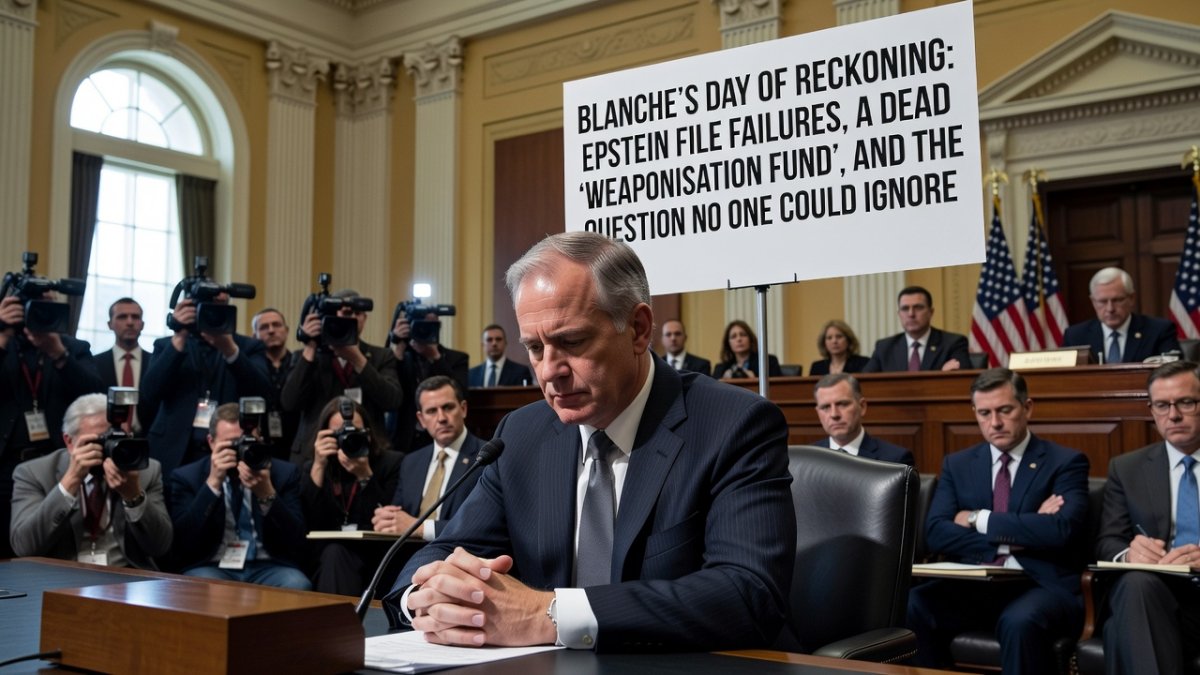
Blanche's Day of Reckoning: Epstein File Failures, a Dead 'Weaponisation Fund', and the Question No One Could Ignore
It is not every day that a nominee for attorney general walks into a confirmation hearing and ends up apologising to survivors of Jeffrey Epstein's abuse network. But Wednesday was not an ordinary day on Capitol Hill. Todd Blanche, President Donald Trump's pick to lead the US Department of Justice on a permanent basis, faced a tense and at times explosive bipartisan grilling — one that exposed the raw nerves surrounding the Epstein files controversy, the administration's relationship with the tax authority, and the fundamental question of whether Trump's former criminal defence lawyer could ever truly operate independently.
Blanche has served as acting attorney general since Trump dismissed Pam Bondi amid the political firestorm over the slow release of the Epstein files. His confirmation hearing before the Senate Judiciary Committee was always going to be a test. What unfolded was rather more than that: two hours of pointed exchanges, an admission of error, and at least one moment that left even seasoned observers raising their eyebrows.
Apologising to Survivors: The Epstein File 'Mistakes'
The Epstein files are, by any measure, the most politically sensitive issue to land on the justice department's desk since Trump returned to the White House. Following sustained public outcry, Congress ordered the release of millions of pages related to the FBI's investigation into the late convicted sex offender. But the pace of disclosure has been glacial, and the level of redaction has infuriated lawmakers and survivors alike.
About a dozen women attended Wednesday's hearing wearing T-shirts emblazoned with images of the redacted documents — a silent but powerful visual reminder of what is at stake. Senate Judiciary Chairman Chuck Grassley, the top Republican on the panel, pressed Blanche on "problematic redactions", "insufficient effort" on investigative leads, and the department's "refusal to meet with victims". Grassley also raised questions about the transfer of Epstein accomplice Ghislaine Maxwell to a lower-security prison.
Blanche described the task of processing six million pages in a compressed timeframe as a "Herculean task". He acknowledged that "approximately 1% of the redactions had to be fixed", adding that "dozens of lawyers" had been deployed to manage the review. But when Democratic Senator Richard Blumenthal asked directly if he would apologise to Epstein survivors, Blanche did not equivocate.
"I will absolutely say that any mistake that we made should not have been made," he replied. "And I very much — I very much apologise."
The apology, however, may not be enough to satisfy critics who view the entire process as a deliberate attempt to obscure rather than illuminate. For survivors and their advocates, words are welcome — but the substance of what remains redacted matters far more.
The 'Anti-Weaponisation Fund': Dead, Buried, or Just Sleeping?
One of the most extraordinary revelations of the hearing concerned a settlement between Trump, his family and business interests, and the Internal Revenue Service — a deal that a federal judge nullified the day before Blanche appeared before the committee.
The settlement had included immunity from future audits and the creation of a $1.7bn (£1.2bn) "anti-weaponisation fund" for individuals who believed they had been unfairly targeted by the government. It sparked bipartisan outrage almost immediately, and senators from both parties were eager to hear Blanche confirm that the fund was truly finished.
"You have no reason to believe that the so-called weaponisation fund will continue because of the settlement, agreement, is that correct?" Senator Mike Lee, a Republican, asked.
"I am confident it will not," Blanche replied.
Senator Thom Tillis, a North Carolina Republican, was less willing to take that assurance at face value. He pressed Blanche for an "agreed to piece of text, coming from the administration, that just renders this thing dead, gone." The exchange underscored a broader scepticism even among Trump's allies about the optics — and the legality — of a deal that effectively paid off a president's tax disputes while creating a fund in his political image.
For British readers, the concept of a government settlement that includes a privately controlled "weaponisation fund" may sound like something from dystopian fiction. But it is worth remembering that the politics of perceived governmental targeting — whether over Brexit, Covid lockdowns, or the BBC's coverage — resonates powerfully on this side of the Atlantic too.
'Are You Trump's Friend?' The Independence Question That Refuses to Die
Blanche served as Trump's personal attorney in three of four major criminal cases the president faced before the 2024 election, most notably leading his defence in the New York criminal trial. That history has dogged his nomination from the start.
Senator John Kennedy, a Louisiana Republican broadly supportive of the administration, cut through the niceties. Were Blanche and Trump "friends"?
"I'm his lawyer — was his lawyer," Blanche responded. "And now I'm the deputy attorney general." Pressed further, he added: "I met him as his criminal defence attorney. I'm not sure there's very many people who have ever had a criminal defence attorney who calls that person their friend."
It was a carefully calibrated answer — one that deflected without quite denying. But the underlying concern remains: can a man who mounted Trump's legal defences, who argued his cases in court, who knows his confidences and his strategies, now be trusted to prosecute the president's political enemies even-handedly? Trump has publicly vowed "retribution" against his critics, including former FBI Director James Comey and New York Attorney General Letitia James. The justice department under Trump has pursued controversial cases against both.
Blanche's answer on the third-term question, however, may have done him some favours among Democrats and institutionalists. Asked by Senator Chris Coons whether Trump could constitutionally run for a third term in 2028, Blanche answered plainly: "I don't believe he is, no." It was a small but significant gesture toward legal orthodoxy — one that Trump's most ardent supporters will not have welcomed.
Flashes of the Defence Attorney: 'An Extraordinarily Obnoxious Question'
For most of the hearing, Blanche maintained the measured, lawyerly tone expected of a would-be attorney general. But every so often, the pugnacious defence attorney who sparred with judges in Trump's criminal trial surfaced.
When Senator Sheldon Whitehouse asked about FBI Director Kash Patel's fitness for office, Blanche shot back: "That's an extraordinarily obnoxious question, Senator." Later, when Democratic Senator Cory Booker launched into rapid-fire questioning about a proposed merger between Paramount and Warner Bros Discovery, Blanche snapped: "You don't even let me answer, man."
The outbursts may have played well among Trump loyalists who prize combative energy. But in a confirmation hearing, temperament matters. The Department of Justice is not a defence firm, and the attorney general is not a hired gun. The question hovering over Blanche is whether he can make the transition from advocate to arbiter — from fighting for one client to serving the law itself.
What This Means: A Confession, Not Yet a Conviction
Blanche's confirmation is by no means assured. He needs the backing of every Republican on the judiciary committee, and Senator John Cornyn of Texas has yet to commit. After the hearing, Cornyn told CNN he "continues to have some concerns" and is not "going to make any decisions at this point". Tillis, the other Republican question mark, appeared to soften after Blanche confirmed the "anti-weaponisation fund" was dead.
The full Senate will ultimately decide Blanche's fate. What Wednesday's hearing demonstrated, however, is that the Epstein files issue will not simply fade. The apology was necessary, but it was also — for Blanche — the least he could offer. The deeper questions about independence, about the weaponisation of government, and about the justice department's role in an era of polarised politics remain very much alive.
For British observers, the parallels are not difficult to draw. The relationship between political power and prosecutorial independence is a live issue in the UK as well — from the Royal Prerogative of Mercy controversies to questions about the Crown Prosecution Service's handling of politically sensitive cases. What happens to Todd Blanche in the coming weeks will be watched closely not only in Washington but in Whitehall, and for good reason.
The judiciary committee is expected to vote on Blanche's nomination shortly. If it advances, the full Senate will decide whether America's top law enforcement officer is a man who can separate his personal loyalty to the president from his duty to the law. On Wednesday's evidence, that question has not been settled.
By Erica Thornton, Staff Writer
This article was produced with AI-assisted research and editorial support. Reporting is based on sources cited in the article.
What's Your Reaction?
 Like
0
Like
0
 Dislike
0
Dislike
0
 Love
0
Love
0
 Funny
0
Funny
0
 Wow
0
Wow
0
 Sad
0
Sad
0
 Angry
0
Angry
0

US Politics and Policy Correspondent at Global1.News. Based in Washington DC, covering American politics, policy, elections, and the courts. Knows how the system works and tells you what it actually means.













Comments (0)