
U.S. Strategic Recalibration at Shangri-La 2026 and Its Consequences for South Korea
U.S. Strategic Recalibration at Shangri-La 2026 and Its Consequences for South Korea The Evolving U.S. Presentation of Regional Leadership At the 2026 Shangri-La Dialogue, the absence of China’s defense minister generated immediate speculation, yet the more consequential development lay in how the United States framed its own role. Secretary of Defense Pete Hegseth presented Wa
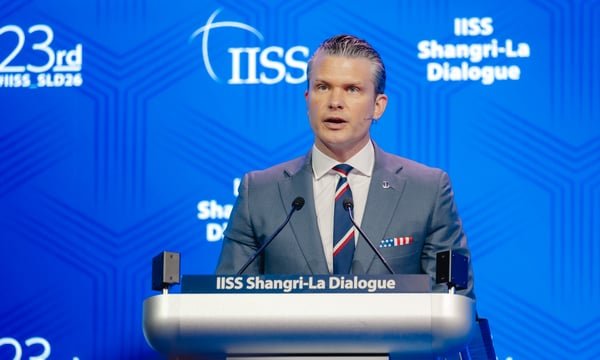
The Evolving U.S. Presentation of Regional Leadership
At the 2026 Shangri-La Dialogue, the absence of China’s defense minister generated immediate speculation, yet the more consequential development lay in how the United States framed its own role. Secretary of Defense Pete Hegseth presented Washington as militarily central but less inclined to serve as the public architect of a rules-based order. Allies and partners were instead positioned to shoulder greater visible responsibility for organizing security arrangements. This approach echoes the post-2017 period after the U.S. withdrawal from the Trans-Pacific Partnership, when Japan assumed leadership in reshaping the agreement into the CPTPP. The security domain now appears to follow a parallel trajectory, with the United States encouraging others to connect bilateral ties into broader regional structures while retaining offshore balancing capacity.
Hegseth’s Triad and the Doctrine of Offshore Balancing
Hegseth distilled the new posture into three repeated terms: strong, quiet, and clear. The formulation signals a deliberate move away from moralistic rhetoric toward explicit statements of interests and expectations. The United States remains committed to preventing any single power from dominating the Indo-Pacific, yet the emphasis on partners rather than protectorates marks a structural departure from earlier alliance management models. Japan’s defense minister Koizumi Shinjiro sought explicit reassurance during the proceedings, reflecting allied uncertainty about the durability of this recalibration. The triad responds directly to capability gaps while attempting to preserve strategic centrality without the costs of constant public orchestration.
Resource Pressures and the Limits of Sustained Forward Presence
The U.S. position is complicated by documented shortfalls in missiles and ammunition stemming from the Iran-U.S. conflict. Hegseth referenced a planned $1.5 trillion defense budget as a generational investment intended to restore industrial capacity within three to five years. These constraints lend weight to the call for allies to assume more operational visibility. The distinction drawn between model allies and those perceived as free-riders further structures expectations, implying that burden-sharing will determine the quality of future U.S. commitments. Such differentiation introduces new variables into alliance management across the region.
South Korea and the ROK-U.S. Alliance Under Recalibration
For Seoul, the Shangri-La messages carry immediate implications for the ROK-U.S. alliance. The Ministry of National Defense has historically anchored South Korea’s defense planning on extended U.S. deterrence guarantees. A shift toward partners rather than protectorates requires the ROK to demonstrate independent contributions to regional stability if it wishes to retain high-priority status. Analysts at the Korea Institute for Defense Analyses have long examined the risks of alliance asymmetry; the 2026 dialogue underscores the need for Seoul to accelerate joint planning mechanisms that reduce reliance on unilateral U.S. signaling. South Korea’s defense industry, already expanding through export successes, offers one avenue for demonstrating tangible value within the emerging framework.
Defense Industrial Capacity and Institutional Preparedness
Seoul’s ability to translate industrial strength into alliance relevance will depend on coordination between the Ministry of National Defense and research institutions such as the Asan Institute for Policy Studies. The emphasis on partners suggests that U.S. expectations will increasingly favor measurable contributions in munitions production, intelligence sharing, and regional exercises. South Korea’s established manufacturing base positions it to fill gaps left by U.S. shortages, yet this requires deliberate policy choices rather than passive alignment. The Asan Institute’s work on alliance modernization highlights that such adaptation can strengthen deterrence credibility provided it is paired with clear political signaling to Washington.
Inter-Korean Relations and the Risks of Strategic Ambiguity
The recalibration also intersects with inter-Korean dynamics. North Korea has historically exploited perceived gaps in U.S. commitment language. A quieter U.S. posture, even if paired with maintained military strength, could create windows for Pyongyang to test alliance resolve. Seoul must therefore monitor whether the ROK-U.S. combined defense posture evolves to emphasize South Korean lead roles in conventional deterrence while preserving U.S. extended nuclear guarantees. The Ministry of National Defense will need to clarify escalation management protocols with Washington to prevent ambiguity from undermining stability on the peninsula. At the same time, enhanced South Korean contributions to broader Indo-Pacific initiatives could reinforce the alliance’s relevance beyond the immediate Korean theater. By Prof. David Park, Staff Writer
This article was produced with AI-assisted research and editorial support. Reporting is based on sources cited in the article.
What's Your Reaction?
 Like
0
Like
0
 Dislike
0
Dislike
0
 Love
0
Love
0
 Funny
0
Funny
0
 Wow
0
Wow
0
 Sad
0
Sad
0
 Angry
0
Angry
0

East Asia/Technology Correspondent at Global1.News. Seoul-based voice covering Korean politics, technology, business, and culture. Analyzes how technology and geopolitics intersect across East Asia.














Comments (0)