
Iran-US Conflict: Peace Deal Collapses Amid Strikes on Gulf
Iran declares existential war after US strikes void the June 2026 peace deal, with fighting spreading across the Gulf as oil prices surge past $85 a barrel and the Strait of Hormuz becomes a flashpoint.
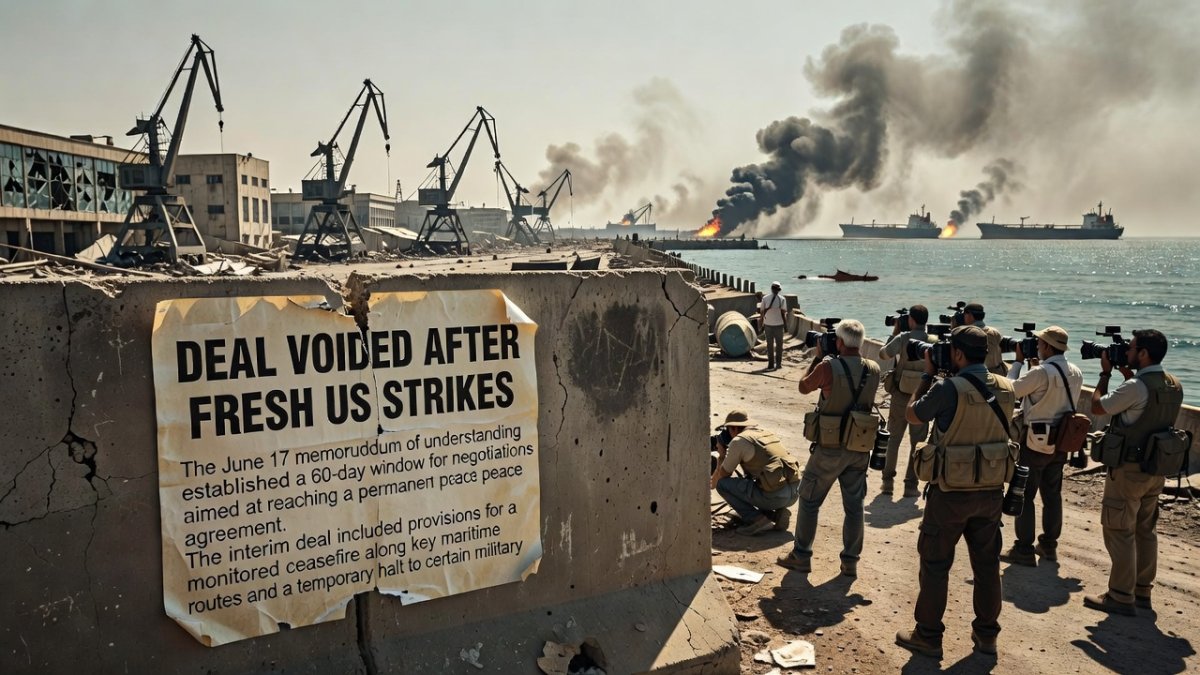
Deal Voided After Fresh US Strikes
The June 17 memorandum of understanding had established a 60-day window for negotiations aimed at reaching a permanent peace agreement. The interim deal included provisions for a monitored ceasefire along key maritime routes and a temporary halt to certain military activities near the Strait of Hormuz. Both sides had committed to de-escalatory measures while talks proceeded, with the understanding that any violation would render the arrangement void.
US Central Command strikes on Tuesday night and Wednesday targeted military installations near the Strait of Hormuz and Greater Tunb island, killing seven Iranian troops. Iranian officials immediately declared the memorandum void. Mohammed Bagher Ghalibaf stated that the armed forces now possessed complete freedom of action, ending the constraints imposed by the June agreement. The sequence began with earlier US operations that struck approximately 140 targets in a single night, followed by the latest wave that directly hit barracks belonging to the 388th Brigade in Bampour.
The June 17 memorandum envisioned a structured 60-day negotiation framework under which both parties would maintain a monitored ceasefire, suspend provocative military deployments near the Strait of Hormuz, and engage in phased confidence-building measures. This interim arrangement was designed to create space for technical talks on maritime security and sanctions relief before any permanent accord could be finalized.
The collapse was triggered by the cumulative effect of US strikes on Iranian coastal facilities and the direct hit on the 388th Brigade barracks, which Tehran viewed as a material breach of the de-escalation pledges. Iranian officials framed their decision to void the memorandum as a defensive necessity, while Washington maintained that Iranian maritime interference had already undermined the original terms, leaving little room for salvaging the 60-day process.
Details of Overnight Assaults
US Central Command operations unfolded in multiple phases, with the most recent wave commencing at 10:30 pm Iranian time. Strikes focused on military infrastructure supporting maritime access, including sites around Bandar Abbas, Chabahar, and Ahvaz. Additional explosions were reported in Khorramabad in western Iran. The broader targeting strategy extended beyond immediate Hormuz chokepoints to logistics nodes and command facilities intended to limit Iranian operational reach.
Commercial vessels were redirected as part of renewed restrictions on Iranian port access. One strike disabled an oil tanker attempting to reach an Iranian port through the use of Hellfire missiles. These actions followed earlier patterns of precision operations against coastal and island facilities, reflecting a sustained effort to enforce maritime controls without committing large-scale ground forces.
The civilian dimension of these operations has drawn renewed scrutiny, particularly the reported damage to a hospital in Ahvaz that houses the child cancer treatment department. Iranian authorities described the facility as a non-combatant site, while the incident has complicated efforts to maintain medical services amid the broader disruption of local infrastructure.
Controversy has also emerged around strikes near a wheat storage facility, with Iranian reports alleging deliberate targeting of civilian food supplies and US statements denying any intent to hit non-military sites. Iran's health ministry has updated its casualty figures to at least 35 dead and more than 300 injured, underscoring the widening humanitarian consequences that extend beyond the declared military objectives.
Tehran Frames Conflict as Existential
Foreign Ministry spokesman Esmaeil Baghaei emphasized that Iran's commitments under the memorandum remained valid only as long as the opposing side honoured its pledges. He presented the collapse as a legal consequence of US actions rather than an Iranian initiative. This framing allowed Tehran to maintain that it retained the right to respond while shifting responsibility for the breakdown onto Washington.
Ghalibaf described the situation as an essential and existential war, removing any obligation to observe ceasefire terms. He outlined an approach that balanced continued diplomatic channels with expanded military latitude. Iranian statements indicated no immediate plans for renewed talks, with priority placed on national defence measures and internal security through the deployment of NOPO special police units in Tehran.
Ghalibaf's dual-track approach reflects an attempt to preserve diplomatic openings even as military options expand, signalling to both domestic constituencies and external mediators that Iran remains open to de-escalation provided core security concerns are addressed. This calibrated posture aims to avoid total isolation while demonstrating resolve.
Al Jazeera correspondent Resul Serdar, reporting from Tehran, has noted that Iranian officials continue to assess the viability of backchannel contacts despite the public rhetoric, suggesting that prospects for renewed negotiations may hinge on whether Washington can offer credible guarantees against further strikes on critical infrastructure.
IRGC Counter-Operations and Neighbouring Responses
The Islamic Revolutionary Guard Corps reported strikes against the US Fifth Fleet headquarters in Bahrain and a logistics hub in Mina Abdullah, Kuwait. Kuwaiti forces intercepted four cruise missiles and 21 drones, while Jordanian defences downed three missiles. These exchanges represented the first direct cross-border incidents since the June memorandum collapsed.
The IRGC separately announced the downing of an MQ-9 drone using a new air defence system over Andimeshk. Air defence systems were activated over Tehran in anticipation of further incursions. These developments illustrate Iran's ongoing efforts to enhance drone and missile interception capabilities, allowing the IRGC greater flexibility in responding to maritime and aerial threats while managing escalation risks.
The IRGC's successful downing of the MQ-9 drone with its newly deployed air defence system, coupled with the activation of protective coverage over Tehran, demonstrates incremental improvements in Iran's layered defences against persistent surveillance platforms. These adaptations allow Tehran to impose costs on US aerial operations without immediate recourse to broader retaliation.
Analysts note that Iran's evolving drone and missile capabilities continue to present a low-cost asymmetric threat to US naval assets in the Gulf, a point echoed by JD Vance in recent commentary. This dynamic complicates Washington's calculations by raising the potential price of sustained maritime enforcement operations.
Oil Markets React to Hormuz Tensions
Brent crude rose 0.4 percent to $85.28 a barrel, with West Texas Intermediate climbing 0.5 percent to $80.02. Analysts at Goldman Sachs projected that prices could exceed $110 in the fourth quarter should exports through the Strait remain constrained. Iran has begun selling oil at a 20 percent premium amid blockade pressures, adding further volatility to global supply calculations.
Historical disruptions through Hormuz have repeatedly demonstrated the Strait's leverage over worldwide energy flows. President Trump proposed a 20 percent charge on cargo ships transiting the waterway. These measures complicate OPEC+ production strategies and place additional strain on Gulf states pursuing Vision 2030 diversification, as sustained instability threatens investment timelines in Saudi Arabia and the UAE.
The Goldman Sachs projection of $110 per barrel in the fourth quarter has prompted European and Asian importers to accelerate contingency planning for potential supply shortfalls, highlighting the Strait's continued centrality to global energy security. Prolonged constraints could force greater reliance on alternative routes and strategic reserves.
The crisis is also reshaping OPEC+ dynamics, as members weigh revenue preservation against market share considerations while Gulf states confront delays to Vision 2030 diversification plans. Sustained instability risks undermining investor confidence in non-oil projects across Saudi Arabia and the UAE.
Humanitarian Toll
Iran's health ministry has reported at least 35 people killed and more than 300 injured since the latest escalation. A hospital in Ahvaz sustained damage that forced partial evacuation, including the child cancer treatment department. These figures reflect the widening impact on civilian infrastructure beyond purely military targets.
Explosions in western and southwestern cities have added to local strain, prompting authorities to strengthen civil order measures in the capital. The combination of casualties and service disruptions underscores the challenges of containing the conflict to designated military zones.
The health ministry's updated casualty count of 35 dead and more than 300 injured captures only verified cases, with local medical facilities reporting additional unconfirmed admissions from surrounding areas affected by the strikes. The partial evacuation of Ahvaz's hospital, including its dedicated child cancer unit, has forced families to seek alternative care amid disrupted transport links.
Explosions reported in Khorramabad and the strike on the 388th Brigade barracks in Bampour have compounded pressure on regional hospitals already operating under strain. These incidents illustrate how the conflict's reach extends into civilian population centres, complicating efforts to shield non-combatants from the effects of sustained military exchanges.
Washington's Political Signals
President Trump warned that attacks would intensify unless Iran returns to negotiations, while expressing gratitude following the release of an American detainee. He avoided setting a firm deadline for renewed talks. Vice President JD Vance, in a detailed interview, stated that securing maritime navigation through military force alone is extremely difficult because cheap drones can threaten ships. He further noted that the era of sending thousands of US troops to overthrow governments is over, framing the current approach as focused on targeted objectives rather than large-scale intervention.
The State Department approved a $1.96 billion weapons sale to Saudi Arabia and a $484 million sustainment package for Kuwait. In Congress, an amendment sponsored by Representative Tlaib to end $3.3 billion in military aid to Israel received 103 Democratic votes but was defeated 314-104. These signals indicate continued bipartisan support for security assistance to Gulf partners alongside ongoing debate over the scope of direct involvement.
Trump's unusual expression of gratitude following the hostage release points to the persistence of backchannel communications even amid public confrontation, suggesting that limited dialogue remains available should conditions allow. This gesture contrasts with the administration's broader hardline posture.
JD Vance's appearance on the Rogan podcast revealed internal administration divisions over the feasibility of purely military solutions to Hormuz navigation, while the Congressional vote on defunding aspects of Israel aid highlighted the narrow but vocal domestic opposition to unchecked security assistance in the current environment.
What This Means
The collapse of the June 17 memorandum shifts the regional balance toward prolonged low-intensity conflict. Gulf states now confront direct threats to their territories and energy infrastructure while remaining wary of Iranian missile reach. Their patience thresholds will likely determine whether further alignment with Washington deepens or whether hedging strategies gain traction to avoid full entanglement.
Russia and China are positioned to exploit any prolonged vacuum, offering alternative diplomatic or economic avenues that could dilute US influence. For the IRGC, expanded operational latitude must be weighed against the risk of greater isolation should GCC capitals conclude that Iranian actions threaten their core interests.
Oil price scenarios range from sustained elevation above $100 if Hormuz constraints persist to partial relief if limited diplomacy resumes. OPEC+ coordination faces added complexity as members balance revenue needs against market share concerns. Vision 2030 timelines in Saudi Arabia and the UAE encounter fresh headwinds from regional instability that could delay project financing and foreign investment.
Paths forward hinge on whether the current blockade evolves into a managed standoff or gives way to renewed negotiations. The interplay between US political signals, Iranian defensive adaptations, and Gulf economic priorities will shape whether escalation remains contained or broadens into wider confrontation.
GCC capitals continue to calibrate their tolerance for Iranian missile activity against the costs of deeper entanglement with Washington, a threshold that will influence whether they pursue additional hedging through quiet contacts with Tehran or accelerate security coordination with the United States.
Russia and China have positioned themselves to offer diplomatic cover and economic alternatives should the conflict drag on, potentially eroding Washington's leverage. Within Iran, the IRGC enjoys expanded operational latitude but must still weigh the risk of overreach that could unify Gulf states against its regional posture.
Potential paths forward range from a managed standoff that allows limited tanker traffic to renewed negotiations if backchannel signals can be converted into verifiable restraints. The coming weeks will test whether these competing pressures produce de-escalation or further hardening of positions on all sides.
By Malik Hassan, Staff Writer
This article was produced with AI-assisted research and editorial support. Reporting is based on sources cited in the article.
What's Your Reaction?
 Like
0
Like
0
 Dislike
0
Dislike
0
 Love
0
Love
0
 Funny
0
Funny
0
 Wow
0
Wow
0
 Sad
0
Sad
0
 Angry
0
Angry
0

Middle East Correspondent at Global1.News. Based in Beirut, covering politics, conflict, energy, and society across the Middle East. Brings context and depth to a region often reduced to headlines.















Comments (0)