
The Remote Access Security Act: A New Front in Tech Competition
The United States House of Representatives passed the Remote Access Security Act (H.R. 2683) on January 12, 2026, by an overwhelming bipartisan margin of 369-22. Introduced in the Senate by Senators Dave McCormick and Ron Wyden, the legislation seeks to amend the Export Control Reform Act of 2018. Its core provision authorizes the Bureau of Industry and Security (BIS) within the Department of Commerce to extend export controls to remote access of U.S. goods, software,...
The Remote Access Security Act and Its Strategic Intent
The United States House of Representatives passed the Remote Access Security Act (H.R. 2683) on January 12, 2026, by an overwhelming bipartisan margin of 369-22. Introduced in the Senate by Senators Dave McCormick and Ron Wyden, the legislation seeks to amend the Export Control Reform Act of 2018. Its core provision authorizes the Bureau of Industry and Security (BIS) within the Department of Commerce to extend export controls to remote access of U.S. goods, software, or technology, particularly through cloud computing services. This measure directly addresses a perceived loophole: Chinese entities have been utilizing cloud infrastructure based in Singapore and other Southeast Asian jurisdictions to circumvent restrictions on advanced artificial intelligence chips.
On May 31, 2026, BIS reinforced its regulatory posture by confirming that licenses are now required for the export of advanced AI processors, including Nvidia's Blackwell series and AMD's MI350x, to any entity whose ultimate parent company is domiciled in China or Macau. Investigations subsequently revealed that prominent American AI firms, including OpenAI and Google, had provided AI services to the Singapore operations of Alibaba, Baidu, and Tencent — companies identified by the Pentagon as posing national security risks. OpenAI responded by terminating several accounts linked to Alibaba. These developments underscore Washington's determination to prevent technology leakage that could accelerate Beijing's military modernization.
From an academic perspective grounded in East Asian technology geopolitics, the Remote Access Security Act (RASA) represents a significant evolution in U.S. export control doctrine. Rather than focusing solely on physical transfers, it targets intangible, cloud-mediated access. This shift reflects the transformation of global technology supply chains into layered, virtual ecosystems where data centers in neutral third countries function as de facto bypass routes. Yet, as Stanford researcher Charles Mok argued in his July 13, 2026, analysis for The Diplomat, such measures risk producing unintended consequences that may ultimately undermine American technological primacy.
Potential for Regulatory Backfire and Chinese Cloud Ascendancy
The central thesis advanced by Mok and echoed in broader scholarly discourse is that RASA could inadvertently accelerate the displacement of U.S. cloud providers in global markets. By imposing stringent licensing requirements on remote access, the legislation raises compliance costs and legal uncertainties for multinational enterprises. Chinese technology conglomerates, facing restricted access to American cloud services, are likely to pivot toward domestic alternatives. China's cloud computing market is projected to surpass 800 billion yuan in 2026, with Alibaba Cloud, Huawei Cloud, and Tencent Cloud locked in intense competition for both domestic dominance and international expansion.
This dynamic creates a classic case of regulatory displacement. When American hyperscalers such as Amazon Web Services, Microsoft Azure, and Google Cloud become less attractive or legally risky for clients with Chinese affiliations, Beijing's state-backed cloud champions gain a competitive opening. Huawei Cloud, in particular, has invested heavily in "sovereign cloud" architectures that appeal to governments wary of U.S. surveillance concerns. The result may be a bifurcated global cloud ecosystem: one anchored in American technology for trusted partners, and another centered on Chinese infrastructure for a growing bloc of nations seeking technological autonomy.
Historical parallels from Korean technological development offer instructive lessons. During the 1980s and 1990s, South Korean chaebol such as Samsung and LG faced U.S. export controls and intellectual property pressures yet ultimately leveraged these constraints to build indigenous capabilities in semiconductors and consumer electronics. A similar logic may now apply to Chinese cloud operators. Forced localization could hasten innovation in areas such as secure multi-party computation, homomorphic encryption, and energy-efficient data center design — domains where Chinese firms already demonstrate rapid progress.
South Korea's Precarious Position in the Semiconductor Value Chain
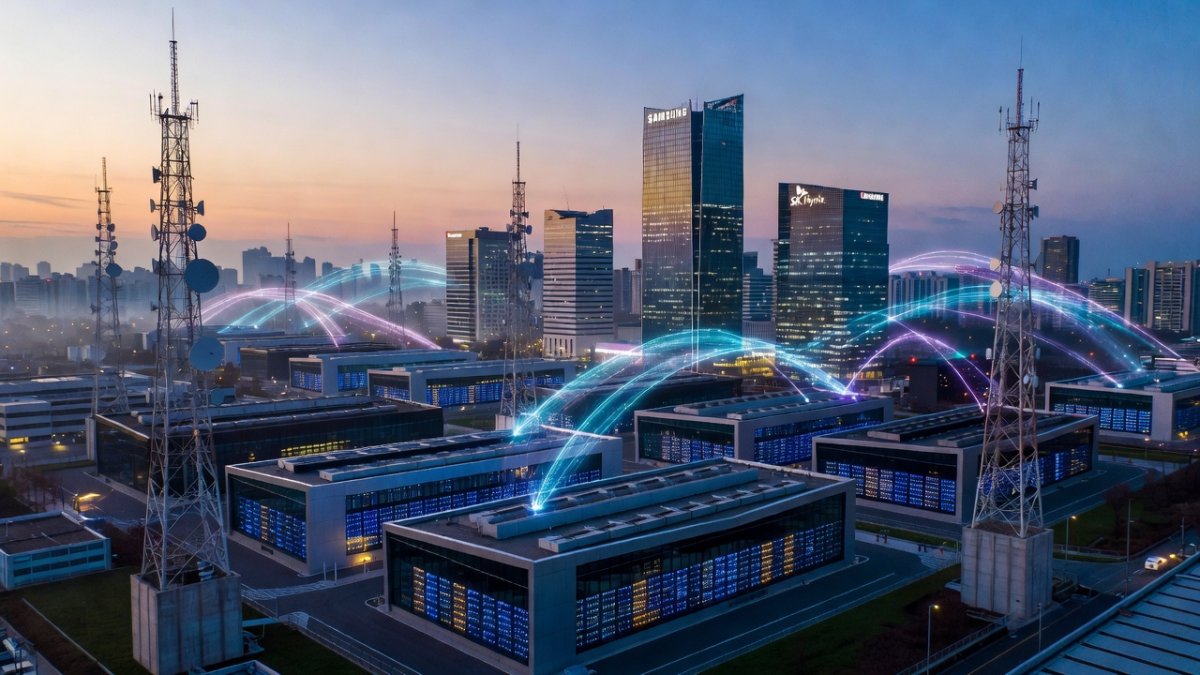
For South Korea, a pivotal U.S. ally and home to two of the world's leading semiconductor manufacturers — Samsung Electronics and SK Hynix — the Remote Access Security Act carries profound implications. These companies supply critical memory chips (HBM, DRAM, NAND) that power advanced AI training systems. Both firms have invested billions in facilities producing high-bandwidth memory essential for Nvidia's GPU ecosystems. Yet they also maintain substantial exposure to the Chinese market, where Samsung and SK Hynix derive roughly 30-40 percent of their revenue from sales to Chinese clients, including those now subject to tightened U.S. controls.
The Ministry of Trade, Industry and Energy (MOTIE) in Seoul has long navigated this triangular dilemma. South Korea's participation in the U.S.-led Chip 4 alliance (alongside the United States, Japan, and Taiwan) signals alignment with Washington's technology containment strategy. However, Beijing remains Seoul's largest trading partner. Any disruption in cloud-mediated AI services could ripple through Korean supply chains. For instance, if Chinese hyperscalers accelerate development of indigenous AI training infrastructure using Huawei Ascend chips and domestic cloud platforms, demand for Korean HBM could fragment across competing ecosystems.
Moreover, South Korea's own cloud ambitions face new headwinds. Naver Cloud and Kakao Enterprise have pursued aggressive expansion, yet they rely heavily on partnerships with global providers. RASA's extraterritorial reach may complicate these alliances. Korean regulators at the Korea Communications Commission and the Personal Information Protection Commission must now evaluate whether compliance with American remote-access rules conflicts with domestic data sovereignty legislation, such as the amended Network Act. The result is heightened regulatory complexity for Korean firms seeking to position themselves as neutral Asia-Pacific cloud hubs.
Implications for Inter-Korean Technology Dynamics and Regional AI Competition
The legislation also intersects with broader inter-Korean and Northeast Asian technology competition. North Korea's cyber capabilities have historically targeted South Korean semiconductor and cloud infrastructure. A more fragmented global technology order could create additional vectors for Pyongyang to exploit, particularly if Chinese cloud providers expand their regional footprint with less stringent export controls. Seoul's National Intelligence Service has repeatedly warned of Beijing-Pyongyang technology cooperation in dual-use domains.
From a foreign policy standpoint, the Yoon Suk-yeol administration (or its successor) must calibrate responses that preserve the U.S. security alliance while protecting economic interests. South Korea's participation in the Indo-Pacific Economic Framework for Prosperity (IPEF) Pillar II on supply chains reflects an attempt to institutionalize trusted technology partnerships. Yet the RASA-induced push toward Chinese cloud sovereignty may erode the viability of such minilateral arrangements. Japanese firms, similarly caught between U.S. pressure and Chinese markets, confront parallel dilemmas, suggesting opportunities for Seoul-Tokyo coordination on cloud governance standards.
Academically, this situation illustrates the limitations of "small yard, high fence" technology policies in an era of ubiquitous connectivity. As I have argued in previous analyses of East Asian innovation systems, export controls function most effectively when paired with credible multilateral regimes. Unilateral American measures risk catalyzing exactly the technological decoupling they seek to prevent, particularly in cloud computing where network effects and data gravity favor first-mover scaling.
Korea's Cloud Market and National AI Strategy in the Crossfire
South Korea's domestic cloud market, valued at approximately 8.5 trillion won in 2025 and growing rapidly, stands at an inflection point. Government initiatives under the Digital New Deal and subsequent AI Basic Act have positioned cloud infrastructure as foundational to national competitiveness. The Korea Advanced Institute of Science and Technology (KAIST) and major universities have expanded AI research clusters that depend on access to cutting-edge computational resources. Restrictions on remote access to American AI models could delay these efforts or force costly duplication.
Furthermore, Korean chaebol are investing heavily in sovereign AI capabilities. Samsung has developed its own AI accelerators, while SK Group pursues integrated solutions spanning chips, batteries, and cloud services. These initiatives could benefit from a more diversified supplier landscape if Chinese cloud providers offer competitive pricing and fewer compliance burdens. However, over-reliance on any single foreign technology bloc introduces new vulnerabilities, particularly regarding intellectual property protection and data security — concerns that resonate deeply in a nation still recovering from past cyber incidents attributed to both state and non-state actors.
The strategic significance extends to education and human capital. Korean universities have increased enrollment in AI and cloud computing programs, responding to government targets of training 100,000 AI specialists by 2030. Students and researchers now face uncertainty about which technology stacks will dominate regional markets. Will future Korean AI engineers train primarily on American, Chinese, or hybrid platforms? The answer will shape not only technical competencies but also normative orientations toward data governance, privacy, and international technology standards.
Policy Recommendations and Long-Term Strategic Considerations
Scholarly analysis suggests several prudent pathways forward. First, South Korean policymakers should accelerate development of interoperable cloud standards through forums such as the Asia-Pacific Economic Cooperation (APEC) and the Global AI Safety Summit process. By championing technical neutrality, Seoul can position itself as a bridge between competing ecosystems rather than a passive participant in technological bifurcation.
Second, enhanced coordination between MOTIE, the Ministry of Science and ICT, and the National Security Office is essential to conduct comprehensive scenario planning. This should include stress-testing Korean semiconductor and cloud firms against various degrees of U.S.-China technology decoupling. Third, investment in domestic foundational models and open-source AI infrastructure could reduce dependency on foreign remote access services, echoing Korea's successful strategy in developing its own 5G standards through public-private partnerships.
Finally, Washington should consider the diplomatic costs of overly expansive export controls. As a middle power with deep integration into both American and Chinese economic networks, South Korea exemplifies the collateral damage that poorly calibrated policies can inflict on allies. Multilateralizing aspects of RASA through the Wassenaar Arrangement or a new semiconductor suppliers' coalition would enhance legitimacy and effectiveness while mitigating backlash.
The Remote Access Security Act, though well-intentioned, risks becoming a case study in the law of unintended consequences. By potentially catalyzing the rise of a robust Chinese-led cloud ecosystem, it may hasten the very technological multipolarity that American strategists seek to forestall. For South Korea, navigating this emerging landscape requires sophisticated statecraft that balances alliance commitments with economic pragmatism. The coming years will test whether Seoul can transform these pressures into opportunities for technological leadership in an increasingly contested Asia-Pacific digital order.
The episode also highlights deeper theoretical questions in international political economy: how do regulatory asymmetries reshape global value chains? What is the optimal granularity of technology controls in networked industries? And how do middle powers leverage their positions to influence great-power competition? These remain fertile areas for continued academic inquiry as the contours of the AI age continue to emerge.
By Prof. David Park, Staff WriterThis article was produced with AI-assisted research and editorial support. Reporting is based on sources cited in the article.
What's Your Reaction?
 Like
0
Like
0
 Dislike
0
Dislike
0
 Love
0
Love
0
 Funny
0
Funny
0
 Wow
0
Wow
0
 Sad
0
Sad
0
 Angry
0
Angry
0

East Asia/Technology Correspondent at Global1.News. Seoul-based voice covering Korean politics, technology, business, and culture. Analyzes how technology and geopolitics intersect across East Asia.












Comments (0)