
Putin Rejects Blame for Drone Crash in Romania, Demands Evidence It Came From Russia
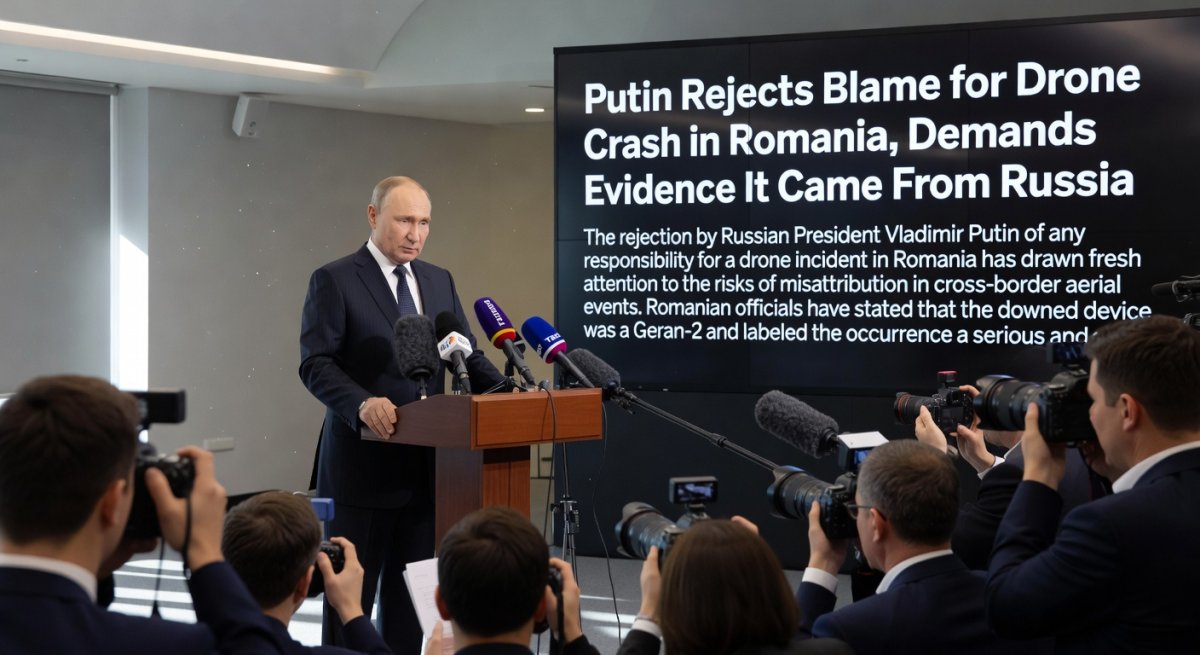
The rejection by Russian President Vladimir Putin of any responsibility for a drone incident in Romania has drawn fresh attention to the risks of misattribution in cross-border aerial events. Romanian officials have stated that the downed device was a Geran-2 and labeled the occurrence a serious and irresponsible escalation. Putin has countered by insisting on verifiable proof that the object originated from Russia, underscoring the importance of clear evidence in such disputes.
This exchange occurs amid heightened sensitivities along NATO’s eastern flank, where even limited incidents can influence alliance consultations and public discourse on security commitments. The absence of publicly released technical data at this stage leaves open questions about origin, flight path, and intent, all of which require methodical examination before conclusions can be drawn.
Russian Response and Call for Evidence
Putin’s statement centers on the need for concrete proof rather than assumptions based on the drone’s reported model. By framing the matter as one that demands documentation, Russian authorities signal a preference for technical verification over immediate acceptance of external claims. This approach aligns with standard diplomatic practice when incidents involve objects that could theoretically originate from multiple sources or be subject to misidentification. The demand for evidence also serves to shift focus toward procedural steps, such as joint analysis of wreckage or flight data, rather than immediate political attribution. Without such material made available through transparent channels, the episode risks remaining a point of contention rather than a resolved matter.Romanian Assessment and Regional Concerns
Bucharest’s identification of the drone as a Geran-2 and its characterization of the event as an escalation reflect the country’s position as a NATO member sharing a border area with ongoing regional tensions. The public statement emphasizes the potential for unintended consequences when unidentified aerial objects enter sovereign airspace, regardless of ultimate origin. Romanian authorities have not, at this stage, released detailed forensic findings or invited independent international examination in a manner that would allow wider scrutiny. This leaves the incident in a phase where national statements stand alongside calls for further proof, a common pattern in the early stages of such investigations.Implications for Verification Standards
Incidents involving drones or other unmanned systems highlight the practical difficulties of establishing origin when wreckage is limited or when electronic signatures are absent. Putin’s insistence on evidence illustrates the broader requirement for chain-of-custody protocols and shared technical assessments if similar events are to be addressed without prolonged diplomatic friction. NATO members, including Romania, maintain monitoring capabilities along their frontiers, yet distinguishing between debris from distant launches, local malfunctions, or third-party activity remains technically complex. The current exchange therefore points to the value of established mechanisms for rapid information exchange rather than reliance on model identification alone.Background on Russia-NATO Aerial Boundary Issues
Relations between Russia and NATO countries have long included periodic reports of objects entering or approaching national airspace, often leading to diplomatic notes and demands for clarification. These episodes occur against a backdrop of differing interpretations of international aviation norms and military operating procedures. The Geran-2 designation itself refers to a type of unmanned aerial vehicle whose production and deployment patterns have been discussed in open sources over several years. Attribution based solely on physical characteristics, however, can be contested when similar designs circulate beyond a single operator or when components are widely available.Next Steps and Outlook
Resolution of the matter will likely depend on whether technical data or wreckage analysis is shared through bilateral or multilateral channels. Absent such steps, the incident may remain a reference point in ongoing discussions about airspace security without producing a definitive shared conclusion. Observers will watch for any subsequent releases of radar records, material examination results, or joint statements that could narrow the range of possible explanations. Until that occurs, the emphasis remains on the evidentiary threshold set by both sides rather than on immediate policy shifts.By Irina Volkov, Staff Writer
This article was produced with AI-assisted research and editorial support. Reporting is based on sources cited in the article.
What's Your Reaction?
 Like
0
Like
0
 Dislike
0
Dislike
0
 Love
0
Love
0
 Funny
0
Funny
0
 Wow
0
Wow
0
 Sad
0
Sad
0
 Angry
0
Angry
0
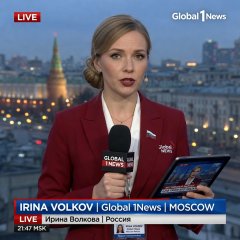
Irina Volkov
Russia/Eastern Europe Correspondent at Global1.News. Covering Russian politics, energy, security, and the shifting dynamics of the post-Soviet space. Provides clear-eyed analysis on one of the world's most opaque regions.













Comments (0)