
Nato condemns Russian 'recklessness' after drone hits Romanian residential block
NATO Slams Russian 'Recklessness' After Stray Drone Slams Into Romanian Apartment Block, Injuring Two The Strike That Crossed the Line A Russian drone slammed into a residential building in the Romanian border town of Tulcea early Tuesday, injuring two civilians and sending shrapnel through three floors of apartments. Romanian authorities confirmed the weapon was a Shahed-type
NATO Slams Russian 'Recklessness' After Stray Drone Slams Into Romanian Apartment Block, Injuring Two
The Strike That Crossed the Line
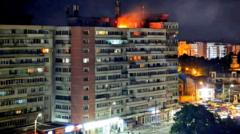
A Russian drone slammed into a residential building in the Romanian border town of Tulcea early Tuesday, injuring two civilians and sending shrapnel through three floors of apartments. Romanian authorities confirmed the weapon was a Shahed-type loitering munition launched during Moscow's latest barrage on Ukrainian ports. The drone veered across the Danube after Ukrainian air defenses engaged it, crashing at 3:17 a.m. local time and sparking a fire that took firefighters 45 minutes to contain.
Residents described the impact as a thunderclap that blew out windows and scattered debris across the street. A 42-year-old mother and her 11-year-old son suffered lacerations and smoke inhalation; both are stable at a Bucharest hospital. No deaths reported, but the message is unmistakable: Russia's war has now physically reached NATO soil.
Bucharest Calls Emergency Session
Romanian President Klaus Iohannis ordered an emergency National Security Council meeting for this afternoon. Prime Minister Marcel Ciolacu will brief lawmakers on damage assessments and request additional Patriot missile batteries from allies. Romania has already scrambled F-16s along the border and raised alert levels at its Mihail Kogălniceanu air base, home to NATO's Black Sea rotational forces.
Foreign Minister Luminița Odobescu summoned Russia's chargé d'affaires and delivered a formal protest. "This is not an accident of war," she told reporters outside the Foreign Ministry. "This is the direct result of reckless targeting decisions made in Moscow."
NATO's Sharp Condemnation
NATO Secretary General Jens Stoltenberg issued a statement within hours labeling the incursion "reckless and dangerous." The alliance stopped short of invoking Article 5 language but warned that repeated violations of allied airspace would trigger "further defensive measures." U.S. Ambassador to NATO Julianne Smith echoed the line, calling the episode "another example of Moscow's disregard for sovereign borders."
Behind closed doors, several eastern flank ambassadors pushed for immediate deployment of additional air-defense systems and expanded maritime patrols in the Black Sea. One senior NATO official, speaking on background, told Global1 News the alliance is reviewing rules of engagement for drones that cross into member territory after Ukrainian intercepts.
Context From the Ukraine War's Spillover
This is not the first time Russian munitions have landed in Romania. Fragments from earlier strikes have been recovered near the border, but Tuesday's direct hit on a populated building marks a clear escalation. Moscow has intensified attacks on Ukrainian grain and fuel infrastructure along the Danube, using the river as a natural corridor that brings weapons uncomfortably close to NATO territory.
Russian forces have launched more than 120 Shahed drones in the past ten days alone, many aimed at Odesa and Izmail. Ukrainian intercept rates hover around 80 percent, yet the sheer volume means some always leak through. When those drones lose guidance or are nudged by electronic warfare, their flight paths become unpredictable—and Romania sits directly in the danger zone.
Strategic Stakes on NATO's Eastern Flank
Romania hosts roughly 3,000 NATO troops and serves as the alliance's logistical hub for Black Sea operations. Any sustained threat to its territory forces NATO to divert resources from Ukraine support to pure territorial defense. Moscow understands this math. The Kremlin has repeatedly tested how far it can push without triggering collective defense, betting that Western leaders will absorb "accidents" rather than risk direct confrontation.
Energy security adds another layer. Romania's port of Constanța has become a critical alternative route for Ukrainian grain after Russian strikes crippled Odesa terminals. A drone strike that damages civilian infrastructure near that corridor threatens both food exports and alliance credibility.
Analysis: Recklessness or Calculated Probing?
Russian recklessness is real, but it is also deliberate. By flooding the skies with cheap drones, Moscow forces Ukraine to expend expensive interceptors while occasionally reminding NATO neighbors that the war does not respect maps. Each stray munition tests whether Bucharest or Warsaw will demand stronger alliance responses that could escalate the conflict.
Yet the pattern is unsustainable. If one more drone causes fatalities inside Romania, political pressure on NATO capitals will spike. Article 5 is not automatic for every drone fragment, but sustained attacks on residential areas would cross a political red line. The alliance's credibility hinges on showing it can protect its own territory even while arming Ukraine.
What's Next
Romania is expected to request an Article 4 consultation at NATO headquarters this week. That mechanism allows any ally to demand urgent talks when its security is threatened. Expect discussions on additional air-defense deployments, expanded radar coverage, and possible joint patrols with Turkish and Bulgarian forces.
Moscow has offered no apology and instead accused Ukraine of "provoking incidents near NATO borders." The usual disinformation cycle is already spinning. Romania and its allies are not buying it. Two injured civilians and a hole in a Tulcea apartment block are facts that demand accountability, not Kremlin talking points.
This is Jessica Ali for Global1 News. 🔥
This article was produced with AI-assisted research and editorial support. Reporting is based on sources cited in the article.
What's Your Reaction?
 Like
0
Like
0
 Dislike
0
Dislike
0
 Love
0
Love
0
 Funny
0
Funny
0
 Wow
0
Wow
0
 Sad
0
Sad
0
 Angry
0
Angry
0

Editor-in-Chief at Global1.News. Atlanta-based journalist who cuts through the BS and tells it like it is. Lead anchor, host, and the voice you hear when the spin stops and the truth starts.















Comments (0)