
Hayabusa2 Sharp Flyby Bolsters Japan Planetary Defense
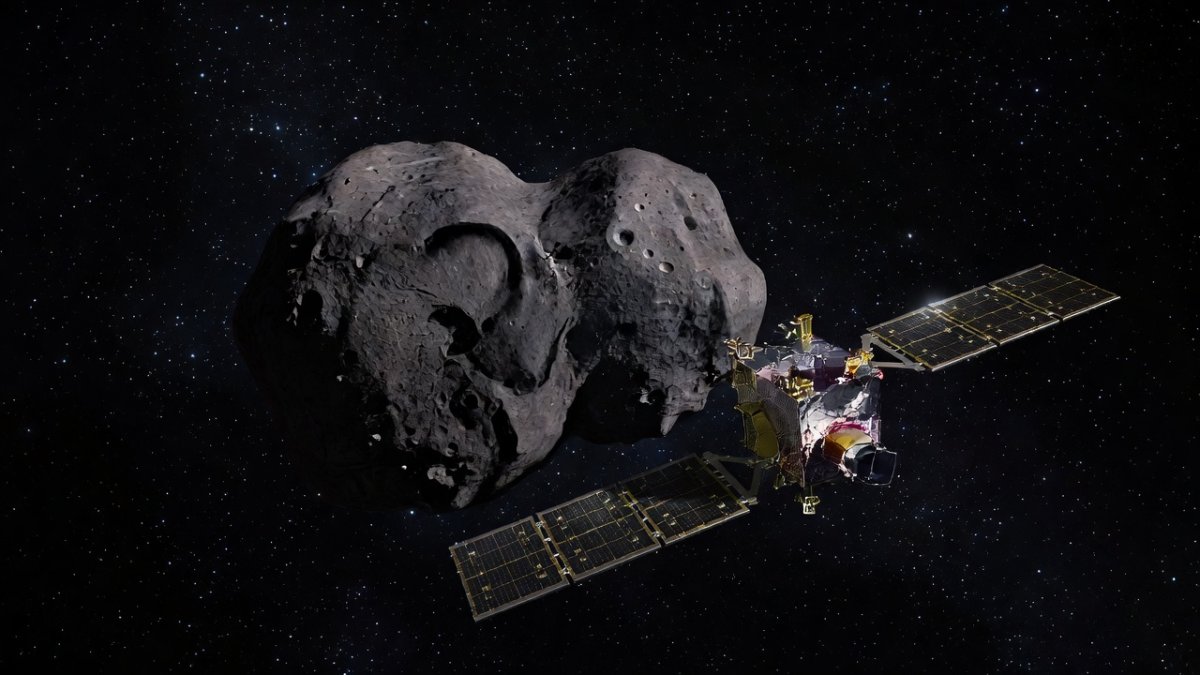
The Japan Aerospace Exploration Agency's extended Hayabusa2 mission achieved another milestone on July 5, 2026, when the spacecraft now designated Hayabusa2♯ flew past asteroid (98943) Torifune at approximately 6:30 p.m. Japan time. The probe passed roughly 800 meters from the asteroid's center while traveling at about 5 km/s. Torifune measures approximately 450 meters across and displays a peanut shape consistent with a contact binary. At the time of the encounter the asteroid was about 100 mil
The Japan Aerospace Exploration Agency's extended Hayabusa2 mission achieved another milestone on July 5, 2026, when the spacecraft now designated Hayabusa2♯ flew past asteroid (98943) Torifune at approximately 6:30 p.m. Japan time. The probe passed roughly 800 meters from the asteroid's center while traveling at about 5 km/s. Torifune measures approximately 450 meters across and displays a peanut shape consistent with a contact binary. At the time of the encounter the asteroid was about 100 million km from Earth.
The Flyby Event and Initial Data Return
Hayabusa2♯ collected imagery and other measurements using four instrument types, including the Optical Navigation Camera Telescope (ONC-T). Early images revealed surface details of the contact-binary body. Yuya Mimasu, head of the operations team at JAXA, stated: "I'm just utterly moved that it was able to take such a beautiful image. I have goosebumps."
The spacecraft maintained a stable trajectory throughout the high-speed passage, confirming the reliability of its navigation systems after more than a decade in space.
Significance for Japan's Space Program and JAXA
This flyby reinforces JAXA's position as a leader in small-body exploration. The original Hayabusa2 mission launched in December 2014, reached asteroid Ryugu in June 2018, and returned 5.4 g of samples to Earth in December 2020. The extended phase demonstrates Japan's ability to repurpose proven hardware for new scientific objectives without requiring an entirely new spacecraft development cycle.
Japanese policymakers view such missions as practical steps toward the goals outlined in the nation's space basic plan, which emphasizes technology demonstration and international cooperation in space science.
Technical Achievement of Close-Range High-Speed Navigation
Executing a flyby at 5 km/s while maintaining an 800-meter miss distance requires precise trajectory control and real-time optical navigation. The ONC-T provided the primary data for approach and departure imaging, allowing the operations team to verify the spacecraft's position relative to the asteroid's center of mass.
Engineers at JAXA adjusted the probe's path using a series of small trajectory correction maneuvers in the weeks leading up to the encounter. The success of these adjustments highlights improvements in autonomous navigation software developed since the Ryugu phase of the mission.
Planetary Defense Implications
The Hayabusa2♯ mission carries the subtitle "Small Hazardous Asteroid Reconnaissance Probe," reflecting its focus on technologies applicable to planetary defense. Precise trajectory control demonstrated during the Torifune flyby could support future kinetic impactor concepts, where a spacecraft would deliberately collide with a threatening asteroid to alter its orbit.
Komoto Kyota, NHK WORLD-JAPAN science correspondent, noted that the data gathered will help refine models of asteroid shape and rotation, both critical inputs for deflection simulations. The mission therefore contributes directly to the knowledge base required for any eventual deflection campaign.
Japan's Role in Global Planetary Defense Efforts
Japan participates in international planetary defense coordination through forums such as the International Asteroid Warning Network and the Space Mission Planning Advisory Group. The DLR (German Aerospace Center) continues its scientific involvement in the extended mission, having previously deployed the MASCOT lander on Ryugu during the original campaign.
This partnership illustrates how bilateral cooperation between JAXA and European agencies strengthens the overall international response capability. Data sharing from the Torifune encounter will feed into global databases used by multiple space agencies.

Next Target: Rendezvous with 1998 KY26 in 2031
Following the Torifune flyby, Hayabusa2♯ will continue toward its primary extended-mission objective: a rendezvous with asteroid 1998 KY26, estimated to be about 11 meters across. The encounter is scheduled for 2031 and will allow close-range study of a much smaller object than Torifune.
Observations of 1998 KY26 are expected to provide additional calibration data for planetary defense techniques, particularly for objects in the size range that could cause regional damage if they impact Earth. The mission timeline remains subject to ongoing trajectory refinement and spacecraft health checks.
By Kenji Tanaka, Staff Writer
This article was produced with AI-assisted research and editorial support. Reporting is based on sources cited in the article.
What's Your Reaction?
 Like
0
Like
0
 Dislike
0
Dislike
0
 Love
0
Love
0
 Funny
0
Funny
0
 Wow
0
Wow
0
 Sad
0
Sad
0
 Angry
0
Angry
0

Japan Correspondent at Global1.News. Tokyo-based voice covering Japanese politics, technology, economy, and culture. Tracks the intersection of tradition and innovation in one of the world's most dynamic societies.















Comments (0)