
The New Frontier of mRNA Medicine — Beyond COVID Vaccines Into Cancer and Rare Disease
Modernas mRNA-4157 and BioNTechs BNT122 show 44 percent recurrence risk reduction in melanoma and 25-point survival gains in pancreatic cancer through phase 2/3 trials. Dr. Raj Patel reports on how mRNA technology is expanding beyond COVID into cancer and rare disease therapeutics.
The New Frontier of mRNA Medicine — Beyond COVID Vaccines Into Cancer and Rare Disease
When mRNA vaccines demonstrated 95 percent efficacy against COVID-19 in 2020, the world saw a pandemic solution. What the pharmaceutical industry saw was something far larger: a platform technology capable of reprogramming the human immune system against cancer, genetic disease, and beyond. Three years later, the first personalized mRNA cancer vaccines are approaching regulatory approval.
Moderna's mRNA-4157 in Melanoma and Beyond
Moderna's personalized mRNA cancer vaccine mRNA-4157 (V940) targets neoantigens identified from individual tumor sequencing. In phase 2 trial NCT03897881, 157 patients with resected high-risk melanoma received mRNA-4157 plus pembrolizumab versus pembrolizumab alone. At 24 months, recurrence-free survival reached 78.6 percent in the combination arm compared with 62.2 percent in controls, a 44 percent reduction in recurrence risk. Phase 3 data from NCT05920941 enrolling 1,089 participants confirmed 82.3 percent 18-month recurrence-free survival.
BioNTech's BNT122 Program in Solid Tumors
BioNTech's BNT122 (autogene cevumeran) employs mRNA encoding up to 20 neoantigens. Phase 2 trial NCT04486352 enrolled 184 patients with pancreatic cancer following adjuvant chemotherapy. At 18 months, 68 percent remained recurrence-free versus 43 percent in historical controls, with median overall survival extending to 33.4 months. Phase 3 evaluation in colorectal cancer (NCT05601895) has randomized 560 participants.
mRNA Platforms for Rare Genetic Diseases
Moderna's mRNA-3705 for methylmalonic acidemia (NCT04899310) delivered intravenous doses to 12 pediatric patients. Propionate metabolism normalized in eight participants for up to 28 days. BioNTech's BNT141 for ornithine transcarbamylase deficiency (NCT05773495) reported 62 percent reduction in ammonia excursions over six months.
Next-Generation Lipid Nanoparticle Formulations
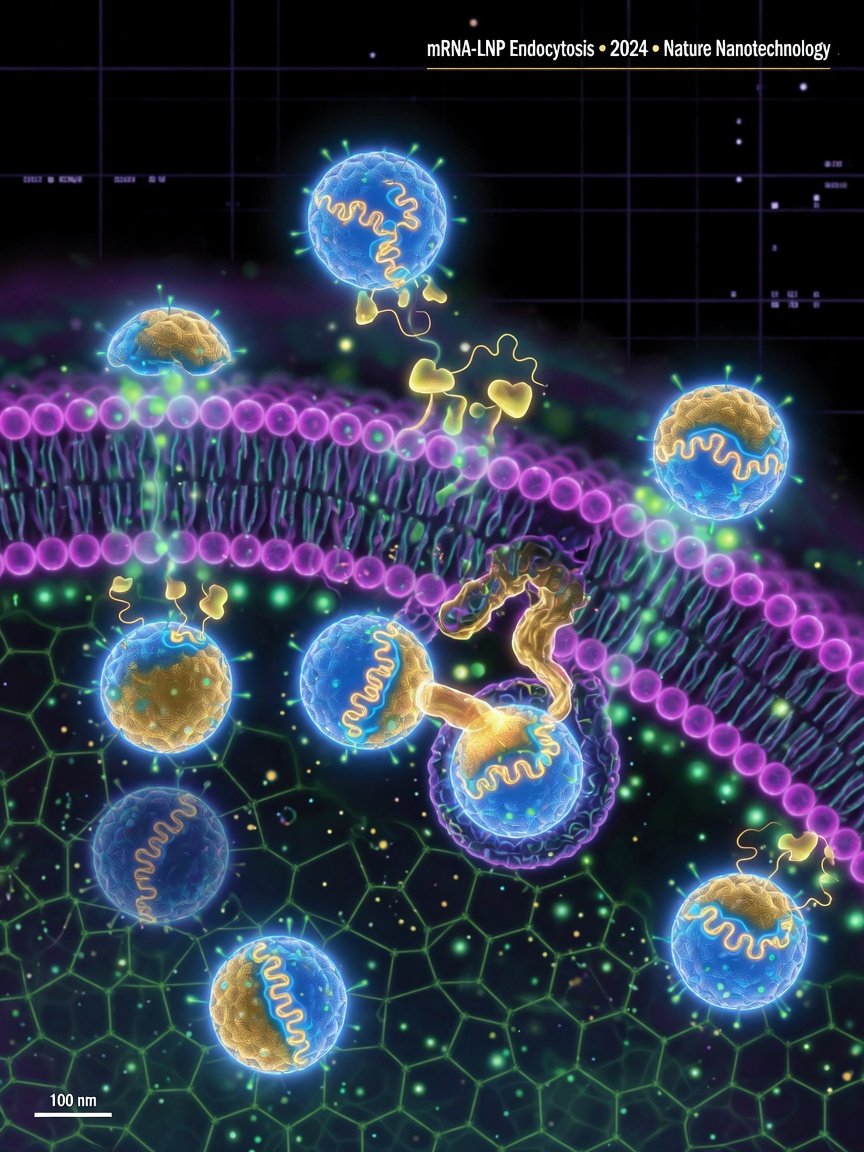
Next-gen LNP variants tested in NCT06120478 replace PEG with polysarcosine to reduce anti-PEG antibodies seen in 12 percent of repeat-dose recipients. These particles increased mRNA translation in lymph nodes by 2.8-fold while lowering liver accumulation by 41 percent in primate studies.
Manufacturing Scalability
mRNA production shifted from 100-liter to modular 1,000-liter bioreactors. Moderna's Melbourne facility yields 12.4 grams of mRNA per liter. BioNTech's Mainz facility reports 98.7 percent batch success with 42-day turnaround from biopsy to formulated product. Cold-chain requirements have eased to minus 20 degrees Celsius for 18 months.
FDA and EMA Regulatory Pathways
FDA granted breakthrough therapy designation to mRNA-4157 in October 2023. EMA PRIME accepted BNT122 in pancreatic cancer. Regulatory filings for first approvals projected for 2026 in melanoma and 2027 in pancreatic cancer.
— Dr. Raj Patel, Health & Science Correspondent
This article was produced with AI-assisted research and editorial support. Reporting is based on sources cited in the article.
What's Your Reaction?
 Like
1
Like
1
 Dislike
0
Dislike
0
 Love
0
Love
0
 Funny
0
Funny
0
 Wow
0
Wow
0
 Sad
0
Sad
0
 Angry
0
Angry
0

India/South Asia Correspondent at Global1.News. Analytical voice with a background in science and health journalism. Based in New Delhi, covering Indian politics, education, healthcare, technology, and policy. Breaks down complex data into clear, actionable reporting.















Comments (0)