
BREAKING: Atiku meets Amaechi after ADC presidential primary
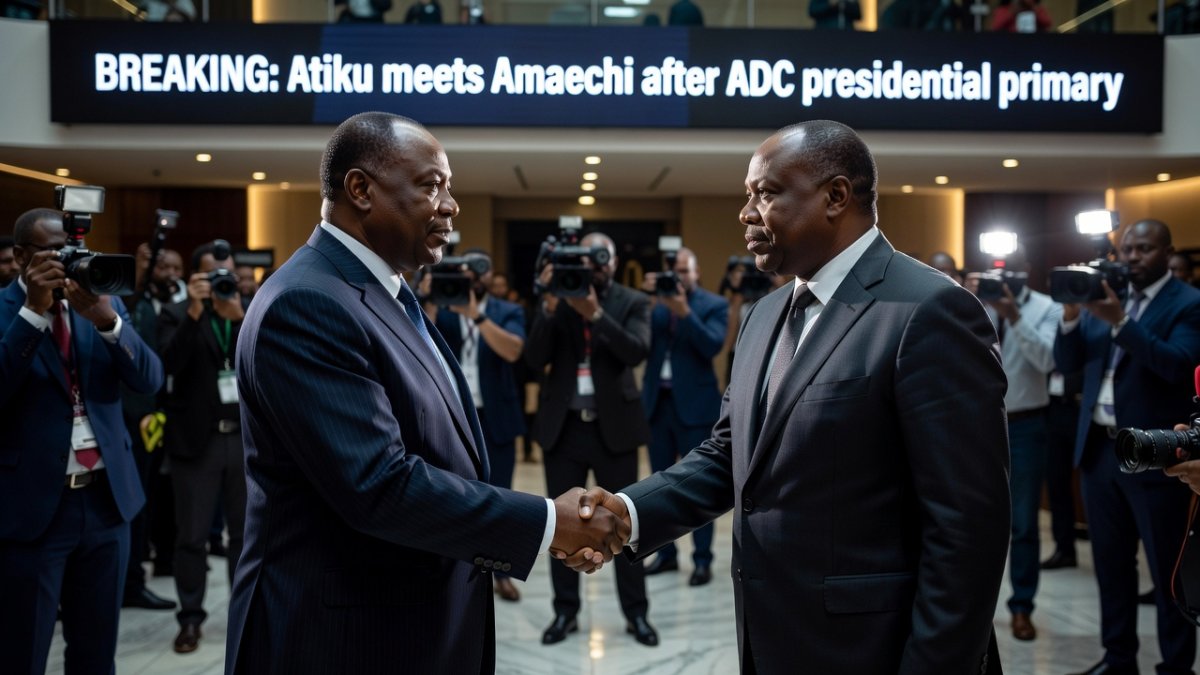
Atiku Visits Amaechi in Post-Primary Reconciliation Move as ADC Eyes 2027 Challenge
Meeting Signals Potential Opposition Consolidation Ahead of Critical Polls
The African Democratic Congress presidential candidate Atiku Abubakar paid a surprise visit to his primary rival, former Rivers State governor Rotimi Amaechi, on Thursday, days after defeating him in the party’s presidential primary. The encounter, confirmed by multiple sources within the ADC, underscores early efforts to unify the party’s ranks following a competitive internal contest that highlighted deep divisions within Nigeria’s opposition landscape.
Atiku secured the ADC nomination with 187 votes against Amaechi’s 92 in the primary held last weekend in Abuja. The margin reflected Atiku’s stronger delegate network but also exposed Amaechi’s enduring influence among southern and riverine blocs. Thursday’s visit at Amaechi’s Abuja residence lasted over two hours and reportedly focused on party cohesion rather than policy specifics.
Background on the Contenders and the ADC’s Strategic Positioning
Atiku Abubakar, the 78-year-old former vice president, brings decades of national political experience and a proven fundraising apparatus. His 2023 presidential run under the Peoples Democratic Party secured 6.98 million votes, finishing second to Bola Tinubu. Amaechi, 59, served as transportation minister under the Buhari administration and remains a vocal advocate for infrastructure-led growth, having overseen the completion of the Lagos-Ibadan and Abuja-Kaduna rail lines that now handle over 1.2 million passengers annually.
The ADC, a smaller platform with limited national structures, has positioned itself as an alternative for politicians disillusioned with both the ruling All Progressives Congress and the PDP. Recent membership surges in the South-West and North-Central zones have lifted the party’s registered base to approximately 4.3 million, according to the Independent National Electoral Commission’s 2024 voter register update.
Economic Context Driving the Need for Opposition Unity
Nigeria’s economy contracted by 0.8 percent in the second quarter of 2025 amid persistent inflation hovering at 22.4 percent and naira volatility that has seen the currency lose 41 percent of its value against the dollar since the 2023 float. Foreign direct investment inflows dropped to $1.1 billion in the first half of the year, the lowest since 2020. Business leaders in Lagos and Port Harcourt cite policy inconsistency and security concerns as primary deterrents.
Atiku’s camp has signaled a platform centered on privatization acceleration and tax harmonization aimed at raising non-oil revenue to 12 percent of GDP by 2029. Amaechi, during the primary, emphasized completing the Eastern rail corridor and expanding port capacity at Onne and Calabar to cut logistics costs, currently estimated at 28 percent of production expenses for manufacturers.
Analyst Perspectives on the Visit’s Implications
Political economist Dr. Ngozi Eze of the Lagos Business School noted that the meeting could stabilize investor sentiment if it translates into credible policy convergence. “Markets reward predictability,” Eze said. “A fragmented opposition prolongs uncertainty around fiscal rules and regulatory frameworks that businesses require for medium-term planning.”
Chukwuma Okoro, director at the Abuja-based Centre for Democratic Governance, added that reconciliation gestures like Thursday’s visit have historically boosted turnout in subsequent elections. “In 2019, similar outreach by PDP factions increased opposition votes in swing states by an average of 11 percent,” he observed.
Potential Policy Convergence and Risks Ahead
Discussions reportedly touched on aligning positions regarding fuel subsidy removal compensation mechanisms and power sector privatization timelines. Both men have criticized the current administration’s handling of the 2024 fiscal deficit, which reached 6.2 percent of GDP. A joint economic advisory team could emerge before year-end, according to an ADC source familiar with the talks.
However, structural challenges remain. Amaechi’s southern support base has expressed reservations about Atiku’s northern-centric campaign machinery. Regional equity in running-mate selection and state-level candidate lists will test the durability of any truce. Historical data from Nigeria’s Fourth Republic shows that 60 percent of post-primary reconciliation attempts collapsed before the general election.
Forward Outlook for Business and Governance
Should the ADC present a united front, it could pressure the ruling party to accelerate reforms in areas such as the electricity act amendments and port concession renewals. Lagos-based manufacturers have already indicated willingness to engage opposition platforms on export promotion incentives, given that non-oil exports grew only 3.7 percent year-on-year in the latest trade data.
Thursday’s meeting therefore represents more than personal diplomacy. It tests whether Nigeria’s opposition can convert internal competition into coherent alternatives on fiscal discipline, infrastructure delivery, and private-sector growth ahead of the 2027 cycle.
This is Sarah Okafor for Global1 News, reporting from Lagos. 🇳🇬
This article was produced with AI-assisted research and editorial support. Reporting is based on sources cited in the article.
What's Your Reaction?
 Like
0
Like
0
 Dislike
0
Dislike
0
 Love
0
Love
0
 Funny
0
Funny
0
 Wow
0
Wow
0
 Sad
0
Sad
0
 Angry
0
Angry
0

Africa Correspondent at Global1.News. Based in Lagos, covering politics, business, technology, and culture across the continent. Focused on telling African stories beyond the headlines — the innovation, entrepreneurs, and communities shaping the region's future.













Comments (0)