
Bolivia Allows Military Deployment Amid Protests Over Land, Fuel, and Resources
Bolivia's Congress Clears Path for Military Response As of May 31, 2026, Bolivia's Chamber of Deputies has approved legislation that would ease restrictions on President Rodrigo Paz declaring a state of emergency and deploying troops. The vote, which passed with more than two-thirds support, repeals elements of a 2020 law that limited military involvement in protests to situati
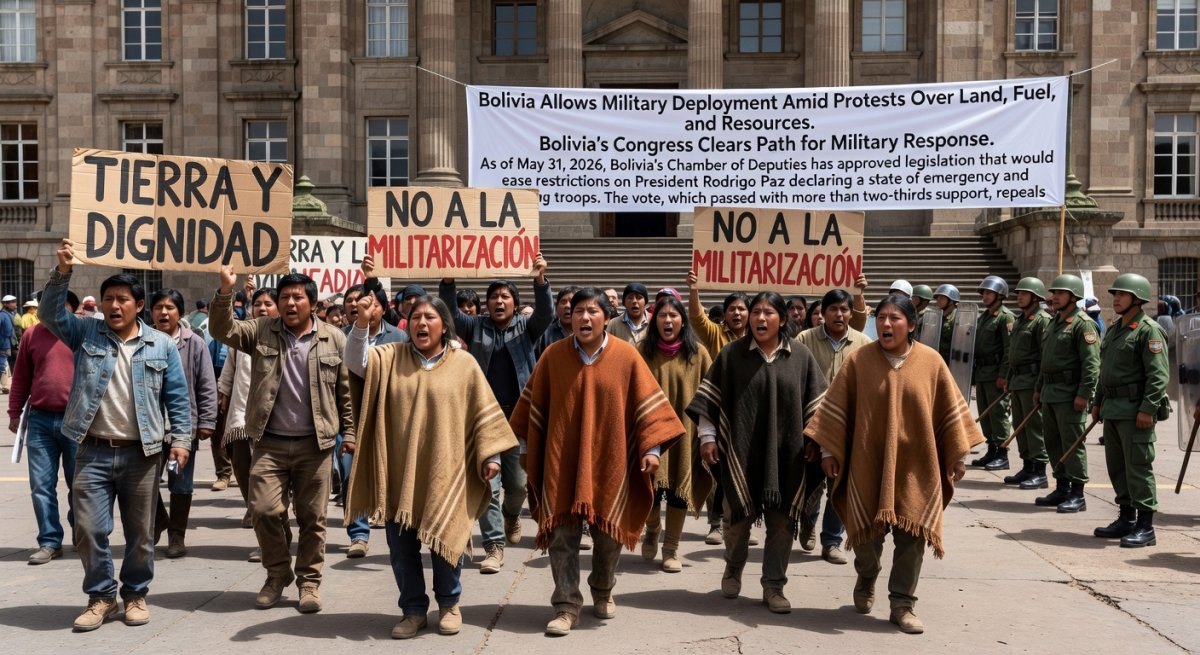
Bolivia's Congress Clears Path for Military Response
As of May 31, 2026, Bolivia's Chamber of Deputies has approved legislation that would ease restrictions on President Rodrigo Paz declaring a state of emergency and deploying troops. The vote, which passed with more than two-thirds support, repeals elements of a 2020 law that limited military involvement in protests to situations where police forces were overwhelmed. This development follows nearly a month of road blockades by miners, farmers, and indigenous organizations demanding Paz step down.
Land Reform Sparks Early Indigenous Resistance
The unrest began in late April with opposition to a proposed land reform measure from the Paz administration. Small-scale farmers expressed fears that the changes could facilitate purchases of their holdings by larger landowners, despite government assurances that any transactions would remain voluntary. Organizations representing these farming communities, many of them indigenous, responded with highway blockades that disrupted supplies across affected regions. Paz later withdrew the proposal, yet the initial grievances had already mobilized broader participation.
Fuel Subsidy Cuts Deepen Resource and Livelihood Strains
Transport workers and drivers joined the demonstrations after the government ended long-standing fuel subsidies. The policy shift coincided with reports of declining petrol quality and instances of adulterated fuel damaging vehicle engines. Road blockades have since worsened shortages of fuel, water, and medicines in several areas, creating feedback loops that intensify daily hardships for rural and urban populations alike. These developments highlight ongoing tensions between energy policy decisions and the economic realities faced by communities dependent on affordable access to resources.
Constitutional Reforms and Governance of Natural Resources
Proposed amendments to the 2009 constitution, originally enacted under former President Evo Morales, have added another layer to the conflict. Paz, who campaigned on expanding private investment in key economic sectors, faces accusations from Morales supporters that such openings could weaken state oversight of natural resources. Indigenous groups, whose territories often overlap with resource-rich areas, view these shifts as potential threats to collective control over land and water. Sonia Siñani, a lawmaker who opposed the military deployment bill, warned that the measure risks escalating existing social frictions.
Accusations, Dialogue Efforts, and Environmental Stakes
Paz has attributed the protests in part to orchestration by Evo Morales, who denies involvement and faces an arrest warrant issued on May 11 related to separate legal proceedings. The former leader retains significant influence among indigenous communities. In response to the unrest, Paz has reshuffled his cabinet, reduced salaries for himself and ministers, and proposed a negotiation council. From an environmental perspective, these events underscore how disputes over land rights and resource governance can rapidly translate into widespread social disruption, affecting both ecosystems and the communities that depend on them. Sustained dialogue remains essential to address underlying pressures on Bolivia's natural heritage.
This article was produced with AI-assisted research and editorial support. Reporting is based on sources cited in the article.
What's Your Reaction?
 Like
0
Like
0
 Dislike
0
Dislike
0
 Love
0
Love
0
 Funny
0
Funny
0
 Wow
0
Wow
0
 Sad
0
Sad
0
 Angry
0
Angry
0

Latin America Correspondent at Global1.News. Based in Mexico City, covering politics, economics, energy, and culture across the region. Brings an on-the-ground perspective to stories spanning from the Rio Grande to Patagonia.















Comments (0)