
Belfast Riots: Water Cannon in Second Night of Violence
Belfast Riots: Water Cannon Deployed as Second Night of Violence Erupts After Knife Attack Second Night of Unrest Erupts in Belfast Violence erupted on the streets of Belfast for a second night on Wednesday as masked young men hurled bricks at police, who responded by firing water cannon to disperse gathering crowds. Masked youths broke up parts of pavements and walls of privat
Belfast Riots: Water Cannon Deployed as Second Night of Violence Erupts After Knife Attack
Second Night of Unrest Erupts in Belfast
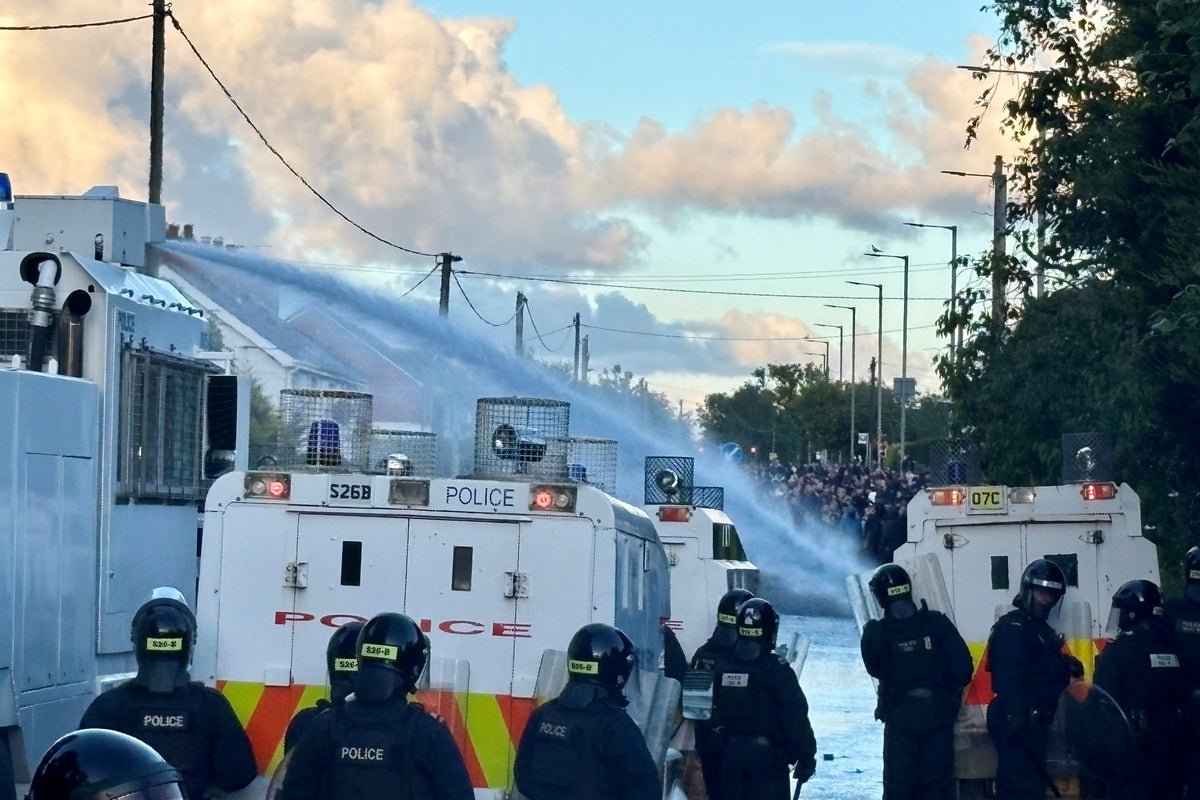
Violence erupted on the streets of Belfast for a second night on Wednesday as masked young men hurled bricks at police, who responded by firing water cannon to disperse gathering crowds. Masked youths broke up parts of pavements and walls of private homes to make bricks to throw at police, and a vehicle appeared to have been set alight, sending black smoke billowing into the sky. A second night of unrest broke out in Northern Ireland on Wednesday night, as rioters took to the streets to cause widespread destruction. The demonstration saw police pelted with bricks and petrol bombs, and homes further damaged. Footage showed dozens of balaclava-clad men gathering on Antrim Road, tearing bricks from properties and smashing paving stones with sledgehammers to create projectiles to throw at police. Protestors also attempted to set a derelict property near a petrol station in Newtownabbey on fire. Several more residents were forced to flee their homes amid the violence. Public transport was suspended and some schools closed early in Northern Ireland on Wednesday amid fears of a second night of violence.
Background to the Disorder and Extra Policing
Two hundred extra police officers were on the streets after residents were forced to flee homes that were set alight on Tuesday night, as a Sudanese man was charged over a knife attack in Belfast. The unrest followed Monday's stabbing incident, which led to widespread concern across the region. On Wednesday, the pattern of destruction continued with masked groups targeting police lines and residential areas. Officials noted that the violence involved the use of improvised weapons made from local materials, including paving stones and sections of walls. This escalation prompted the deployment of water cannon as a measure to manage the crowds and protect officers on the ground.
Reactions from Affected Families and Local Leaders
The family of Stephen Ogilvie, who lost an eye in the attack, condemned the second night of violence and said they were "disgusted" by the response. Mr Ogilvie's family said they felt "disgusted" by the violence, and said they did not want Monday's stabbing to stoke division. Northern Ireland's infrastructure minister described the second night of destruction as "racism, intimidation and thuggery". These statements highlighted the personal impact on victims and the broader condemnation from community representatives who sought to distance the original incident from subsequent disorder.
Legal Proceedings Against the Suspect
Suspect Hadi Alodid appeared at Belfast magistrates' court charged with attempted murder, threats to kill an NHS radiographer and possession of a knife. The charges relate directly to the knife attack that preceded the unrest. Court proceedings confirmed the details of the accusations against the Sudanese national, who had been granted asylum under a previous fast-track process. This legal step provided clarity on the individual responsible for the initial stabbing while the wider community dealt with the fallout from subsequent events.
Government Stance on Social Media and Regulation
Elon Musk's X will not face any action from the UK government to remove posts that have incited violence in Belfast for at least two months. Officials have hit out at misinformation spreading on social media in the wake of Monday's stabbing. Labour chair Anna Turley said Mr Musk was "grievously wrong and doing damage." Eventual action could be taken if ministers amend the Online Safety Act and require social media firms to act more quickly to remove inflammatory content during such events. However, if the amendment goes ahead it will not come into force until mid-July at the earliest. These developments connect the Belfast situation to wider UK debates on platform accountability and the need for faster responses to content that fuels unrest in cities and towns across the country.
Northern Ireland Secretary Hilary Benn on Racist Thuggery
The Northern Ireland Secretary Hilary Benn has hit out at the "racist thuggery" seen in the wake of the Belfast knife attack. Asked on Sky News whether these were racist riots rather than protests, Benn said: "Well, if you are targeting people on the basis of the colour of their skin how else can you describe them? That is racist thuggery, there's no question about it at all." Mr Benn also said ethnic minority people in the region were concerned whether they would be targeted next, adding: "We've had reports of people being stopped in their cars to be asked what their nationality is on their way to work, and this is completely unacceptable." His remarks underscored the unacceptable nature of the behaviour and its potential to affect daily life for communities throughout Northern Ireland and beyond.
Metropolitan Police Commissioner Monitors Developments
Sir Mark Rowley said the Met Police is watching the unrest in Northern Ireland closely, warning that "extreme rhetoric" is "driving some of this activity". The head of Britain's biggest police force also told GB News that police officers "don't enjoy being a political football in the culture wars". "All they want to do is go out, take on criminals, protect victims and they need that public support rather than being at the centre of this sort of battle of culture wars from either side," he said. Asked whether he was concerned that violence and disorder could be more widespread, Sir Mark said: "I really feel for colleagues in Police Service of Northern Ireland, they're dealing with some very challenging situations on the street. We see some of the extreme rhetoric that tends to be more common in public debate now, driving some of this activity. We saw it with Southport, where extreme rhetoric and online commentary led to disorder. So we're paying close attention to it." These comments link the events in Belfast to similar challenges faced by forces elsewhere in the UK.
Changes to Asylum Procedures Highlighted
The fast-track asylum scheme under which the suspect in the Belfast knife attack was reportedly granted asylum in the UK is no longer in operation, the Northern Ireland Secretary has said. Hadi Alodid, as a Sudanese national, was able to stay in Britain in 2023 after filling in a questionnaire rather than facing the standard interview. Hilary Benn told Times Radio: "That was a process that was put in place by the last government." Asked whether it still exists now, he said: "Well it does not." This clarification addresses procedural aspects of the case while reinforcing that such arrangements have ended under current policy.
By Erica Thornton, Staff WriterThis article was produced with AI-assisted research and editorial support. Reporting is based on sources cited in the article.
What's Your Reaction?
 Like
0
Like
0
 Dislike
0
Dislike
0
 Love
0
Love
0
 Funny
0
Funny
0
 Wow
0
Wow
0
 Sad
0
Sad
0
 Angry
0
Angry
0

US Politics and Policy Correspondent at Global1.News. Based in Washington DC, covering American politics, policy, elections, and the courts. Knows how the system works and tells you what it actually means.












Comments (0)