
Xi Jinping's Pyongyang Visit Signals Beijing's Bid to Rebalance Influence in Northeast Asia
The Symbolism of Xi's First Pyongyang Visit Since 2019 Chinese President Xi Jinping concluded a two-day visit to Pyongyang that marked his first official trip to North Korea since 2019. North Korean leader Kim Jong Un arranged an elaborate reception featuring a red-carpet welcome and acrobatic performances upon Xi's arrival on Monday. Although the visit produced no concrete agr
The Symbolism of Xi's First Pyongyang Visit Since 2019
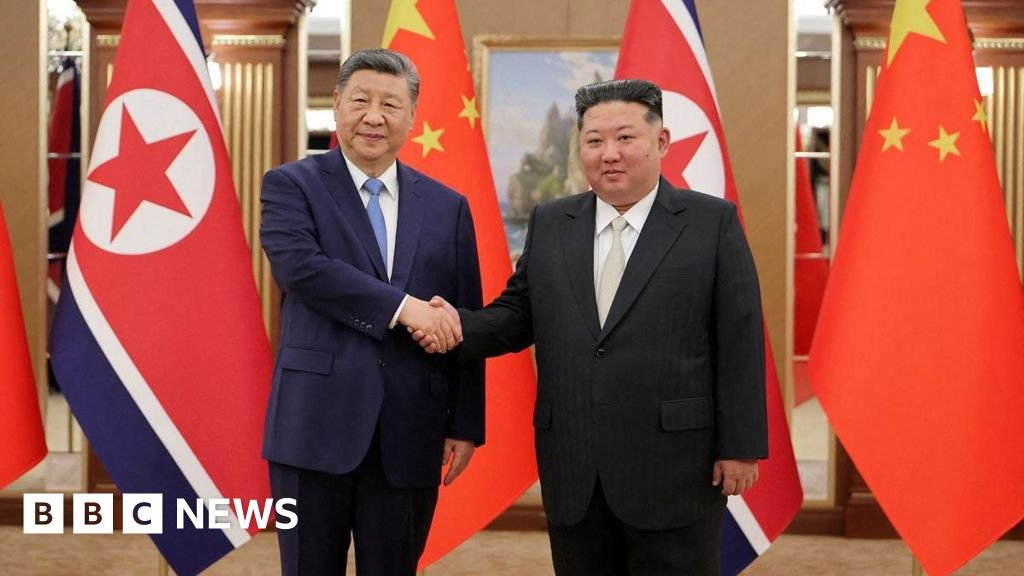
Chinese President Xi Jinping concluded a two-day visit to Pyongyang that marked his first official trip to North Korea since 2019. North Korean leader Kim Jong Un arranged an elaborate reception featuring a red-carpet welcome and acrobatic performances upon Xi's arrival on Monday. Although the visit produced no concrete agreements, Kim publicly described Xi's selection of Pyongyang for his first state visit of the year as evidence of the utmost importance attached to bilateral relations, according to a KCNA report.
The timing underscores Beijing's effort to reassert influence over a strategically vital neighbour that has grown closer to Russia. For Xi, the journey serves as a reminder to Kim that China remains the primary benefactor. Kim, in turn, gains visible demonstration that he retains significant international connections despite ongoing sanctions, particularly after Xi's recent meetings with US President Donald Trump and Russian President Vladimir Putin.
State media coverage from both sides framed the encounter in terms of enduring proximity. Xinhua reported Xi's banquet remarks that China and North Korea are linked by mountains and rivers and share a common destiny. Kim responded by pledging to maintain friendship with China as a top priority and reiterating support for Beijing's One China principle.
These gestures carry weight because they revive a pattern of high-level contact that had cooled in recent months. The visit therefore functions less as routine diplomacy and more as a deliberate signal of renewed attention from Beijing at a moment when alternative alignments threaten to dilute Chinese leverage along its northeastern border.
Inside the Summit: High-Level Delegations and Public Messaging
Xi travelled with a senior delegation that included his de facto chief of staff Cai Qi, Defence Minister Dong Jun, Foreign Minister Wang Yi and Commerce Minister Wang Wentao. Their presence signalled the breadth of issues under discussion, spanning security, diplomacy and economic coordination. The composition of the entourage reflected Beijing's interest in managing multiple dimensions of the relationship simultaneously.
Public statements during the visit emphasised historical and geographic ties rather than new initiatives. At the Monday evening banquet, both leaders invoked shared destiny language while avoiding references to specific policy outcomes. Kim's remarks highlighted continuity in North Korea's foreign-policy priorities, placing the relationship with China at the forefront.
The absence of detailed communiqués or signed documents was consistent with the visit's emphasis on symbolism over substance. Western diplomatic sources noted that the muted tone contrasted with more celebratory past summits, yet the very fact of the meeting after a six-year gap in formal encounters conveyed its own message of restored contact.
State outlets on both sides limited coverage to expressions of mutual respect and reaffirmed principles. This restrained approach allowed each capital to project stability without committing to verifiable deliverables that might later constrain flexibility amid shifting regional dynamics.
The Strategic Context: Why Beijing Is Reasserting Influence Now
China seeks stability along its border and continued influence in Pyongyang while avoiding entanglement in crises arising from North Korea's nuclear programme. The current visit therefore centres on restoring leverage rather than celebrating friendship alone. Beijing's calculus prioritises preventing any deterioration that could draw Chinese forces into direct confrontation or economic disruption.
Recent months had shown signs of cooling. The 75th anniversary of diplomatic relations in October 2024 passed with minimal public commemoration, and China's ambassador was absent from North Korea's founding celebrations the previous month. Such restraint indicated that Beijing was withholding warmer gestures until conditions favoured a reset.
By hosting Kim at a military parade in Beijing late last year, Xi initiated the process of re-engagement. That event marked the first formal summit in six years and positioned Kim prominently alongside both Xi and Putin. The Pyongyang visit extends this sequence, demonstrating that Beijing intends to maintain regular high-level contact.
Strategic timing also reflects China's broader global posture. After Xi's meetings with Trump and Putin, the trip to North Korea completes a diplomatic circuit that underscores Beijing's determination to manage relations with all three capitals from a position of regional primacy.
The Russia Factor: Pyongyang-Moscow Alignment and Chinese Concerns
Western diplomatic sources indicate that Beijing has grown increasingly uneasy about the expanding partnership between Pyongyang and Moscow. Following Xi's meeting with Putin the previous week, the Pyongyang visit appears designed in part to ensure that Kim does not drift too far into Russia's orbit. China holds the sole formal defence treaty with North Korea and views any rival influence as a potential reduction in its own leverage.
North Korea's military cooperation with Russia has intensified since the invasion of Ukraine. A mutual defence pact was concluded during Putin's 2024 visit to Pyongyang. BBC reporting estimates that approximately 2,300 North Korean soldiers have died fighting alongside Russian forces, while Pyongyang has supplied ammunition in exchange for oil and other assistance.
These developments create second-order effects for Chinese interests. A Kim less dependent on Beijing could pursue policies that increase border instability or complicate China's efforts to project influence on the global stage. Beijing therefore prefers a relationship in which North Korea remains reliant on Chinese economic and diplomatic support.
The invitation extended to Kim for the Beijing military parade served as an early corrective measure. By keeping the North Korean leader visibly aligned with Chinese leadership, Xi sought to counterbalance the momentum generated by the Russia-North Korea defence agreement and to reassert China's role as the indispensable interlocutor.
Denuclearisation: The Subject Beijing No Longer Raises
Public readouts of the talks contained no reference to North Korea's nuclear arsenal or to denuclearisation of the Korean peninsula. This omission aligns with a broader shift in Chinese policy over recent years, during which Beijing has markedly reduced its public advocacy for denuclearisation. The 65th anniversary of the China-North Korea defence pact was noted, yet nuclear issues remained outside the stated agenda.
The change reflects pragmatic recognition that repeated calls for denuclearisation have yielded limited results while risking friction with Pyongyang. Instead, Beijing now emphasises stability and influence, accepting that North Korea's nuclear status is unlikely to be reversed through Chinese pressure alone.
By declining to raise the topic during the visit, Xi avoided placing Kim in a position that might prompt defensive reactions or closer alignment with Russia. The silence therefore serves as a tactical adjustment that preserves space for continued economic and diplomatic engagement.
China's sole defence treaty remains with North Korea, giving Beijing a unique stake in managing escalation risks. The decision to sideline denuclearisation during this summit illustrates how leverage is now exercised through economic and political channels rather than through explicit non-proliferation demands.
Economic Levers: Trade, Aid, and Beijing's Comparative Advantage
China's exports to North Korea reached approximately $2.3 billion last year, the highest level recorded in six years. This figure underscores Beijing's position as the dominant economic partner even as political relations fluctuated. Trade volumes provide a tangible mechanism through which influence can be calibrated without formal treaty commitments.
Passenger train services between Beijing and Pyongyang resumed earlier this year after a six-year suspension. The restoration of regular rail links facilitates both commercial exchange and the movement of personnel, reinforcing China's role as the primary conduit for North Korea's external economic activity.
Unlike Russia, which offers military cooperation and limited material support, China supplies a wide range of goods and infrastructure access that North Korea cannot easily replace. This comparative advantage allows Beijing to maintain leverage even when political messaging is restrained.
The economic relationship therefore functions as the most reliable instrument for reasserting influence. By sustaining and gradually expanding trade ties, Beijing signals that cooperation yields concrete benefits while alternative alignments with Moscow remain narrower in scope and more conditional.
Implications for Northeast Asian Geopolitics
The visit illustrates China's determination to shape the regional balance without being drawn into nuclear-related crises. By restoring high-level contact, Beijing seeks to ensure that North Korea's external options remain constrained and that any future escalation can be managed through Chinese channels.
Russia's growing footprint introduces a new variable that complicates traditional Chinese calculations. Although the mutual defence pact and troop deployments do not directly threaten Chinese territory, they reduce Pyongyang's dependence on Beijing and could embolden Kim to adopt more assertive postures.
Over time, sustained Chinese economic engagement may offset some of these effects. The combination of resumed rail services, elevated trade figures and regular summits provides Beijing with ongoing points of access that Moscow currently lacks.
Ultimately, the trip reinforces China's preference for managed stability along its northeastern frontier. By prioritising leverage over denuclearisation and balancing Russian influence through economic means, Beijing positions itself to navigate the evolving alignments of Northeast Asia while protecting its core interest in border security and regional pre-eminence.
By Prof. Marcus Chen, Staff Writer.This article was produced with AI-assisted research and editorial support. Reporting is based on sources cited in the article.
What's Your Reaction?
 Like
0
Like
0
 Dislike
0
Dislike
0
 Love
0
Love
0
 Funny
0
Funny
0
 Wow
0
Wow
0
 Sad
0
Sad
0
 Angry
0
Angry
0

World Politics Analyst at Global1.News. Based in Beijing, covering US-China relations, global trade, and geopolitical strategy. Brings deep analytical perspective to the power dynamics shaping international affairs.













Comments (0)