
The South China Sea Land Rush: Asean and China in a New Territorial Competition
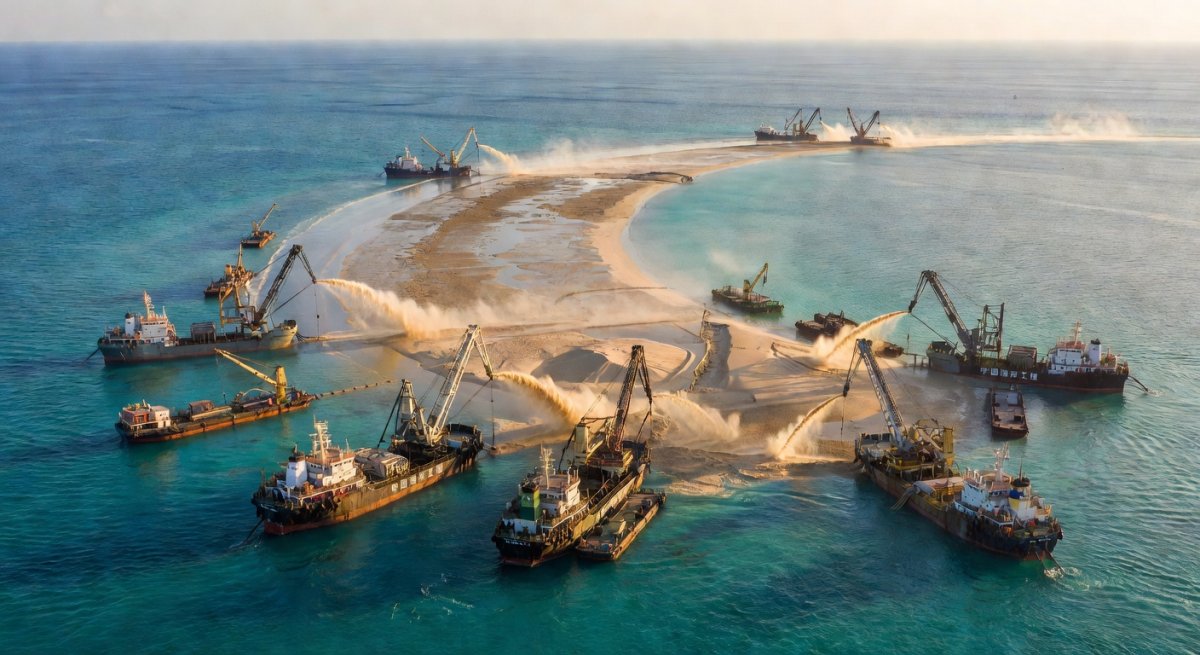
Recent Transformations at Antelope Reef The Paracel Islands have long featured submerged reefs with limited habitability. Antelope Reef, previously a small feature largely underwater, has seen substantial sand dredging over recent months, resulting in approximately 6 square kilometres of newly formed land. This development occurred within a compressed timeframe of roughly six m
Recent Transformations at Antelope Reef
The Paracel Islands have long featured submerged reefs with limited habitability. Antelope Reef, previously a small feature largely underwater, has seen substantial sand dredging over recent months, resulting in approximately 6 square kilometres of newly formed land. This development occurred within a compressed timeframe of roughly six months, involving cutter suction dredgers operating at high capacity. The presence of multiple vessels in the adjacent lagoon aligns with observations of China's extensive fleet of such equipment.
These changes occur in territory also claimed by Vietnam, Taiwan, the Philippines, Malaysia and Brunei. China's administrative control over the Paracels dates to 1974, following earlier military engagements. The scale and pace of work at Antelope Reef invite consideration of possible infrastructure elements, such as straight alignments that could relate to future aviation facilities, though any specific purpose remains subject to further observation.
China's Established Pattern in the Spratlys
Earlier reclamation projects at Mischief Reef, Fiery Cross Reef and Subi Reef produced islands supporting runways and associated installations. These sites now form part of a network of facilities within the area delineated by the nine-dash line. Maritime operations by coastguard and militia vessels have accompanied these developments, contributing to interactions with vessels from other claimant states.
Antelope Reef lies in proximity to existing Chinese facilities on Woody Island and installations on Hainan. The timing and location of current work may relate to concurrent activities by other parties in the broader region, though official statements have not elaborated on precise objectives.
Vietnam's Parallel Reclamation Activities
Vietnam has conducted dredging operations at more than twenty reef locations over the past three years, according to monitoring by the Asian Maritime Transparency Initiative. These efforts have produced an estimated 11 square kilometres of new land and several harbours. The approach mirrors techniques observed in Chinese operations, employing comparable dredger technology.
Vietnam has registered formal diplomatic protests regarding Antelope Reef while maintaining restrained public commentary. At the same time, Vietnamese authorities have advanced infrastructure such as navigation aids on features under their administration. This combination of protest and on-site development reflects a pattern of measured responses to regional developments.
Leadership Dynamics and Bilateral Engagements
President and party general secretary To Lam undertook a state visit to China earlier this year, during which references to differences over the Paracels and Spratlys employed notably measured phrasing from both sides. This engagement occurred against a backdrop of reduced public rhetoric from Vietnamese authorities compared with earlier periods.
Analysts have noted that Vietnamese actions on the water have continued even as diplomatic channels remain active. Greg Poling of the Asian Maritime Transparency Initiative has observed that Vietnamese authorities appear more inclined to address matters directly on site rather than through extended public statements, allowing Philippine counterparts to occupy a more visible role in certain disputes.
Expert Assessments of Recent Developments
Ray Powell, director of Sealight at Stanford University, has suggested that the pace of work at Antelope Reef may relate to Vietnamese reclamation occurring while Chinese attention has focused elsewhere, particularly on Philippine positions. Such sequencing could serve to signal continued presence in areas of overlapping claims.
Greg Poling has further noted that Vietnamese drilling operations have proceeded with reduced interference in recent periods. These observations point to a fluid operational environment where multiple actors adjust activities in response to one another's moves, without clear public articulation of overarching strategies.
ASEAN Negotiations and the Code of Conduct
ASEAN has pursued a binding code of conduct with China for three decades, building on the 2002 Declaration on the Conduct of Parties. Annual summit statements continue to reference progress toward such an instrument, yet the process has not yielded enforceable provisions to date. China has maintained its own positions while participating in dialogue formats.
The four ASEAN member states with claims in the area face differing domestic and external pressures. The absence of a completed code leaves space for unilateral actions, including reclamation, to continue alongside diplomatic efforts. This situation affects the collective capacity of ASEAN to shape outcomes in the Spratlys and Paracels.
Implications for Remaining Claimants
The Philippines has encountered repeated encounters involving coastguard vessels in overlapping zones. These incidents occur against the backdrop of larger-scale land formation by other parties. Malaysia and Brunei maintain claims but have pursued smaller-scale or less public adjustments to their positions.
Continued reclamation by both China and Vietnam may influence the negotiating leverage available to all claimants. The creation of harbours and potential support facilities alters the practical capacity for sustained presence on previously submerged features. ASEAN states will likely continue balancing bilateral ties with China against collective discussions on maritime rules.
Regional Context and Future Monitoring
The South China Sea remains an arena where technical capabilities in dredging and maritime operations intersect with longstanding territorial positions. Monitoring organisations such as the Asian Maritime Transparency Initiative provide ongoing data on land area changes and infrastructure additions, contributing to transparent assessment of developments.
Relations between Vietnam and China have featured both competition and cooperation, with recent leadership exchanges indicating an effort to manage differences through established channels. The broader involvement of ASEAN and external actors suggests that any stabilisation will require sustained attention to both diplomatic formats and operational realities on the water.
By Prof. Marcus Chen, Staff WriterThis article was produced with AI-assisted research and editorial support. Reporting is based on sources cited in the article.
What's Your Reaction?
 Like
0
Like
0
 Dislike
0
Dislike
0
 Love
0
Love
0
 Funny
0
Funny
0
 Wow
0
Wow
0
 Sad
0
Sad
0
 Angry
0
Angry
0

World Politics Analyst at Global1.News. Based in Beijing, covering US-China relations, global trade, and geopolitical strategy. Brings deep analytical perspective to the power dynamics shaping international affairs.














Comments (0)