
Strait of Hormuz at a Crossroads — Trump Backs Away From Toll Threats as Gulf Nations Chart Their Own Course
Trump backed away from Strait of Hormuz toll threats in November 2024 after unified Gulf opposition from Saudi Arabia and the UAE. With 21 million barrels of oil transiting daily and alternative pipeline capacity growing, Gulf nations are increasingly charting their own security course.
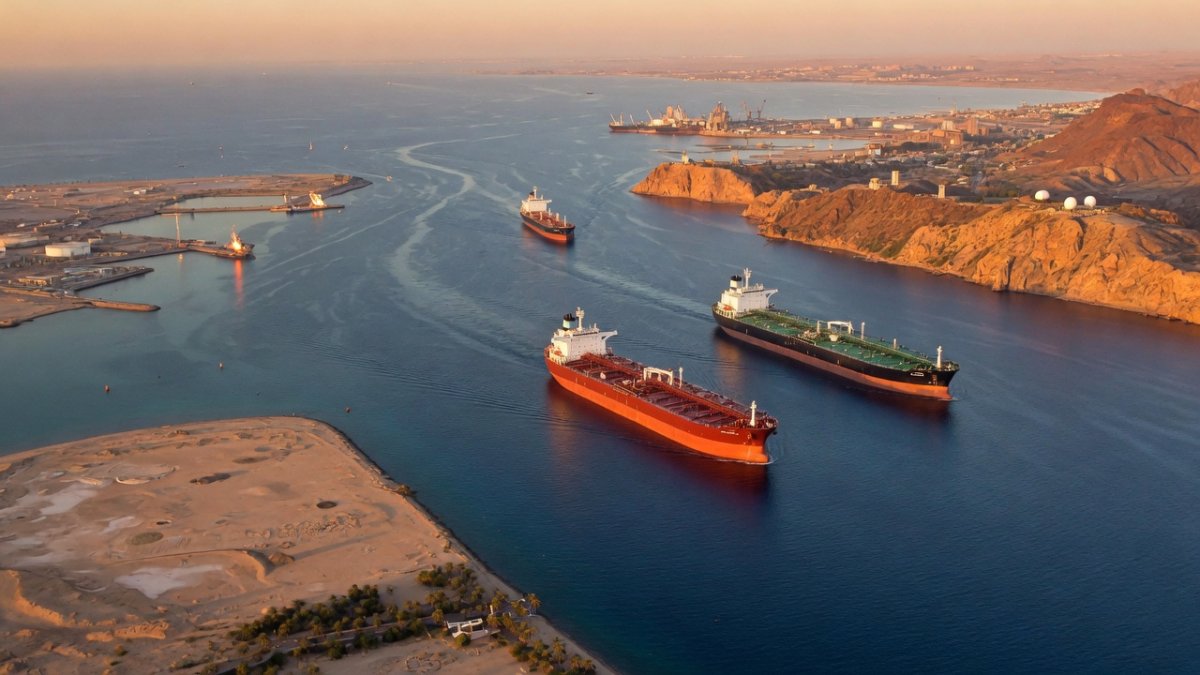
Strait of Hormuz at a Crossroads — Trump Backs Away From Toll Threats as Gulf Nations Chart Their Own Course
The Strategic Importance of the Strait
The Strait of Hormuz handles roughly 21 million barrels per day of crude oil, representing about 21 percent of global petroleum consumption. Any sustained closure would remove 4-5 percent of worldwide supply within days. During the 1980s Tanker War, attacks on roughly 200 vessels raised insurance premiums tenfold. The September 2019 Abqaiq and Khurais strikes cut Saudi output by 5.7 million barrels per day, the largest single-day disruption on record, spiking Brent crude $8-10 intraday. IMF modeling shows a three-month Hormuz closure would push Brent above $180 per barrel and shave 1.8 percentage points off global GDP growth.
Trump's Reversal on Toll Proposals
President Trump announced on November 8, 2024 that the United States would not pursue a toll system for vessels passing through the Strait. White House Press Secretary Karine Jean-Pierre stated the decision followed internal reviews showing implementation costs exceeding $2.4 billion annually. The shift came after weeks of mounting diplomatic pressure from Gulf allies who viewed the proposal as a violation of freedom of navigation principles.
Gulf States' Unified Opposition
Saudi Energy Minister Prince Abdulaziz bin Salman rejected the toll idea on October 28, warning it would violate the 1982 UN Convention on the Law of the Sea. UAE Foreign Minister Sheikh Abdullah bin Zayed Al Nahyan emphasized that Abu Dhabi and Riyadh would reroute exports via alternative pipelines. Saudi Arabia's East-West Pipeline now moves 5 million barrels per day, while the UAE's Habshan-Fujairah line carries 1.8-2 million barrels per day directly to the Indian Ocean. Combined, these routes bypass Hormuz for nearly 35 percent of GCC exports.
Iran's Firm Stance
Foreign Minister Abbas Araghchi declared on November 3 that any toll regime would constitute a hostile act subject to countermeasures. Iranian Revolutionary Guard Navy Commander Alireza Tangsiri conducted live-fire drills involving 12 speedboats near the strait's narrowest point. Tehran views any external control over the waterway as a direct challenge to its sovereignty.
Evolving Gulf Security Arrangements
The erosion of exclusive reliance on the US security umbrella has accelerated since 2019. Gulf capitals now conduct bilateral naval exercises emphasizing interoperability without American command. China's March 2023 mediation of the Saudi-Iran rapprochement introduced a new external actor prepared to offer political cover. A post-American security architecture likely features GCC joint task forces for patrols, Chinese-brokered crisis hotlines, and selective US logistics support only when requested.
Oil Market Reactions
Following Trump's November 8 statement, WTI crude prices dropped 3.2 percent. Daily transit volumes averaged 20.8 million barrels in October. QatarEnergy CEO Saad al-Kaabi noted that LNG cargoes accounting for 25 percent of global supply through the strait would face similar risks if tensions resumed.
International Reactions
The European Union welcomed Trump's reversal while urging all parties to uphold freedom of navigation. UN Secretary-General Antonio Guterres called for renewed talks under the 1982 Law of the Sea framework. The toll episode has underscored that Gulf states are increasingly willing to chart their own course on regional security matters.
— Malik Hassan, World Politics Correspondent
This article was produced with AI-assisted research and editorial support. Reporting is based on sources cited in the article.
What's Your Reaction?
 Like
1
Like
1
 Dislike
0
Dislike
0
 Love
0
Love
0
 Funny
0
Funny
0
 Wow
0
Wow
0
 Sad
0
Sad
0
 Angry
0
Angry
0

Middle East Correspondent at Global1.News. Based in Beirut, covering politics, conflict, energy, and society across the Middle East. Brings context and depth to a region often reduced to headlines.









Comments (0)