
Russian Warship Fires Warning Shots Near British Yacht in English Channel, Prompting Fresh Scrutiny of Naval Conduct
Russian Warship Fires Warning Shots Near British Yacht in English Channel, Prompting Fresh Scrutiny of Naval Conduct The Incident: Warning Shots in the Channel The encounter unfolded on Tuesday morning when Jane and Alan Kelvey, a retired British couple aboard their UK-registered yacht Bright Future, found themselves in close proximity to the Russian frigate Admiral Grigorovich
Russian Warship Fires Warning Shots Near British Yacht in English Channel, Prompting Fresh Scrutiny of Naval Conduct
The Incident: Warning Shots in the Channel
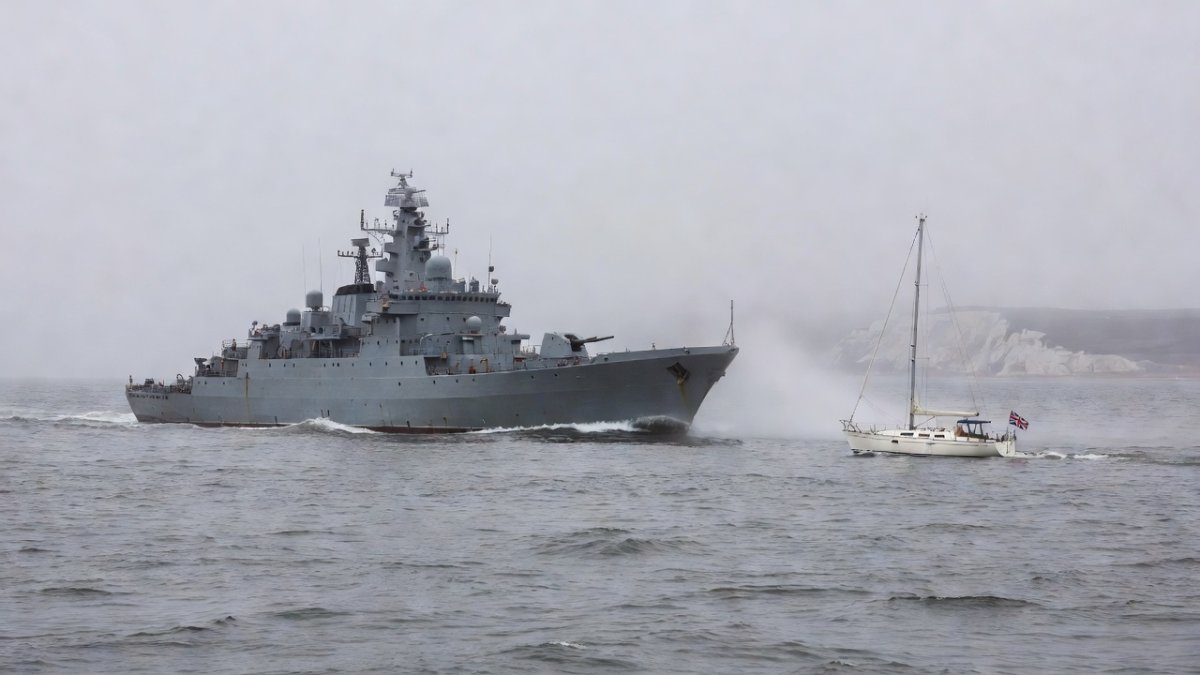
The encounter unfolded on Tuesday morning when Jane and Alan Kelvey, a retired British couple aboard their UK-registered yacht Bright Future, found themselves in close proximity to the Russian frigate Admiral Grigorovich approximately 23 miles south of the Isle of Wight. The location placed the vessels outside UK territorial waters yet well within the busy shipping lanes of the English Channel, where Russian naval movements have become increasingly familiar to British maritime authorities. The frigate discharged several rounds of small arms fire into the yacht's path after issuing auditory signals, an action the Ministry of Defence later described as an isolated incident intended to avert collision.
According to accounts gathered by British officials, the yacht had drifted toward the warship amid foggy conditions following its departure from the UK coast. The Admiral Grigorovich responded with five horn blasts, followed by additional signals and then warning shots fired from an estimated distance of around 500 yards. A boat from the Royal Navy patrol vessel HMS Tyne was subsequently dispatched to the scene to assess the safety of the yacht's occupants and collect further details of the sequence of events.
The timing of the incident coincides with a period of sustained Russian naval presence in the Channel, where vessels routinely transit international waters under close observation by UK forces. British authorities received reports from the couple on Tuesday morning, confirming that the shots were not directed at the yacht itself but served as a precautionary measure in line with the Russian account of events.
‘We Definitely Were Not on a Collision Course’
Jane Kelvey recounted the sequence to BBC Newsnight with clarity, explaining that the frigate first sounded five blasts on its horn to establish contact. The couple responded by altering course two degrees to port, a deliberate manoeuvre intended to signal their awareness of the larger vessel's presence. Moments later, further horn blasts preceded the discharge of four to five rounds of small arms fire into the air, which the Kelveys interpreted as warning shots rather than targeted aggression.
Both Jane and Alan Kelvey maintained that their yacht was never on a trajectory that would have resulted in collision, describing the gunfire as entirely unnecessary under the circumstances. Jane noted that she reported the episode as a hazard to navigation in accordance with standard maritime practice, while her husband continued to steer the vessel. When questioned about any sense of fear, the couple responded calmly, with Jane remarking that she had simply crouched and drawn her canvas hood over her head for protection during the brief episode.
The surreal nature of the encounter was emphasised by the pair, who stressed that the situation only escalated once the shots were fired. Their account directly contradicts elements of the Russian narrative regarding the yacht's approach, highlighting the subjective assessments that can arise during close-quarters maritime interactions in restricted visibility.
Conflicting Accounts: London and Moscow Respond
The Ministry of Defence characterised the firing of warning shots as a response following unsuccessful attempts to establish radio contact with the British vessel. An MoD spokesperson stated that the action by the Admiral Grigorovich was not aimed at the yacht and represented an effort to prevent a possible collision, framing the episode as an isolated occurrence without broader implications for ongoing naval operations in the area.
In contrast, Russia's Defence Ministry asserted that the frigate's crew had acted in strict accordance with international shipping regulations after multiple radio attempts and the launch of warning flares failed to elicit a response. The Russian statement described the yacht's approach as dangerous, positioning the warning shots as a necessary measure to safeguard the warship's manoeuvrability in the prevailing conditions.
The divergence between the two official positions underscores differing interpretations of maritime right of way and communication protocols. While both sides agree that no direct harm was intended toward the yacht, the incident illustrates how assessments of collision risk can vary significantly between civilian mariners and military crews operating in shared waters.
The Shadow Fleet Context
The warning shots incident occurred days after Royal Marine Commandos carried out an interception of a Russian shadow fleet tanker carrying sanctioned oil in the Channel on Sunday. That operation marked the first occasion on which British forces had seized such a vessel, drawing attention to the broader pattern of Russian maritime activity linked to efforts to circumvent international sanctions.
The Ministry of Defence has explicitly stated that the firing of shots near the Kelveys' yacht bore no connection to the tanker seizure earlier in the week. Nevertheless, the proximity of the two events has prompted observers to consider whether heightened Russian naval sensitivity in the Channel may reflect recent operational setbacks experienced by Moscow's shadow fleet operations.
James Parkin, a former Royal Navy rear admiral, observed that the tanker interception represented a significant embarrassment for Russia. Such developments occur against a backdrop of regular Russian warship transits through the Channel, which are monitored as a matter of routine by Royal Navy assets including HMS Mersey, the vessel shadowing the Admiral Grigorovich at the time of the yacht encounter.
Russian Naval Activity Close to UK Shores
The Admiral Grigorovich has maintained an extended presence in the region, having been first detected off the coast of Brest in France before proceeding into the Channel under continuous Royal Navy surveillance. British officials assess that the frigate has been operating in the area for a considerable period, supported by resupply operations that have enabled prolonged deployment without returning to port.
Satellite imagery reviewed by BBC Verify has documented the activities of the Russian repair vessel PM-82, which has shuttled between the Channel and the North Sea in recent months. Nato sources believe this vessel has delivered essential supplies including food and water to the Admiral Grigorovich, facilitating its role in escorting shadow fleet vessels through the waterway.
Last week a Nato source indicated to BBC Verify that the frigate had received orders from Moscow to accompany such vessels. In April the same warship was reported to have escorted six shadow fleet units through the Channel while under Royal Navy observation, underscoring a sustained pattern of Russian naval coordination in waters adjacent to the United Kingdom.
Routine Patrol or Rising Threat?
Former rear admiral James Parkin emphasised that the use of armed force at sea remains a measure of last resort, reserved strictly for circumstances involving self-defence. He noted that standard maritime procedures prioritise graduated responses beginning with visual and radio signals before any escalation to warning shots occurs.
The episode raises questions about the thresholds applied by Russian naval commanders when assessing collision risks involving civilian craft in international waters. While British authorities continue to describe such transits as routine, the involvement of warning shots introduces an element of unpredictability that could affect the calculations of commercial and recreational mariners operating in the same vicinity.
Broader implications extend to the ongoing Nato monitoring of Russian naval movements, where the presence of support vessels such as the PM-82 enables extended operations that challenge conventional assumptions about Russian sustainment capabilities in the North Atlantic and adjacent seas. The Channel remains a focal point for these activities due to its strategic importance as a transit route.
What Happens Next
British maritime authorities are expected to maintain close observation of the Admiral Grigorovich as it continues its passage, consistent with established procedures for tracking Russian naval units in the area. The incident has been logged and will inform future risk assessments for vessels operating in the English Channel during periods of reduced visibility.
Diplomatic channels between London and Moscow are likely to register the event through standard military-to-military communications, although neither side has indicated any intention to escalate the matter beyond existing protest mechanisms. Mariners are advised to remain vigilant and adhere to international collision avoidance regulations when encountering foreign warships in these waters.
By Erica Thornton, Staff Writer
This article was produced with AI-assisted research and editorial support. Reporting is based on sources cited in the article.
What's Your Reaction?
 Like
0
Like
0
 Dislike
0
Dislike
0
 Love
0
Love
0
 Funny
0
Funny
0
 Wow
0
Wow
0
 Sad
0
Sad
0
 Angry
0
Angry
0

US Politics and Policy Correspondent at Global1.News. Based in Washington DC, covering American politics, policy, elections, and the courts. Knows how the system works and tells you what it actually means.















Comments (0)