
Nvidia CEO Jensen Huang's June 2026 Korea Visit Underscores Strategic Interdependence in Global AI Supply Chains
Nvidia CEO Jensen Huang arrived at Gimpo International Airport at approximately 1 p.m. on 5 June 2026, launching a five-day visit that strategically blended high-profile cultural engagement with closed-door industrial negotiations. The itinerary immediately directed the world's most valuable semiconductor chief executive to T1 Base Camp in Hongdae, where he met the T1 League of
Nvidia CEO Jensen Huang arrived at Gimpo International Airport at approximately 1 p.m. on 5 June 2026, launching a five-day visit that strategically blended high-profile cultural engagement with closed-door industrial negotiations. The itinerary immediately directed the world's most valuable semiconductor chief executive to T1 Base Camp in Hongdae, where he met the T1 League of Legends roster including six-time world champion Lee "Faker" Sang-hyeok. This sequence of events illustrates how Korean esports culture, chaebol industrial concentration, and advanced memory manufacturing have become interdependent pillars of Nvidia's global AI strategy.
Nvidia CEO Jensen Huang's June 2026 Korea Visit Underscores Strategic Interdependence in Global AI Supply Chains
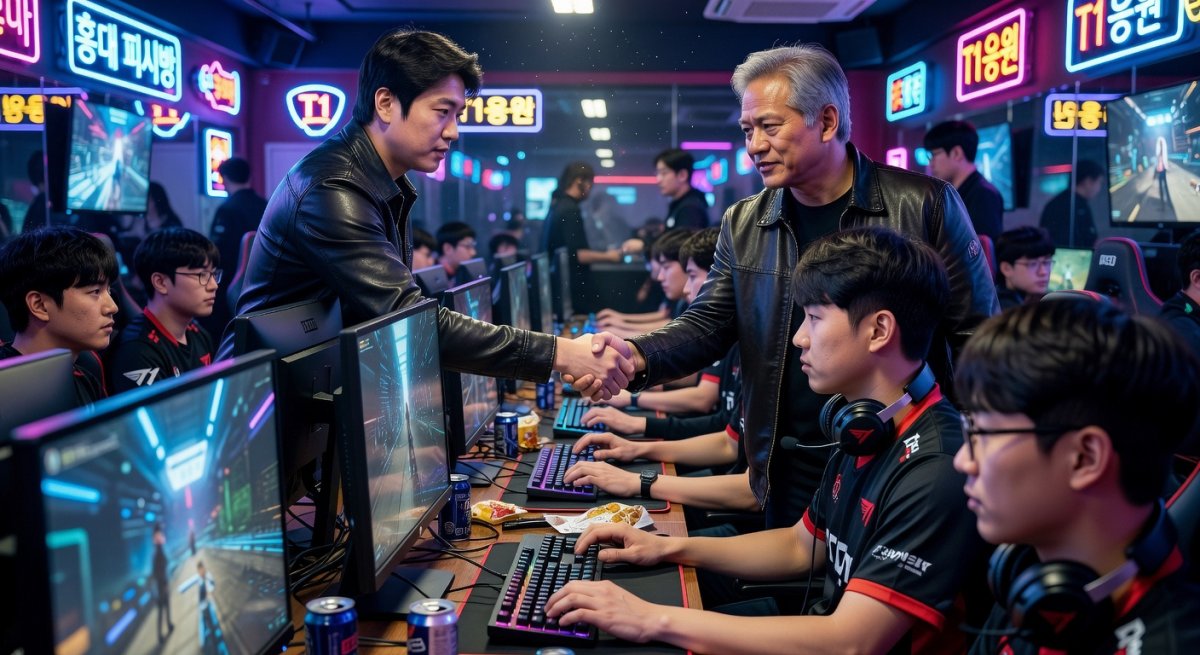
Seoul, South Korea — June 6, 2026 — Huang's decision to proceed directly from the airport to an esports venue rather than a corporate headquarters signals an intentional linkage between consumer gaming origins and enterprise AI hardware. Security personnel managed crowds outside T1 Base Camp in western Seoul's Hongik University district while Huang entered the PC bang that has become a landmark for the esports organization T1. The choice of venue reflects Nvidia's recognition of Korea's distinctive gaming culture as the historical foundation of its GeForce franchise, which began as a graphics card for gamers before becoming the backbone of the AI revolution.
Korea's Esports Ecosystem as a Technology Asset
Huang described Korea as "very close to my heart, and very important to Nvidia, for a very, very long time," crediting the country's PC bang culture with building the GeForce business. He noted that Korea "not only made gaming, but also spectating the game," thereby establishing the spectator economy that later scaled into professional esports leagues worldwide. This acknowledgment carries geopolitical weight: Korean gaming infrastructure, supported by government investment in broadband and competitive gaming facilities, created a domestic market large enough to incubate global hardware demand. The Korean model of state-backed digital infrastructure, from the 1990s broadband buildout to the current semiconductor cluster in Pyeongtaek, has consistently produced end-to-end technology ecosystems that attract foreign investment.
During the session, Huang raffled off an RTX 5090 graphics card signed by himself and Faker. When asked what card they use, Faker answered the RTX 5070. Huang also gave vouchers for the forthcoming RTX Spark compact device, scheduled for a fall 2026 release. Faker described the encounter as "a meaningful time," emphasizing the centrality of graphics hardware to competitive play and confirming his daily practice regimen of ten hours. One recipient, 23-year-old Sebastian Calvo, had flown from Ireland specifically for the event.
Samgyeopsal Diplomacy: The Chaebol Dinner
Later that evening, Huang moved 400 meters from T1 Base Camp to Hyeongnim Jeoyo, a samgyeopsal restaurant in the same Hongdae neighborhood. The private dinner included SK Group Chairman Chey Tae-won and Hyundai Motor Executive Chair Euisun Chung. This gathering continued a pattern established during Huang's October 2025 visit, which featured a chimaek dinner with Samsung Electronics Executive Chairman Lee Jae-yong and Euisun Chung. The repetition of such informal settings underscores the dense interpersonal networks that characterize Korean industrial policy.
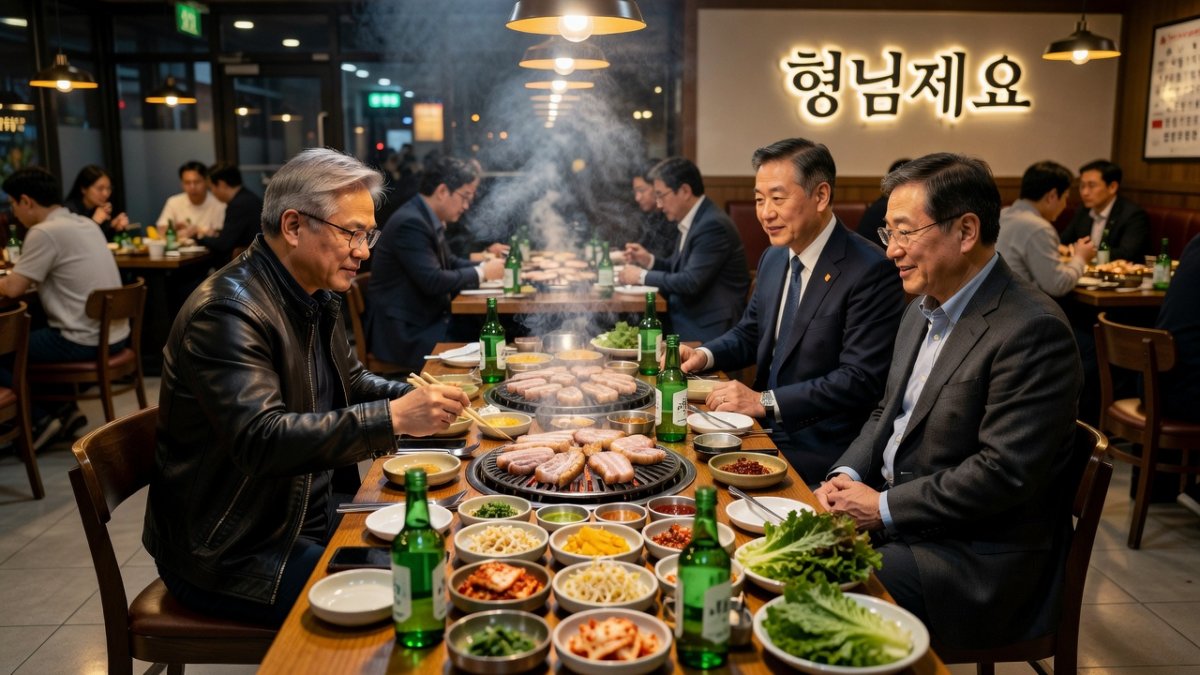
The samgyeopsal dinner format has become a hallmark of Huang's Korea engagement strategy. Rather than formal boardroom negotiations, these meals leverage Korea's distinctive corporate social culture — where business relationships are forged over shared food and soju — to facilitate the high-level commitments that underpin Nvidia's supply chain. For the Korean side, the ability to host the Nvidia CEO in such settings reinforces the chaebol's traditional role as the primary conduit for foreign technology partnerships.
Robotics as Korea's Next Strategic Sector
During public remarks, Huang explicitly identified robotics as South Korea's subsequent major industrial domain after semiconductors and automobiles. Nvidia intends to expand research and development activities in the country, with discussions centering on joint projects that integrate high-bandwidth memory, AI accelerators, and robotic control systems. This aligns with Seoul's national strategy under the current administration to diversify beyond memory chip dominance into system-level AI applications and intelligent manufacturing.
Korea's existing strengths in precision manufacturing, automotive electronics, and industrial automation provide a ready platform for Nvidia's Isaac and GR00T robotics platforms. The proposed establishment of a dedicated research hub in either Pangyo or Suwon would formalize technology transfer mechanisms and talent pipelines already under discussion between Nvidia and Korean engineering universities. Any such expansion would require coordination with the Ministry of Trade, Industry and Energy and the Korea Industrial Technology Evaluation Institute regarding R&D tax incentives and technology security protocols.
HBM Supply and Korea's Position in US-China Semiconductor Geopolitics
Nvidia's dependence on Korean high-bandwidth memory production has intensified under tightened US export controls targeting advanced semiconductors destined for China. Samsung Electronics and SK Hynix together account for the overwhelming majority of global HBM output, creating a structural bottleneck in the AI supply chain that neither US nor Chinese fabrication facilities can yet replicate at scale. Analysts at Hana Securities identified Samsung and SK Hynix as primary beneficiaries of the visit, given Nvidia's increasing allocation of HBM3E and next-generation HBM4 procurement contracts.
Huang's second visit within approximately seven months therefore functions as a diplomatic reassurance mechanism — confirming continued technology collaboration despite extraterritorial regulatory pressures emanating from Washington. Korean policymakers must balance alliance commitments to the United States with the commercial necessity of maintaining supply relationships that sustain domestic employment and export revenues. The Ministry of Foreign Affairs has designated semiconductor supply chain resilience as a core pillar of Korea's economic security strategy, with regular consultations between the Ministry of Trade, Industry and Energy and the U.S. Department of Commerce on semiconductor export licensing frameworks.
Soft Power and Technology Legitimacy
Beyond hardware procurement, the Hongdae stopover demonstrates Korea's capacity to project soft power through esports. By publicly associating Nvidia's brand with Faker and T1, Huang tacitly endorses the Korean model of state-supported gaming infrastructure that has produced multiple world champions. This cultural diplomacy complements formal industrial policy, generating positive brand equity for Korean technology among global youth demographics who later become engineers, system architects, and procurement managers in the AI industry.
The Ministry of Culture, Sports and Tourism has actively promoted esports as a component of Korea's cultural export strategy, alongside K-pop and K-drama. The inclusion of an esports venue in the itinerary of one of the world's most influential technology executives validates these efforts and positions Korean gaming culture as a legitimate component of the country's broader technology narrative.
Looking Ahead: Strategic Implications for Northeast Asian Technology Geopolitics
The five-day duration of the June 2026 itinerary permits follow-up technical discussions on HBM4 qualification timelines and potential co-development of robotics inference platforms. Observers anticipate announcements regarding expanded Nvidia research facilities in Korea, although specific operational dates remain subject to further regulatory alignment between Seoul and Washington on technology transfer protocols.
Korea's strategic location in Northeast Asian technology geopolitics remains defined by its dual role as indispensable memory supplier and emerging robotics innovator. The convergence of esports soft power, chaebol-led industrial organization, and state-supported semiconductor infrastructure creates a uniquely Korean model for attracting foreign technology investment. Whether this model can sustain its momentum amid intensifying US-China technology decoupling and potential supply chain fragmentation will depend on Seoul's ability to maintain the regulatory predictability that multinational technology firms require for long-term capital commitments.
For Nvidia, the Korea visit represents a calculated investment in supply chain relationships that cannot be easily replicated elsewhere. The combination of HBM manufacturing concentration, robotics engineering talent, and culturally embedded gaming expertise makes Korea an increasingly irreplaceable node in the company's global operations. Huang's repeated personal engagement signals that Nvidia's leadership recognizes this interdependence — and that the company is prepared to deepen its commitment to the Korean technology ecosystem.
By Prof. David Park, Staff Writer
This article was produced with AI-assisted research and editorial support. Reporting is based on sources cited in the article.
What's Your Reaction?
 Like
0
Like
0
 Dislike
0
Dislike
0
 Love
0
Love
0
 Funny
0
Funny
0
 Wow
0
Wow
0
 Sad
0
Sad
0
 Angry
0
Angry
0
East Asia/Technology Correspondent at Global1.News. Seoul-based voice covering Korean politics, technology, business, and culture. Analyzes how technology and geopolitics intersect across East Asia.












Comments (0)