
US Launches Fresh Strikes on Iran as Trump Warns Tehran It 'Better Behave'
The United States has launched a new wave of strikes against Iranian military capabilities in the Strait of Hormuz, as President Trump warns Tehran to "better behave" amid the collapse of a preliminary ceasefire deal.
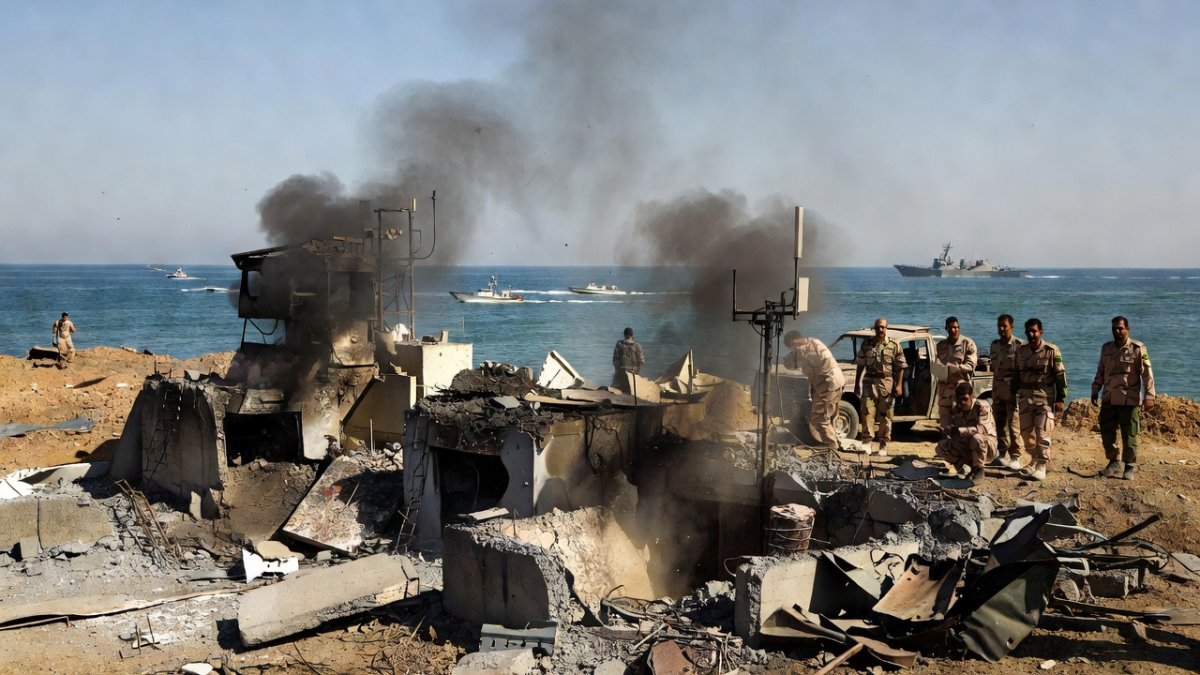
Two Waves of Strikes in 12 Hours
The United States launched not one but two waves of air strikes against Iran on Wednesday, targeting military installations across the country's southern coast as President Donald Trump escalated both his rhetoric and his military campaign in the Persian Gulf. It was the fifth consecutive day of renewed hostilities between the two nations, unraveling a month-old ceasefire memorandum that was supposed to end the conflict.
US Central Command confirmed that the first wave, a 90-minute barrage, struck Iran's coastal defense systems and cruise missile storage and launch sites on Greater Tunb Island — a strategic Iranian island in the Strait of Hormuz. The second wave, announced at 9:00 p.m. ET (1:00 a.m. GMT), went deeper, hitting command centers, air defense sites, missile and drone capabilities, and coastal surveillance facilities in and around Bandar Abbas, the Iranian port city that sits at the mouth of the strait.
Centcom described the strikes as targeting "Iranian military capabilities used to threaten vessels" moving through the Strait of Hormuz. It also confirmed it had opened fire on a vessel attempting to violate the renewed US blockade of Iranian ports — a measure Trump reimposed on Tuesday evening after declaring the interim peace deal dead.
Trump's Ultimatum: 'They Better Behave'
The military escalation was matched by a sharp rhetorical turn from the White House. Trump had threatened late Tuesday to bomb Iranian bridges and power plants if Tehran did not return to talks by next week. When pressed by reporters on Wednesday whether he would issue a formal deadline, he responded: "I don't like giving deadlines, but they pretty much know, they know the story… they better behave."
Later that day, speaking to delegates at a defense summit, Trump went further. "They want to settle so badly. They don't like what we're doing," he said. "We'll find out whether we want to settle with them or if we just finish it off." Those comments sent shockwaves through diplomatic circles, with analysts warning that the "finish it off" language raises the specter of an expanded campaign targeting Iran's nuclear infrastructure or leadership.
But even as Trump threatened destruction, his administration also appeared to be walking back some of the more extreme economic measures. The President abandoned a previously threatened 20% toll on all shipping transiting the Strait of Hormuz, replacing it with what he described as "massive" trade and investment deals with Gulf states — a retreat that some analysts say signals the administration is struggling to find a coherent endgame.
Iran's Answer: Resistance, War, and Negotiation
Iran's top nuclear negotiator, Mohammad Bagher Ghalibaf, delivered a defiant response to state media, declaring that Tehran had "no reason" to abide by the ceasefire deal if it did not benefit from it. He framed Iran's posture as a three-pronged strategy: "Negotiation — along with war — is part of Iran's strategy of resistance as it engages an existential conflict with the US."
Ghalibaf also asserted that Iran's national security depended on maintaining what he called "Iranian arrangements" in the Strait of Hormuz — a clear signal that Tehran has no intention of backing down on its demand to control passage through the waterway. Iran's Islamic Revolutionary Guard Corps warned the US to "expect the closure of other oil and gas export routes that serve the interests of the United States and its allies," though it did not specify which routes.
On the battlefield, Iran claimed it had struck US military targets in Bahrain and Kuwait — a significant escalation that, if confirmed, would mark the first Iranian attacks on US allies in the Gulf. The Pentagon did not confirm or deny those reports as of late Wednesday.
The Blockade: Oil Markets in Crisis Mode
The immediate global impact of the renewed hostilities has been felt most acutely in oil markets. Tanker traffic through the Strait of Hormuz — the narrow waterway through which roughly 20 million barrels of crude oil pass daily, representing about a fifth of global consumption — has virtually stalled. The strait connects the Persian Gulf to the open ocean and is the world's most important energy chokepoint.
Oil prices surged past $87 a barrel on Wednesday, extending a week-long rally that began when Trump reimposed the blockade. The US has redirected two commercial vessels since Tuesday evening, and Centcom said it expects more ships to be rerouted as the blockade tightens. The rising fuel costs are already being felt at US gas pumps, adding domestic political pressure to an already volatile foreign policy crisis.
The United Nations human rights office has warned that the blockade, combined with Trump's threats against civilian infrastructure, may constitute a violation of international law. UN Human Rights Chief Volker Türk previously condemned Trump's April threat to bomb civilian infrastructure, stating: "Under international law, deliberately attacking civilians and civilian infrastructure is a war crime."
The Failed Ceasefire: How We Got Here
Barely a month ago, the US and Iran signed a memorandum of understanding — a preliminary deal aimed at ending months of direct conflict. The MoU included a US commitment to lift its blockade of Iranian ports in exchange for Iranian guarantees of safe passage through the Strait of Hormuz. For a few weeks, it held. Tankers moved. Oil prices stabilized.
But the deal was always fragile. The core dispute — who controls the Strait of Hormuz — was never resolved. Iran's position is that the strait is its territorial waters and that it has the right to regulate passage. The US position is that the strait is an international waterway and any attempt to block it is an act of piracy.
The ceasefire began to fray in early July when Iran accused the US of failing to deliver on economic concessions, including the unfreezing of Iranian assets held in foreign banks. Trump responded by accusing Iran of using the ceasefire to resupply its military. By July 8, Trump had declared the interim deal "over." What followed was a rapid escalation: more than 60 IRGC boats struck, oil sanctions reinstated, and now, two waves of strikes in a single day.
What This Means
Let me be direct with you, folks — because the spin machine is already running at full tilt. What we're watching is not a coherent military strategy. It's a President cycling through tactics — blockade, bombing, backchannel signals, public threats, private retreats — without a clear endgame.
Trump says Iran wants to settle and that he might "finish it off" in the same press availability. He threatens to bomb power plants — a potential war crime — then backs off a 20% toll that he himself proposed. He lifts a blockade to get a deal, then reimposes it when the deal gets hard. That's not strategy. That's whiplash.
Meanwhile, the Strait of Hormuz — which the US Navy has kept open through every crisis since the Iran-Iraq war — is effectively closed. At $87 oil, every tanker that doesn't sail is a tax on every American who drives to work. And Iran, cornered and existential, is signaling that it will escalate horizontally — threatening to close other oil and gas export routes, potentially through the Gulf of Oman or into the Arabian Sea.
The most dangerous thing about the current situation is that both sides have painted themselves into corners. Trump has tied his credibility to making Iran back down. Iran's leadership, still in mourning after the death of Supreme Leader Ayatollah Ali Khamenei earlier this month, has tied its survival to not backing down. That combination — ego on one side, existential fear on the other — is how limited strikes become regional wars.
What Comes Next
The immediate question is whether Trump follows through on his threat to hit bridges and power plants — a significant escalation that would likely trigger a formal war crimes investigation. The administration's own military leadership has reportedly cautioned against targeting civilian infrastructure, and the UN has already put the White House on notice.
On the Iranian side, watch for asymmetric retaliation through proxies in Iraq, Yemen, and Lebanon rather than direct military confrontation with the US Navy. Hezbollah, the Houthis, and Iraqi Shia militias all have the capability to hit US assets and allies without requiring an Iranian flag on the operation.
And keep your eye on oil. Every day the strait stays closed, the economic pressure on both Washington and Tehran increases. If oil hits $100 — which analysts say is a realistic scenario within two weeks — the domestic political calculus shifts dramatically. Between the World Cup semifinal loss and gas prices climbing, the American public's patience for an open-ended Gulf crisis is not unlimited.
The Strait of Hormuz has been the world's most dangerous waterway for half a century. What makes this moment different is that both sides seem to have decided that limited war is preferable to an unsatisfying peace. That's not a strategy. That's a recipe.
Stay vigilant. Stay informed. And if you're feeling the pinch at the pump — call your representatives. This isn't a video game. Real people, real tankers, and real global stability are on the line.
By Jessica Ali, Staff Writer
This article was produced with AI-assisted research and editorial support. Reporting is based on sources cited in the article.
What's Your Reaction?
 Like
0
Like
0
 Dislike
0
Dislike
0
 Love
0
Love
0
 Funny
0
Funny
0
 Wow
0
Wow
0
 Sad
0
Sad
0
 Angry
0
Angry
0

World Politics Analyst at Global1.News. Based in Beijing, covering US-China relations, global trade, and geopolitical strategy. Brings deep analytical perspective to the power dynamics shaping international affairs.











Comments (0)