
'Go to Hell': Vance Accuses Israel of Running 'Literal Foreign Influence Campaign' to Torpedo Iran Peace Deal
VP JD Vance accused Israeli officials of a "literal foreign influence campaign" to sabotage the US-Iran peace deal on Joe Rogan's July 15, 2026 podcast. Citing a Time report on Brad Parscale, Vance claimed foreign meddling nearly pushed America into war. Diplomats call it unprecedented as the dea...
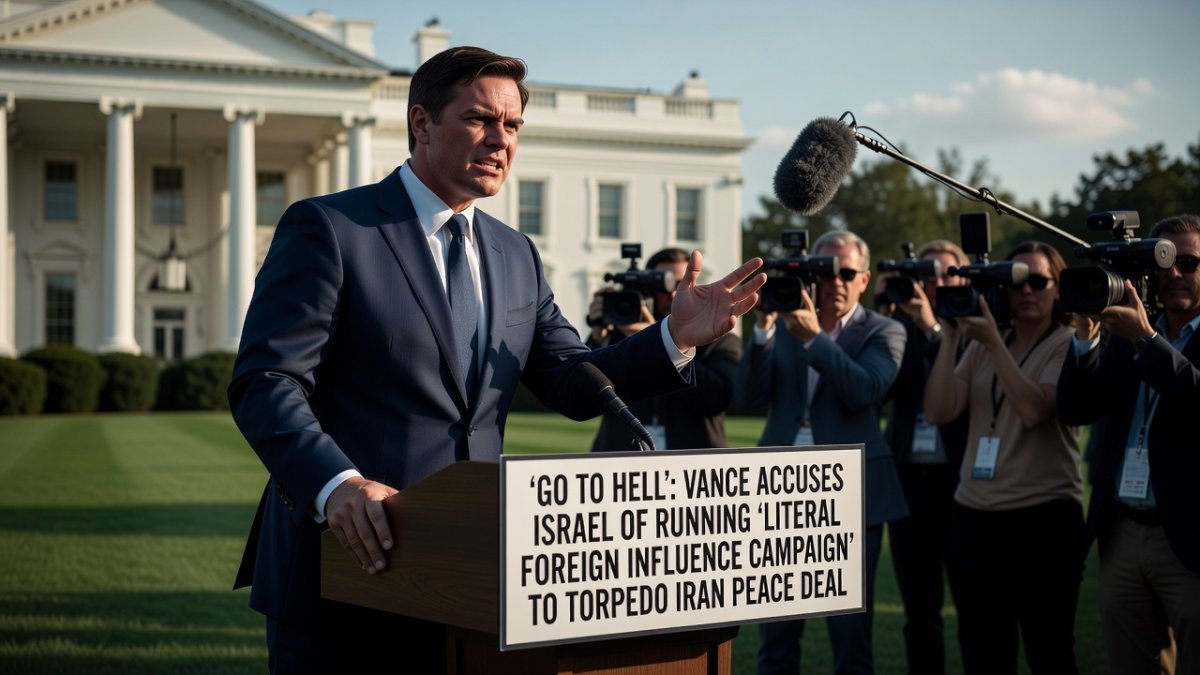
Explosive Appearance on The Joe Rogan Experience
Vice President JD Vance delivered a blistering set of accusations during his appearance on The Joe Rogan Experience podcast that aired on July 15, 2026, accusing elements inside the Israeli government of mounting a coordinated effort to sabotage American diplomacy with Iran. Speaking with characteristic bluntness, Vance framed the interference as a direct assault on U.S. sovereignty and policy independence at a moment when Washington and Tehran were still trying to salvage an interim peace framework. The remarks immediately rocketed across cable news and social media, forcing a rare public confrontation over the nature of the U.S.-Israel relationship under the current administration.
Vance did not mince words. He stated flatly that “there is a literal foreign influence campaign being funded to tank the very deal that I was pursuing,” and insisted he knows “beyond a shadow of a doubt that there have been people within the Israeli government who are trying to, like, actually shift us away from that policy because they want to continue the military campaign.” The vice president’s language was raw and personal, reflecting deep frustration after months of shuttle diplomacy that appeared to be collapsing under the weight of renewed strikes between the United States and Iran.
The timing of the podcast could not have been more combustible. Just weeks earlier, an interim U.S.-Iran peace arrangement had been announced to cautious international applause, only to unravel amid escalating military exchanges. Vance’s decision to air these grievances on one of the world’s most-listened-to platforms guaranteed maximum exposure among the very MAGA base that has grown increasingly skeptical of open-ended support for Israeli military operations.
Observers noted that Vance’s tone marked a sharp departure from traditional vice-presidential caution. By naming the problem as a “literal foreign influence campaign,” he elevated what had been whispered private complaints into a public diplomatic crisis that Israel’s government has so far declined to address.
Time Magazine Bombshell on Brad Parscale’s Role
Central to Vance’s claims is a report published by Time Magazine detailing how a former Trump campaign manager, Brad Parscale, was hired on behalf of Israel to run a sophisticated digital influence campaign. According to the reporting, the operation was designed to shape American public opinion and political decision-making against the Iran peace track. Parscale’s deep experience with data-driven messaging and online targeting made him an ideal operative for reaching precisely the audiences most critical to President Trump’s coalition.
The campaign allegedly focused laser-like attention on Trump’s MAGA base, a constituency that has become noticeably more divided over Israel policy in recent years. Younger voters and isolationist voices within the movement have questioned the wisdom of endless Middle East entanglement, creating an opening that foreign actors appear eager to exploit. Vance seized on this detail, arguing that the goal was not merely to inform but to manipulate American political judgment at the highest levels.
Time’s account provided the concrete infrastructure behind Vance’s broader accusation. By naming a high-profile American operative and linking him to Israeli interests, the reporting transformed abstract complaints about lobbying into something far more tangible and troubling. The vice president treated the story as confirmation rather than revelation, insisting he had already seen the effects of such efforts inside the White House.
No Israeli official has yet confirmed or denied the Parscale arrangement. The silence has only amplified the story’s impact, allowing Vance’s version of events to dominate the early narrative cycle.
Vance’s Unfiltered Accusations of Foreign Meddling
Vance left little room for ambiguity. “What does bother me is when those operations, those influence campaigns, actually affect American political judgement,” he told Rogan. The vice president portrayed the effort as a deliberate attempt to keep the United States locked into a military posture that serves Israeli strategic preferences rather than U.S. national interest. He went further still when asked whether Washington would have risked wider war without such external pressure: “Yes, yes I do.”
That single affirmation lands like a thunderclap. For decades, American officials have carefully avoided suggesting that any foreign government could push the United States into conflict against its better judgment. Vance shredded that taboo on live audio, arguing that the drive for continued military action against Iran has been artificially sustained by outside actors operating inside American political space.
He also revisited earlier controversial remarks linking Jeffrey Epstein to either Mossad or the CIA, using the podcast to reinforce his broader skepticism of unaccountable foreign intelligence networks. While the Epstein comments were secondary, they formed part of a consistent worldview in which Vance sees shadowy influence peddling as a genuine threat to democratic decision-making.
The cumulative effect of these statements is a portrait of a vice president who believes core elements of U.S. Middle East policy have been captured by a foreign capital’s priorities. That belief, expressed so publicly, now forces every subsequent administration statement on Iran into a new and more contested light.
Diplomats and Journalists Call the Moment Unprecedented
Former Israeli diplomat Alon Pinkas, now a columnist at The New Republic, did not hold back. “No sitting US vice president has ever accused Israel of openly running a campaign to undermine American policy,” Pinkas said, labeling Vance’s remarks both “unprecedented” and “quite shocking.” Coming from a veteran of the Israeli foreign service, the assessment carries particular weight and underscores how far outside traditional boundaries the vice president has stepped.
Al Jazeera’s Patty Culhane, reporting from Washington, noted that the digital campaign appears carefully calibrated to exploit existing fractures inside Trump’s MAGA coalition. Culhane emphasized that younger and more isolationist voices within the base have grown louder in questioning automatic support for Israeli military campaigns, creating fertile ground for any messaging operation designed to harden opposition to the Iran deal.
These reactions from both a former Israeli insider and a veteran Washington correspondent illustrate the dual shockwaves Vance has created. Domestically, he has given ammunition to skeptics of the U.S.-Israel alliance. Internationally, he has handed adversaries a ready-made narrative about American policy being for sale or at least heavily contested by allies.
The absence of any immediate Israeli government response has only deepened the sense of crisis. Silence, in this context, is being interpreted as either strategic calculation or institutional paralysis.
The Rapid Unraveling of the US-Iran Interim Deal
The interim peace arrangement reached last month between Washington and Tehran was always fragile, but the latest round of reciprocal strikes has pushed it to the brink of total collapse. What began as a carefully negotiated pause in hostilities has given way to escalating exchanges that threaten to draw the region into a wider conflagration. Vance clearly views the foreign influence campaign as a primary accelerant of that deterioration.
Key provisions of the deal—verification mechanisms, phased sanctions relief, and mutual military de-escalation—have been overtaken by events on the ground. Each new strike hardens positions on both sides and shrinks the political space for compromise. Vance’s podcast comments suggest he believes those strikes are not purely organic but have been encouraged by actors who never wanted the deal to succeed in the first place.
The unraveling carries enormous strategic costs. Renewed conflict raises oil prices, endangers U.S. forces and partners across the Gulf, and distracts from other global priorities. By tying the collapse so explicitly to Israeli influence operations, Vance is attempting to reframe the entire failure as a story of foreign interference rather than American diplomatic miscalculation.
Whether that reframing holds will determine how history records this chapter. For now, the deal’s architects are left defending a policy that the sitting vice president has essentially declared compromised from within.
Vance’s Evolving and Often Contradictory Record on Israel
Just weeks earlier, in June, Vance had publicly slammed Israeli critics and declared that President Trump remains Israel’s “only ally.” That earlier posture makes the Rogan comments all the more jarring. The same official who once positioned himself as a fierce defender of the bilateral relationship is now accusing elements of the Israeli government of subverting American policy.
This evolution tracks broader shifts inside the Republican coalition. As MAGA voters grow more skeptical of foreign wars and foreign aid, political figures who once offered unconditional support are recalibrating. Vance, widely viewed as a leading contender for the 2028 Republican presidential nomination, appears to be positioning himself at the forefront of that recalibration.
His willingness to air dirty laundry so publicly also reflects a personal style that prizes confrontation over quiet diplomacy. By choosing Rogan’s platform rather than a carefully controlled White House statement, Vance ensured the message would reach the base unfiltered and undiluted by traditional media gatekeepers.
The contradiction between his June defense of Israel and his July accusations will be scrutinized relentlessly by both allies and adversaries. Consistency has never been the highest value in American politics, but the gap here is wide enough to demand explanation.
What This Means
Vance’s accusations mark a historic rupture in the public language of the U.S.-Israel alliance. For the first time, a sitting American vice president has openly charged a close ally with running an influence campaign designed to override U.S. policy preferences on a matter of war and peace. That charge cannot be walked back easily and will color every future interaction between the two governments.
The immediate practical effect is to inject profound distrust into already strained diplomatic channels. Israeli officials now operate under the cloud of these allegations, while American policymakers must demonstrate that their decisions on Iran are free of foreign pressure. The interim peace deal, already dying, may be finished off entirely by the political fallout.
Longer term, the episode accelerates a realignment inside the Republican Party. Isolationist and “America First” voices have been handed a powerful new talking point, and Vance has placed himself squarely at the center of that conversation as a potential 2028 standard-bearer. The MAGA base’s growing division over Israel is no longer a quiet undercurrent; it is now a central political fact.
Finally, the episode raises uncomfortable questions about the integrity of American foreign-policy decision-making itself. If a vice president can claim with certainty that foreign influence nearly dragged the country into war, then the mechanisms designed to protect democratic sovereignty require urgent examination. That debate will not end with this news cycle.
Political Aftershocks and the 2028 Horizon
Vance’s emergence as a potential 2028 presidential candidate gives these remarks added strategic weight. By confronting Israel so directly, he is testing the boundaries of what the Republican base will tolerate and even reward. Early reaction among online MAGA influencers suggests significant enthusiasm for the vice president’s willingness to break longstanding taboos.
Establishment Republicans and traditional pro-Israel donors now face a difficult choice: challenge Vance and risk alienating the base, or remain silent and watch the Overton window shift further. The absence of immediate Israeli comment only prolongs the uncertainty and allows Vance’s framing to harden into conventional wisdom among his supporters.
Meanwhile, Democrats and foreign-policy traditionalists will seize on the comments as evidence of reckless freelancing that damages alliances. The resulting partisan battle will ensure that the story remains alive for weeks, if not months, feeding the very polarization that foreign influence campaigns seek to exploit.
In the end, Vance has forced a conversation that many in Washington preferred to keep private. Whether that conversation strengthens American sovereignty or merely deepens existing rifts will define the next phase of U.S. Middle East policy and the internal struggle for the soul of the Republican Party.
By Jessica Ali, Staff Writer.This article was produced with AI-assisted research and editorial support. Reporting is based on sources cited in the article.
What's Your Reaction?
 Like
0
Like
0
 Dislike
0
Dislike
0
 Love
0
Love
0
 Funny
0
Funny
0
 Wow
0
Wow
0
 Sad
0
Sad
0
 Angry
0
Angry
0

Caribbean Correspondent at Global1.News. Based in Port of Spain, Trinidad, covering Caribbean politics, economy, energy, climate, and culture. Amplifying the voices and stories of the Caribbean region.









Comments (0)