
NCERT's Revised Class 8 Book Puts Supreme Court On Top, Drops Freedom Fighters' Portraits
NCERT's New Class 8 Cover Elevates Supreme Court Above Parliament The National Council of Educational Research and Training has released its revised Class 8 Social Science textbook for the 2026-27 academic session. The cover now positions the Supreme Court building as the dominant visual element at the top, while the Parliament building occupies the bottom position. Portraits o
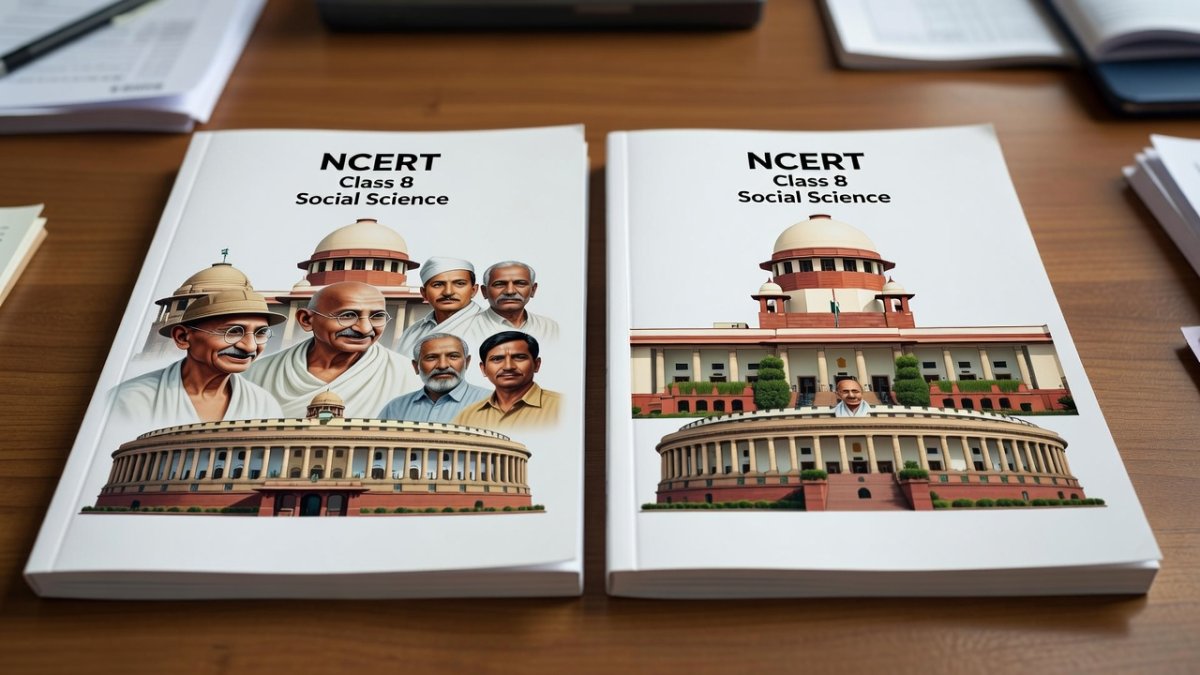
NCERT's New Class 8 Cover Elevates Supreme Court Above Parliament
The National Council of Educational Research and Training has released its revised Class 8 Social Science textbook for the 2026-27 academic session. The cover now positions the Supreme Court building as the dominant visual element at the top, while the Parliament building occupies the bottom position. Portraits of freedom fighters including Mahatma Gandhi, Jawaharlal Nehru and Bhagat Singh have been removed, along with imagery of the Taj Mahal and Red Fort that featured in the previous balanced design.
This redesign affects 2.5 crore students enrolled in CBSE-affiliated schools across states from Delhi to Tamil Nadu and Maharashtra.
Timeline: From February Seizure Order to July Redesign
In February 2026 the Supreme Court of India, led by the Chief Justice, ordered immediate seizure of the prior edition after identifying a chapter on corruption in the judiciary. The bench cited a discernible underlying agenda in the textbook's treatment of judicial institutions. NCERT issued a formal apology to the Supreme Court on February 26, 2026, withdrew the book and rewrote the judiciary chapter. The new content emphasises Public Interest Litigation, tribunals and alternative dispute resolution mechanisms. The July 2026 edition, aligned with the National Education Policy 2020 framework, reflects these institutional adjustments through its cover hierarchy.
Impact on Students and Institutional Relationships
Textbook covers shape initial student perceptions of authority and national priorities. By placing the Supreme Court above Parliament, the new design presents the judiciary as the preeminent institution for 13-14-year-old learners in CBSE classrooms nationwide. Education analysts note that this visual ordering may influence how students in cities such as Bengaluru, Hyderabad and Kolkata first conceptualise the separation of powers. The removal of freedom fighter portraits further narrows the introductory visual narrative away from the independence movement toward contemporary state institutions.
Taxpayers funding NCERT through the Ministry of Education now see curriculum materials adjusted following direct judicial intervention, raising questions about editorial autonomy in the world's largest school system.
Historical Pattern of Textbook Controversies
India has witnessed repeated textbook revisions tied to political and institutional pressures. Earlier episodes involved changes to chapters on medieval history in Rajasthan and Uttar Pradesh boards, as well as debates over content related to the freedom struggle in NCERT publications during the 2000s. The 2026 episode marks the first instance of the Supreme Court directly ordering seizure of an NCERT title over its portrayal of the judiciary itself, extending the pattern from state-level disputes to the highest constitutional court.
Expert Perspectives on Cover Design Significance
Education researchers emphasise that cover imagery functions as more than decoration. It establishes the hierarchy of institutions before students open the first page. With the Taj Mahal and freedom fighter portraits removed, the visual field now foregrounds judicial architecture over symbols of cultural heritage or anti-colonial resistance. Specialists at institutions such as the Tata Institute of Social Sciences have observed that such design choices can subtly reinforce particular narratives about governance for millions of adolescents entering Class 8 each year.
Bottom Line: Curriculum Development Under Institutional Scrutiny
The July 2026 redesign signals that NCERT curriculum decisions now incorporate explicit deference to judicial findings following the February controversy. For Indian students and parents, this means Social Science materials entering CBSE schools carry visible markers of institutional hierarchy shaped by recent Supreme Court directives. The episode underscores how textbook production in contemporary India responds to judicial oversight alongside the National Education Policy 2020 framework, affecting content and presentation for the next generation of learners across the country.
— By Dr. Raj Patel, Staff WriterThis article was produced with AI-assisted research and editorial support. Reporting is based on sources cited in the article.
What's Your Reaction?
 Like
0
Like
0
 Dislike
0
Dislike
0
 Love
0
Love
0
 Funny
0
Funny
0
 Wow
0
Wow
0
 Sad
0
Sad
0
 Angry
0
Angry
0

India/South Asia Correspondent at Global1.News. Analytical voice with a background in science and health journalism. Based in New Delhi, covering Indian politics, education, healthcare, technology, and policy. Breaks down complex data into clear, actionable reporting.











Comments (0)