
Mystery GPS jammer in Iran becomes test for NASA satellites’ capabilities
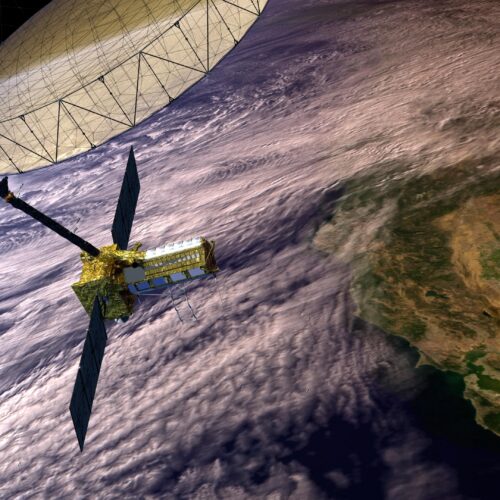
Iran’s Mystery GPS Jammer Exposed by NASA’s Cyclone Satellites – A Wake-Up Call on Dual-Use Tech
The Signal That Shouldn’t Exist
NASA’s Cyclone Global Navigation Satellite System (CYGNSS) was built to track hurricane winds by measuring how GPS signals bounce off ocean waves. Its eight microsatellites also feed data into ice-sheet studies through signal reflection patterns. Last year, researchers noticed something odd in the data streams over central Iran: persistent, localized dropouts in GPS reflections that didn’t match weather, terrain, or orbital geometry. The anomalies pointed to a single ground source emitting powerful jamming signals across L1 and L2 frequencies. The location? Roughly 40 kilometers southeast of Qom, near known military installations.
This wasn’t random interference. CYGNSS instruments logged the jammer’s effective range at over 150 kilometers on multiple passes, with signal power estimates exceeding 200 watts. That’s enough to blind commercial aviation receivers and disrupt precision-guided munitions in a real conflict. NASA scientists didn’t set out to hunt jammers, but the constellation’s dense revisit rate turned it into an accidental forensic tool.
How Environmental Satellites Became Surveillance Assets
CYGNSS works by capturing direct GPS signals alongside their reflections. A jammer floods the spectrum with noise, creating a dead zone in both direct and reflected data. By mapping these voids across dozens of passes and cross-referencing with SMAP soil-moisture data and ICESat-2 laser altimetry, the team isolated the emitter to within a 3-kilometer radius. The method requires no new hardware — just smarter processing of existing public datasets.
The approach scales. With 12-15 daily overpasses possible in mid-latitudes, operators can now generate near-real-time jammer heat maps. Pentagon officials have quietly requested access to the raw CYGNSS Level 1 data streams. One senior Air Force space officer, speaking on background, called it “the cheapest SIGINT upgrade we never budgeted for.”
Iran’s Long Record of GPS Denial
Iran has jammed GPS before. During 2019 Strait of Hormuz tensions, commercial ships reported repeated outages. In 2023, Israel accused Tehran of spoofing GPS to mislead drones near Dimona. The new site near Qom appears more sophisticated — it maintains coherent jamming across multiple frequency bands while avoiding easy geolocation by ground-based monitors. Iranian state media has denied any such facility, claiming the reports are “Zionist fabrications.”
Yet satellite imagery from Planet Labs shows fresh construction and power infrastructure consistent with a high-power transmitter. The timing aligns with Iran’s push to harden underground nuclear sites against precision strikes. A jammer that can degrade GPS-guided munitions buys time for mobile launchers to relocate.
Strategic Ripple Effects Beyond the Middle East
If NASA satellites can locate jammers from orbit, every nation with similar constellations gains a new monitoring edge. China’s Fengyun weather satellites and Europe’s Sentinel fleet use comparable GPS reflection techniques. Russia’s Meteor-M series could be repurposed the same way. The result is an emerging open-source layer of electronic warfare intelligence previously limited to classified military assets.
Commercial implications are immediate. Shipping companies routing through the Persian Gulf now have a new variable: avoid the 150-kilometer exclusion zone around the Qom emitter during heightened tensions. Airlines already reroute around known jamming zones in Syria and Libya; this adds another fixed hazard to global flight planning databases.
Expert Perspectives on the Dual-Use Shift
Dr. Clara Mendoza, CYGNSS science team lead at the University of Michigan, put it bluntly: “We built these birds to study hurricanes. The fact they’re now flagging military jammers shows how porous the line between civil and defense remote sensing has become.” She noted that no classified tasking was involved — the detection came from open scientific archives.
Retired Marine Corps Colonel Thomas Raines, now at the Center for Strategic and International Studies, sees bigger stakes. “GPS is the backbone of Western precision warfare. If adversaries can hide jammers from traditional intelligence but not from weather satellites, we’ve just lost a layer of sanctuary. The U.S. needs a policy on whether these datasets stay fully public.”
Tehran-based analyst Reza Khatami, contacted via secure channel, offered the Iranian counter-view: “Any powerful radio transmitter can look like a jammer to sensitive instruments. This is scientific overreach being weaponized for propaganda.” He declined to address the specific Qom coordinates.
Technical Limits and Future Hardening
The detection method still has gaps. Low-power or pulsed jammers may evade notice. Heavy cloud cover or ionospheric disturbances can mask signals. And the current resolution — a few kilometers — is enough to cue other assets but not to target the emitter itself. NASA is exploring machine-learning filters to sharpen the technique without new satellites.
Meanwhile, jammer operators are adapting. Iran’s next-generation systems reportedly include frequency-hopping and directional antennas to reduce the GPS reflection footprint. That cat-and-mouse game will drive demand for more sensitive bistatic radar constellations.
The Bottom Line on Transparency
NASA’s data remains publicly available through the Physical Oceanography Distributed Active Archive Center. That openness enabled the discovery. It also means any actor — state or non-state — can run the same analysis on Iran or any other hotspot. The era of plausible deniability for large GPS jammers is ending, whether the Pentagon likes it or not.
This isn’t about weather satellites turning into spies. It’s about the physics of signal reflection refusing to respect bureaucratic boundaries between science and security. The Qom emitter is the first public proof of concept. It won’t be the last.
By Jessica, Staff Writer
This article was produced with AI-assisted research and editorial support. Reporting is based on sources cited in the article.
What's Your Reaction?
 Like
1
Like
1
 Dislike
0
Dislike
0
 Love
0
Love
0
 Funny
0
Funny
0
 Wow
0
Wow
0
 Sad
0
Sad
0
 Angry
0
Angry
0

Editor-in-Chief at Global1.News. Atlanta-based journalist who cuts through the BS and tells it like it is. Lead anchor, host, and the voice you hear when the spin stops and the truth starts.















Comments (0)