
Moscow Court Jails Walt Disney Manager 2.5 Years on Drug Charges
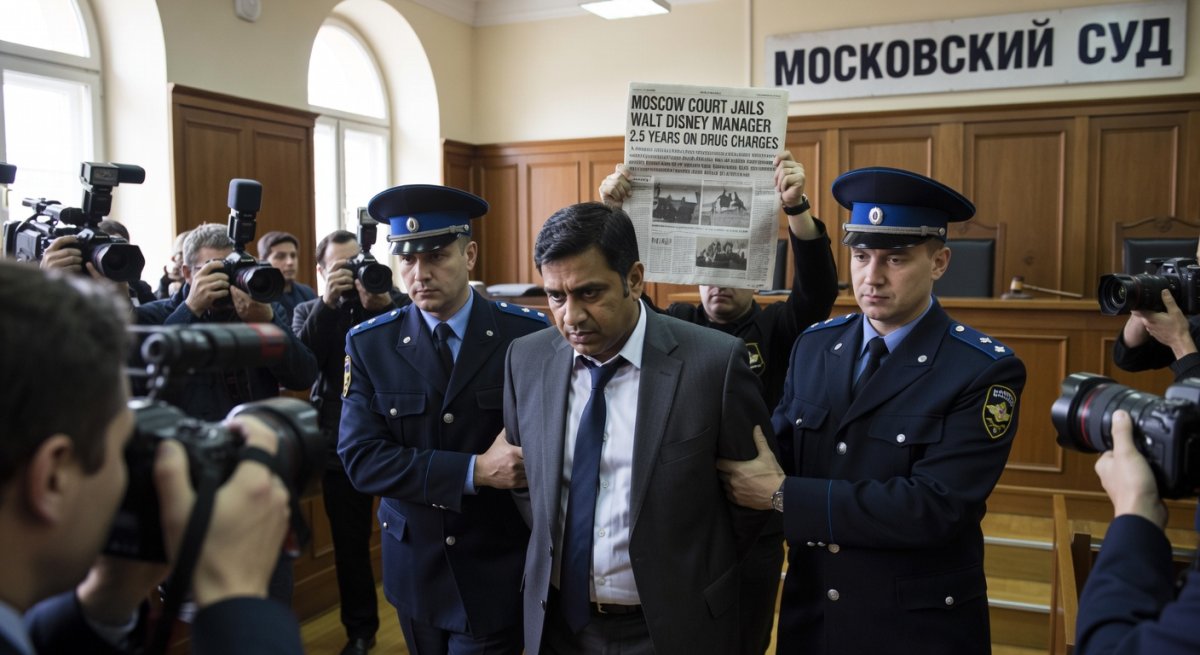
A Moscow court has sentenced Jugal Daterao, a manager at Walt Disney, to two and a half years in prison on drug charges, a ruling that highlights the uncompromising application of Russian narcotics laws to foreign business travelers. The decision, handed down after customs officers discovered THC-infused gummy candies during a routine baggage check in January, serves as a stark reminder that even trace amounts of cannabis derivatives can trigger lengthy custodial sentences in Russia. This case arrives at a time when international companies continue to navigate complex regulatory environments in the country, and it raises immediate questions about the risks faced by expatriate employees whose work requires frequent cross-border movement.
The sentence reflects Russia’s zero-tolerance approach to controlled substances, regardless of the quantity involved or the nationality of the individual. For multinational corporations operating offices or partnerships in Moscow and other major cities, the ruling underscores the need for heightened compliance protocols around personal items that might be legal elsewhere but remain strictly prohibited under Russian statutes.
The January Detention at Customs
Customs officers detained Jugal Daterao during a standard baggage inspection upon his arrival in Russia. The search uncovered THC-infused gummy candies, a product containing a psychoactive compound derived from cannabis. Russian authorities treat such items as narcotics, and the discovery led directly to formal charges. The incident occurred amid routine enforcement activity rather than any targeted investigation, illustrating how ordinary travel procedures can escalate quickly when prohibited substances are present. This type of detention is not uncommon at Russian entry points, where officers routinely screen luggage for items that violate federal drug regulations. The gummies in question, while sometimes marketed as low-dose edibles in other jurisdictions, carry no legal protection in Russia. The case proceeded through standard investigative channels, culminating in the recent court verdict that imposed the two-and-a-half-year term.Legal Framework and Sentencing Considerations
Russian courts apply drug statutes with considerable severity, even when the quantities involved are small. Possession of THC products falls under provisions that criminalize the handling of narcotic or psychotropic substances. Judges consider factors such as the type of substance, the circumstances of possession, and any prior record, yet the baseline penalties remain substantial. In Daterao’s matter, the court determined that the evidence supported a conviction and imposed a custodial sentence rather than a suspended term or fine. The two-and-a-half-year term aligns with sentencing patterns observed in comparable cases involving imported edibles. Defense arguments typically focus on lack of intent or cultural differences in product availability, but these rarely override the statutory requirements. The outcome therefore reinforces the principle that foreign nationals receive the same treatment as Russian citizens under these laws.Implications for Foreign Business Personnel
The conviction carries broader significance for international executives and managers whose roles involve travel to Russia. Companies such as Walt Disney maintain regional operations that depend on personnel moving between offices, production sites, and partner facilities. When an employee faces prosecution over personal items carried in luggage, the disruption extends beyond the individual to affect project timelines, staffing continuity, and corporate risk assessments. Multinational firms have responded to such developments by issuing internal advisories that prohibit the transport of any cannabis-related products, including those legally purchased abroad. Training sessions now emphasize that Russian customs declarations and inspections leave little room for ambiguity. The Daterao case is likely to accelerate these internal compliance efforts, prompting legal departments to review travel policies more frequently.Russia’s Evolving Enforcement Climate
Russia has maintained rigorous drug-control measures for decades, with periodic adjustments to lists of prohibited substances but little softening of penalties. Enforcement agencies prioritize detection at borders and in urban centers, viewing even small-scale possession as a gateway to wider trafficking concerns. International observers note that this stance contrasts with regulatory shifts in parts of Europe and North America, creating friction for travelers accustomed to more permissive environments. The presence of THC in edible form adds another layer, as such products can be compact and easily overlooked by travelers until they encounter inspection. Russian authorities have repeatedly stated that ignorance of the law does not constitute a defense, a position upheld in multiple judicial decisions. Consequently, the current case fits within a consistent pattern rather than representing an outlier.What Happens Next
Daterao retains the right to appeal the verdict through Russia’s higher courts, a process that could extend over several months and potentially result in sentence modification. In the interim, the convicted manager will begin serving the term imposed by the Moscow court. Corporate representatives have not publicly detailed any operational adjustments, yet the episode is expected to influence future travel authorizations for staff assigned to Russian projects. Longer term, the ruling may prompt additional guidance from foreign chambers of commerce and legal advisory firms that assist companies with cross-border compliance. As enforcement practices remain unchanged, executives planning Russian itineraries will need to exercise heightened vigilance over all items in their possession.By Irina Volkov, Staff Writer
This article was produced with AI-assisted research and editorial support. Reporting is based on sources cited in the article.
What's Your Reaction?
 Like
0
Like
0
 Dislike
0
Dislike
0
 Love
0
Love
0
 Funny
0
Funny
0
 Wow
0
Wow
0
 Sad
0
Sad
0
 Angry
0
Angry
0
Irina Volkov
Russia/Eastern Europe Correspondent at Global1.News. Covering Russian politics, energy, security, and the shifting dynamics of the post-Soviet space. Provides clear-eyed analysis on one of the world's most opaque regions.













Comments (0)