
Iran Strikes Kuwait Airport, Kills Indian National, as US-Iran Ceasefire Teeters on the Brink
Iran Strikes Kuwait Airport, Kills Indian National, as US-Iran Ceasefire Teeters on the Brink Folks, if you thought the US-Iran situation couldn't get any more explosive — buckle up. Because today, Iran launched drone and missile strikes on Kuwait International Airport, killing at least one person and wounding more than 60 others. And this isn't some isolated skirmish. This is
Iran Strikes Kuwait Airport, Kills Indian National, as US-Iran Ceasefire Teeters on the Brink
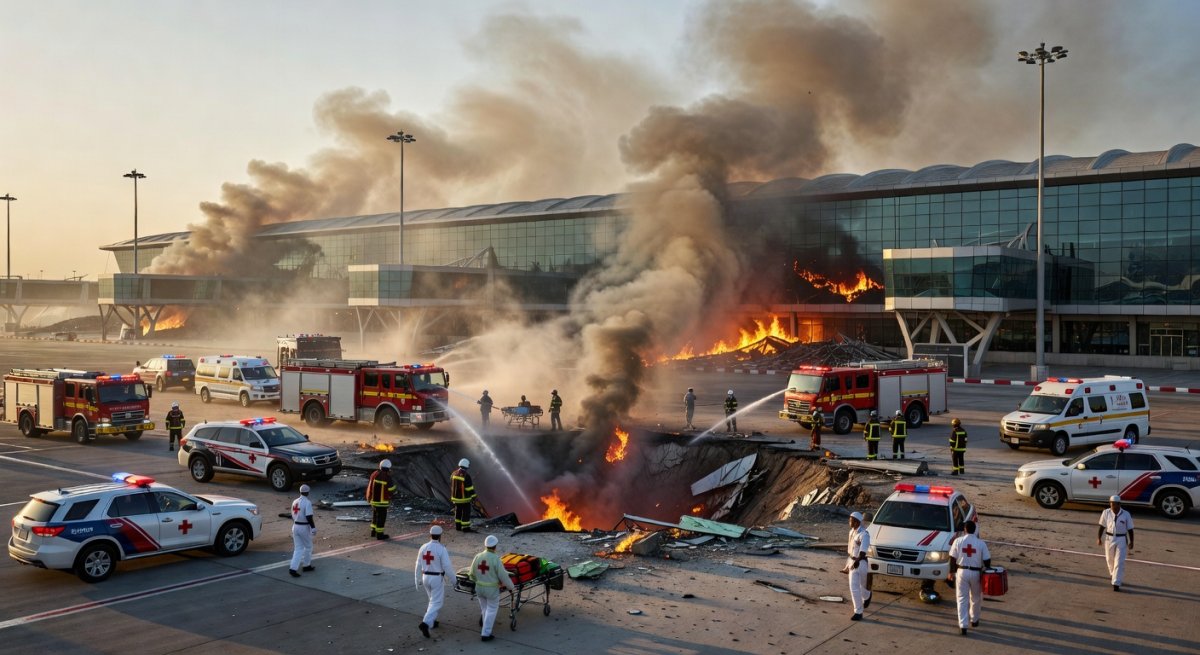
Folks, if you thought the US-Iran situation couldn't get any more explosive — buckle up. Because today, Iran launched drone and missile strikes on Kuwait International Airport, killing at least one person and wounding more than 60 others. And this isn't some isolated skirmish. This is a direct retaliation for US strikes on Iran's Qeshm Island — and it has the entire Gulf region holding its breath.
Let me break down exactly what happened, what's at stake, and why this shaky ceasefire everyone's been talking about might just be paper-thin.
The Attack: What We Know
Early Wednesday morning local time, Iranian drones and ballistic missiles hit Kuwait International Airport. According to Kuwait's state news agency KUNA, the attack caused severe damage to airport facilities and forced a complete freeze on airport operations. Kuwait Airways flights have since resumed — but the damage, both physical and diplomatic, is far from repaired.
Kuwait's defence ministry spokesman Saud Abdulaziz al-Atwan confirmed that 30 ballistic missiles and drones were launched by Iran. "These missiles were intercepted over several residential areas, resulting in some debris falling," he said. "This heinous Iranian aggression targeted civilian and vital facilities."
One person was killed — an Indian national, confirmed by India's foreign ministry, which condemned the attack and called on all parties "to cease such attacks." At least 63 others were injured, including airport workers and passengers, according to Kuwait's health ministry.
Iran's Islamic Revolution Guard Corps (IRGC) claimed responsibility for the attack, saying it struck the US Navy's Fifth Fleet in Bahrain and an airbase in the region — a claim denied by US Central Command (CENTCOM).
Why Now? The Qeshm Island Connection
This didn't come out of nowhere. Hours before the Kuwait attack, US Central Command said it launched "self-defence" strikes on Iran's Qeshm Island in the Strait of Hormuz. CENTCOM said the overnight strikes targeted an Iranian military ground control station "in response to attempted attacks by Iran across the Middle East."
But here's where it gets even more tangled. CENTCOM also confirmed it struck and "disabled" an unladen oil tanker that was sailing toward Iran — part of the US naval blockade on the Strait of Hormuz that began on April 13. A US aircraft fired a Hellfire missile into the engine room of the Botswana-flagged M/T vessel after its crew "ignored repeated warnings," according to CENTCOM.
The IRGC immediately vowed retaliation. "Disrupting the security of the Strait of Hormuz will carry a heavy price for the aggressive US military," they said. And hours later, those drones hit Kuwait.
The Diplomatic Fallout
Kuwait didn't waste time responding. The foreign ministry ordered two Iranian diplomats to leave the country within 24 hours and summoned Iran's charge d'affaires, Hamed Hamid Yaqoubi Far, handing him a protest note that didn't mince words.
Kuwait's defence ministry called the attack "criminal Iranian aggression" and said diplomatic missions had been damaged in the strikes. Iran's foreign ministry hit back, claiming that the leaders of Kuwait and Bahrain bore "direct and unmistakable responsibility" for what it called "last night's acts of aggression" — alleging their territories were used to support US military operations. Kuwait flatly denied this, calling Iran's claims "baseless" and saying its territory and airspace were not used to attack any country.
The UAE also weighed in. Presidential advisor Anwar Gargash called for a united Gulf stance: "No Gulf state should be left to face these attacks alone, because the security of the Gulf Cooperation Council (GCC) states is interconnected, their interests are shared, and their destiny is one and the same. This aggression does not just target one country, it targets us all."
Where's the Ceasefire?
That's the million-dollar question, isn't it? A ceasefire between the US and Iran has supposedly been in place since April 8. But "supposedly" is doing a lot of heavy lifting here.
The attacks happened as ceasefire negotiations stalled. A deal to end the war failed to advance over the weekend. Iran and the US said last week that they had reached a tentative initial agreement to halt the war — but neither side has signed off.
And then there's President Trump. This week, he told his critics to "sit back and relax," claiming Iran "really wants to make a deal, and it will be a good one for the USA." In an interview on the Pod Force One podcast aired Wednesday, Trump said Iran had "already agreed" to not have a nuclear weapon and that Iran's supreme leader, Ayatollah Mojtaba Khamenei, was "involved" in the talks.
"We seem to be getting along quite well," Trump said. Asked if he'd like to meet Khamenei: "I'd like to meet him. We probably will meet at some point, depending on how it all works out."
But on the ground, the picture looks very different. US media reported that Trump had requested edits to the terms of a potential peace deal — changes related to the Strait of Hormuz and the removal of highly enriched uranium from Iran, plus a framework to reopen negotiations on Iran's nuclear program. Iran's foreign ministry spokesman Esmail Baghaei countered that Washington was "constantly changing its views and putting forward new or contradictory demands."
Secretary of State Marco Rubio told Congress on Tuesday that negotiators had not offered Iran sanctions relief in exchange for reopening the Strait. "Right now, everything that's been discussed with them is that any sanctions relief is condition-based," Rubio said. "The war is over," he added in a tense exchange with a senator questioning US strategy.
The Strait of Hormuz: The World's Most Dangerous Chokepoint
Let me zoom out for a second, because this matters far beyond the Gulf. The Strait of Hormuz is the passageway for about 20% of the world's oil. The US naval blockade — in place since April 13 — has effectively closed it to Iranian shipping. Washington has now forcibly halted six ships it said were attempting to violate the blockade.
The uncertainty has weighed heavily on the 20,000 seafarers trapped in the Iran war zone, according to the BBC. Ships anchored, crews stranded, families unable to reach them. This is a humanitarian crisis layered on top of a geopolitical one.
Qeshm Island itself sits right in the middle of this strategic chokepoint. And as long as both sides keep trading strikes, the entire global energy market sits on a knife's edge.
What Happens Next?
Here's what I'm watching. The IRGC has made it crystal clear they will respond to any US action. Iran's parliament's National Security Committee spokesman said something that should give us all pause: "The United States understands the language of missiles better than the language of diplomacy."
Al Jazeera's Almigdad Alruhaid, reporting from Tehran, summarized it well: "It is unclear whether all the escalation between the sides will halt the talks completely, or whether there is a pause in the exchange of messages between the sides."
The big picture? This ceasefire was already shaky. After today, it's practically on life support. Trump needs this war to end — he's under pressure at the polls and from Gulf allies. But Iran is not backing down. Every strike, every retaliation, makes a diplomatic solution harder to reach.
Kuwait's airport is open again. Flights are resuming. But one person is dead, dozens are injured, Iranian diplomats are being expelled, and the Gulf is bracing for what comes next.
Folks, this is not a drill. This is a live-fire crisis escalating in real time. And the question nobody has answered yet is simple: who stops the next round?
By Jessica Ali, Staff Writer
This article was produced with AI-assisted research and editorial support. Reporting is based on sources cited in the article.
What's Your Reaction?
 Like
0
Like
0
 Dislike
0
Dislike
0
 Love
0
Love
0
 Funny
0
Funny
0
 Wow
0
Wow
0
 Sad
0
Sad
0
 Angry
0
Angry
0

Editor-in-Chief at Global1.News. Atlanta-based journalist who cuts through the BS and tells it like it is. Lead anchor, host, and the voice you hear when the spin stops and the truth starts.













Comments (0)