
Hormuz Shock: Pressure Building on Japanese Factories
The blockade of the Strait of Hormuz has placed unprecedented strain on Japanese manufacturing supply chains, exposing the country's deep reliance on Middle Eastern crude oil transported through this critical chokepoint. With energy-intensive industries from automotive assembly to semiconductor fabrication dependent on stable feedstock supplies, any prolonged disruption threate
The blockade of the Strait of Hormuz has placed unprecedented strain on Japanese manufacturing supply chains, exposing the country's deep reliance on Middle Eastern crude oil transported through this critical chokepoint. With energy-intensive industries from automotive assembly to semiconductor fabrication dependent on stable feedstock supplies, any prolonged disruption threatens production schedules and cost structures across Asia's largest economy. The situation underscores Japan's structural vulnerability in global energy markets and raises urgent questions about resilience in high-technology sectors that power regional export growth.
Hormuz Shock: Pressure Building on Japanese Factories
Tokyo, Japan – June 17, 2026 — Japanese factories continue to absorb the aftershocks of the Strait of Hormuz closure that began February 28 following U.S. and Israeli strikes on Iranian targets. Oil prices spiked above $110 per barrel in April before settling in the $90–100 range according to METI weekly reports. With daily consumption at 2.36 million barrels, manufacturers face sustained margin pressure as naphtha and petrochemical feedstock costs remain elevated despite the partial reopening talks concluded June 14-15.
Japan's Exposure to the Strait of Hormuz
Japan imports more than 90 percent of its crude oil from the Middle East, with approximately 70 percent of that volume transiting the Strait of Hormuz. METI data for 2025 record average daily consumption of 2.36 million barrels, making any interruption immediately consequential for refining and downstream chemical production. Strategic petroleum reserves have been drawn down to cover roughly 40 percent of needs while non-Hormuz routes supplied the remaining 60 percent through longer voyages around the Cape of Good Hope or via Fujairah transshipment. Freight costs for very large crude carriers have risen sharply, extending typical voyage times by 12 to 15 days and pushing naphtha contract prices higher throughout the spring. This exposure reflects decades of structural dependence that successive governments have sought to mitigate through diversification yet never fully eliminated. Industry analysts at the Japan Economic Research Institute note that even modest delays compound quickly across just-in-time automotive and electronics supply networks that dominate Japan's export economy.

Government Response and Alternative Supply Routes
METI Minister Ryosei Akazawa secured a 20-million-barrel supply agreement with the United Arab Emirates routed through the Fujairah terminal and an additional one-million-barrel purchase from Mexico to ease immediate shortages. Japan also requested coordinated stock releases through the International Energy Agency while avoiding any commitment of Japan Self-Defense Forces naval escorts, consistent with Prime Minister Sanae Takaichi's stated policy. On March 19, Tokyo joined France, Germany, Italy, the Netherlands and the United Kingdom in a joint framework emphasizing diplomatic pressure and commercial rerouting rather than military involvement. Shipping lines have shifted loadings to Fujairah-based feeder operations, reducing direct Hormuz transits. These measures have stabilized refinery runs at approximately 85 percent of normal capacity, though METI continues to monitor weekly inventory levels closely. Officials emphasize that commercial flexibility and allied diplomatic coordination remain the primary tools for managing the current disruption.
Impact on Automotive and Electronics Manufacturing
Rising naphtha prices have increased costs for resins, synthetic rubber and specialty chemicals essential to plastic components and under-hood parts. Major assemblers report operating margin compression of three to five percent in the April-June quarter, prompting accelerated inventory drawdowns and expanded hedging positions. Tier-one suppliers such as Denso and Aisin have adjusted production schedules at multiple domestic plants while monitoring resin allocation from petrochemical complexes in Chiba and Oita. Electronics manufacturers face parallel pressure on housing materials and connector resins, leading some firms to extend lead times for consumer devices. Recovery is expected to begin only after full verification of tanker traffic following the June 14-15 U.S.-Iran framework, with most analysts projecting normalization no earlier than late August. Companies maintaining larger safety stocks and diversified chemical suppliers are positioned to regain ground faster than competitors locked into single-source contracts.
Semiconductor Industry Under Pressure
Tokyo Electron and Shin-Etsu Chemical have reported higher energy and feedstock expenses for photoresist precursors and silicon wafer manufacturing. Naphtha-derived aromatics used in advanced lithography chemicals have increased input costs by roughly 18 percent since March, according to company filings. METI's semiconductor strategy, which promotes domestic capacity expansion, now faces delays as firms reassess capital expenditure timelines amid uncertain energy prices. Industry associations have urged accelerated development of alternative feedstock projects and greater use of recycled materials to cushion future shocks. The disruption also highlights vulnerabilities in Society 5.0 supply-network resilience goals, prompting METI to consider additional subsidies for regional material diversification. While current inventories remain adequate for the next two quarters, sustained high prices could slow planned capacity additions at new facilities in Kumamoto and Hokkaido.
Shipping and Maritime Security Reassessment
NYK Line and Mitsui O.S.K. Lines suspended all Hormuz transits in early March, shifting vessels to Cape of Good Hope routing that adds approximately two weeks to typical Japan-bound voyages. War-risk insurance premiums have climbed between 40 and 70 percent for tankers still willing to transit the Gulf, increasing delivered crude costs. Fujairah has emerged as the primary hub for transshipment, allowing Japanese refiners to maintain throughput while avoiding direct Hormuz exposure. Industry sources expect gradual restoration of direct sailings only after verification protocols confirm safe passage following the mid-June reopening agreement. MOL executives have indicated that full schedule normalization may require until September. These adjustments have forced charterers to renegotiate contracts and highlighted the need for more robust contingency planning across Japan's maritime logistics sector.
Energy Diversification and Green Transformation Acceleration
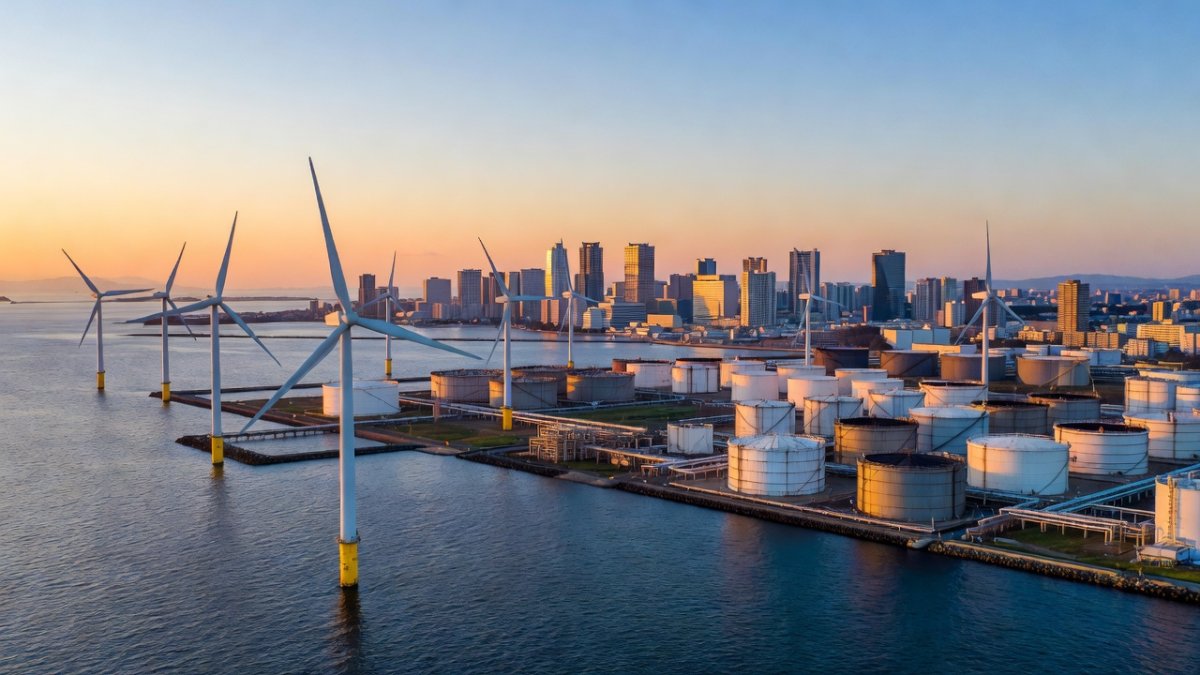
The Hormuz crisis has lent new urgency to Japan's GX Green Transformation agenda, accelerating LNG import diversification away from traditional Middle Eastern sources. Renewable capacity additions, particularly offshore wind projects off Akita and Chiba, are advancing through expedited permitting. Hydrogen and ammonia supply-chain initiatives with Australia and the Middle East are receiving additional budgetary support to meet the long-term target of reducing Middle East oil dependence to below 70 percent by 2035. METI has fast-tracked next-generation battery and grid storage projects to enhance industrial resilience. Society 5.0 digital supply-network platforms are being expanded to provide real-time visibility across chemical and energy feedstock flows. Policymakers view the current episode as a catalyst that could compress the original 2030 timeline for several diversification milestones by two to three years.
What to Watch For
Implementation details of the U.S.-Iran framework will determine when Hormuz tanker traffic fully resumes, with METI scheduled to release weekly inventory updates through August. Further coordinated releases from IEA members remain possible if prices rebound above $105. Long-term structural shifts toward greater non-Middle Eastern crude sourcing and expanded renewable capacity are likely to persist regardless of short-term normalization. Manufacturing firms that quickly adapt procurement strategies and invest in alternative feedstocks stand to gain competitive advantages in both domestic and export markets. Observers will monitor whether the current shock produces durable policy changes in Japan's energy security architecture.
The Hormuz episode has reinforced the imperative for Japanese technology and manufacturing sectors to build deeper supply-chain redundancies while advancing the green transformation that will define regional competitiveness through the coming decade.
By Kenji Tanaka, Staff Writer
This article was produced with AI-assisted research and editorial support. Reporting is based on sources cited in the article.
What's Your Reaction?
 Like
0
Like
0
 Dislike
0
Dislike
0
 Love
0
Love
0
 Funny
0
Funny
0
 Wow
0
Wow
0
 Sad
0
Sad
0
 Angry
0
Angry
0

Japan Correspondent at Global1.News. Tokyo-based voice covering Japanese politics, technology, economy, and culture. Tracks the intersection of tradition and innovation in one of the world's most dynamic societies.















Comments (0)