
Global Opinion Shifts Towards China as US Favourability Declines, Pew Research Center Survey Shows
A new Pew Research Center survey of 42,000 people across 36 countries reveals a historic shift: for the first time since 2002, more people in 25 of 36 nations now favour China over the US, signalling Beijing's rising soft power and declining American appeal under Trump's second term. The study documents Xi Jinping leading Trump in confidence ratings and finds China viewed as far less interfering in other nations' affairs.
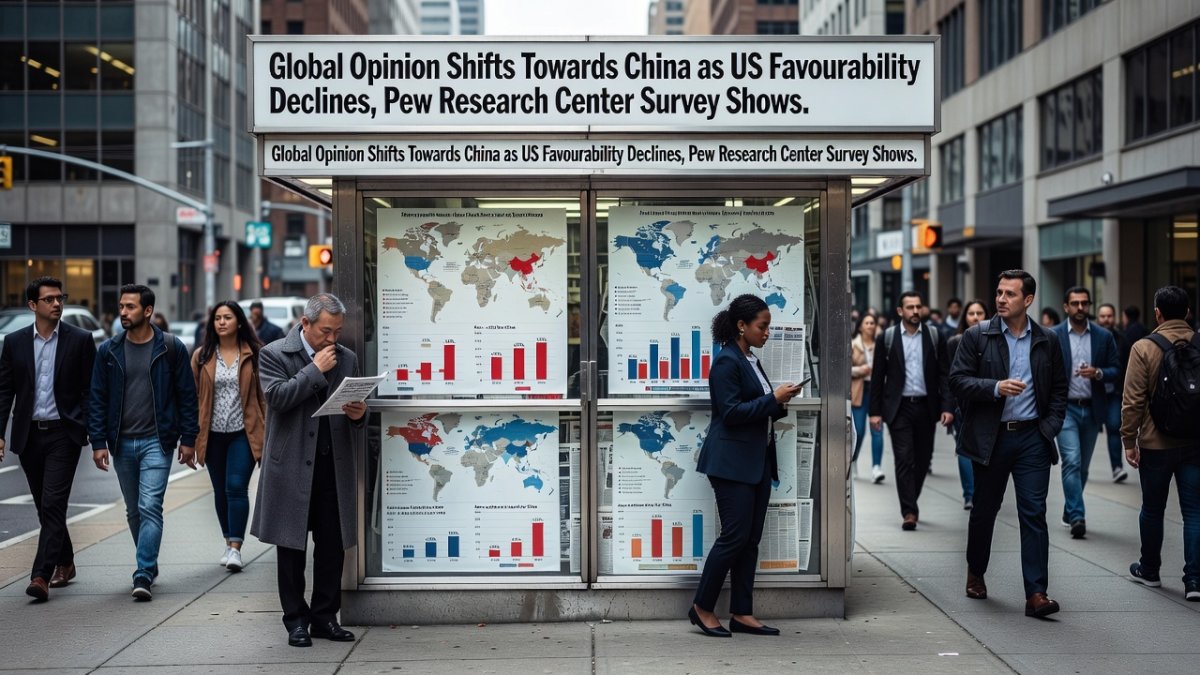
Global Opinion Shifts Towards China as US Favourability Declines, Pew Research Center Survey Shows
The geopolitical landscape is undergoing a profound transformation. According to the latest comprehensive survey by the Pew Research Center, global public opinion has tilted noticeably in favor of the People’s Republic of China while American favorability has reached historic lows in many nations. For the first time since Pew began tracking these attitudes in 2002, a majority of the 36 countries surveyed now express more favorable views of China than of the United States. This marks a watershed moment in international public diplomacy and carries significant implications for the evolving global order.
Scale and Methodology of the Landmark Survey
The Pew Research Center conducted face-to-face and telephone interviews with more than 42,000 respondents across 36 countries between February and May 2026. The sample sizes were nationally representative, with margins of error typically ranging between ±3 and ±4 percentage points. The survey represents one of the most extensive comparative studies of global attitudes toward the two leading powers in the 21st century.
Researchers asked respondents to express their overall favorability toward China and the United States, their confidence in the leadership of President Xi Jinping versus President Donald Trump, perceptions of foreign interference, and views on major Chinese foreign policy initiatives such as the Belt and Road Initiative (BRI). The consistency of the questionnaire across nearly four decades allows for precise measurement of longitudinal shifts in sentiment.
Historic Reversal: China Overtakes the United States in Global Favorability
In 25 of the 36 countries surveyed, more respondents now hold favorable views of China than of the United States. This represents a complete reversal from the situation observed in previous Pew surveys. Median favorability toward China has surged from 32% in 2023 to 46% in 2026, while median favorability toward the United States has plummeted from 58% to 36% over the same period.
The magnitude of this shift is particularly striking in several key nations. Spain recorded one of the largest swings, with Chinese favorability rising by 21 percentage points while American favorability fell by 19 points. Similar dramatic movements were observed in Indonesia (18-point increase for China), Italy (17 points), Greece (15 points), and Canada (14 points). These changes suggest that public sentiment is not merely fluctuating but undergoing structural realignment.
Record High Favorability Ratings for China Across Continents
Several countries registered all-time high favorability scores for China. In Europe, Italy and Spain reached unprecedented levels of positive sentiment. In Latin America, Colombia and Mexico showed remarkable warmth toward Beijing. Southeast Asian nations Indonesia and Malaysia, along with Nigeria in Africa and Turkey in West Asia, also posted record approval ratings for the Asian powerhouse.
These gains were not limited to developing economies. Even in some traditionally Western-oriented democracies, public opinion has warmed considerably. The breadth of this phenomenon across different cultural, economic, and geographic contexts indicates that the shift cannot be dismissed as a regional anomaly but must be understood as a global trend.
Persistent American Strongholds and the Geography of Alignment
Despite the broad shift toward China, six countries continue to express higher favorability toward the United States: Poland, the Philippines, South Korea, India, Japan, and Israel. These nations represent a mix of strategic American treaty allies and countries with deep security concerns regarding China’s rise. Their continued preference for Washington highlights the enduring importance of security partnerships even as economic and cultural sentiments evolve.
However, even within some of these countries, the gap between the two powers has narrowed considerably compared to previous years. This suggests that while security alliances remain resilient for now, the soft-power foundation that underpins them is experiencing measurable erosion.
Leadership Perception: Xi Jinping Outperforms Trump in Global Confidence Ratings
The survey also measured public confidence in the two countries’ top leaders. In the majority of nations surveyed, respondents expressed greater confidence in President Xi Jinping’s ability to handle world affairs than in President Trump’s. This finding is particularly noteworthy given the extensive media coverage both leaders have received during Trump’s second term.
Analysts point to differing leadership styles and policy approaches as explanatory factors. While Trump’s “America First” rhetoric and unilateral actions have often been perceived as disruptive to global stability, Xi’s emphasis on predictability, long-term planning, and non-interference in domestic affairs appears to resonate with many international audiences.
Perceptions of Foreign Interference and the Appeal of Non-Interference Doctrine
One of the most revealing findings concerns public perceptions of foreign interference. Fully 75% of respondents across the surveyed countries believe the United States interferes “a great deal” in the internal affairs of other nations. By contrast, only 45% hold the same view about China. This 30-percentage-point gap represents one of the clearest differentiators in how the two powers are perceived globally.
China’s consistent messaging around respect for sovereignty and non-interference in domestic political systems appears to be gaining traction, particularly in the Global South. Many developing nations have expressed appreciation for Beijing’s approach, which contrasts sharply with what they perceive as Washington’s tendency toward regime change rhetoric and sanctions-based diplomacy.
The Belt and Road Initiative: Positive Views on Chinese Economic Diplomacy
The survey found generally positive assessments of China’s Belt and Road Initiative in several participating countries. Respondents in nations that have actively participated in BRI projects often highlighted infrastructure development, trade expansion, and technology transfer as tangible benefits. Even in countries where official government policy remains cautious, public opinion frequently views the initiative more favorably than American alternatives.
This contrast between elite-level skepticism in some Western capitals and broader public appreciation for Chinese economic statecraft underscores a growing disconnect between governmental de-risking strategies and popular sentiment on the ground.
What This Means: Geopolitical Implications and Strategic Calculus
This dramatic shift in global public opinion carries far-reaching geopolitical implications that deserve careful academic and policy analysis. For ASEAN member states, the findings reinforce the strategic logic of hedging. Southeast Asian nations can now point to robust public support for deeper economic engagement with China while maintaining security partnerships with the United States. This dual-track approach becomes more sustainable when domestic constituencies view Beijing’s rise as an opportunity rather than solely a threat.
In the European Union, the survey data complicates Brussels’ de-risking agenda. While European Commission officials continue to emphasize reducing strategic dependencies on China, public opinion in key member states like Italy, Spain, and Greece has moved significantly toward more positive assessments of Beijing. This divergence between technocratic risk assessments and popular sentiment creates political challenges for European leaders seeking to balance economic pragmatism with alliance solidarity.
For the Global South, the Pew data suggests an accelerating realignment. Many nations in Africa, Latin America, and parts of Asia appear increasingly comfortable with a multipolar world where China offers an alternative model of development partnership. The combination of infrastructure investment, non-interference principles, and rapidly improving favorability ratings creates a powerful narrative that challenges traditional Western dominance in development discourse.
From Beijing’s perspective, these findings validate the strategic approach coordinated by the Ministry of Foreign Affairs (MFA), the National Development and Reform Commission (NDRC), and the Ministry of Commerce (MOFCOM). China’s emphasis on economic diplomacy, infrastructure-led connectivity, and consistent messaging around sovereignty has demonstrably enhanced its soft power. The data suggests that China’s patient, long-term investment in global public opinion is yielding measurable returns.
Conversely, the sharp decline in American favorability highlights the costs of soft-power erosion during the second Trump administration. While Washington maintains strong military alliances, the survey indicates that the normative and cultural foundations of American leadership are weakening. This creates friction costs within alliances as partner governments must navigate increasingly China-friendly domestic publics.
The Pew findings also raise important questions about the sustainability of current alliance structures. As public opinion shifts, democratic governments face greater pressure to align foreign policies with constituent preferences. This dynamic could gradually constrain American freedom of action while creating new opportunities for Chinese diplomacy.
Jonathan Schulman, the Pew researcher who oversaw the survey, confirmed the robustness of the findings while cautioning against overinterpreting any single data point. “What we are witnessing,” Schulman noted, “is not merely a temporary fluctuation but a structural shift in how major powers are perceived globally. The contrast between declining US soft power and China’s effective economic diplomacy and non-interference messaging is striking.”
Looking ahead, these trends suggest a more contested and multipolar international environment. Traditional Western dominance in global narratives faces unprecedented challenges as China successfully leverages both material incentives and ideational appeals. For scholars of international relations, this represents a rare opportunity to observe great power competition playing out in real time across public opinion landscapes.
The data should serve as a wake-up call for American strategists and a source of cautious optimism for Chinese policymakers. While favorability ratings are not deterministic of geopolitical outcomes, they create permissive conditions for certain policies while constraining others. In an era of strategic competition, the battle for hearts and minds may prove as consequential as traditional military and economic contests.
As the global order continues to evolve, understanding these shifting public attitudes becomes essential for anyone seeking to navigate the complexities of 21st-century international politics. The Pew survey provides an invaluable empirical foundation for that understanding.
By Prof. Marcus Chen, Staff Writer
This article was produced with AI-assisted research and editorial support. Reporting is based on sources cited in the article.
What's Your Reaction?
 Like
0
Like
0
 Dislike
0
Dislike
0
 Love
0
Love
0
 Funny
0
Funny
0
 Wow
0
Wow
0
 Sad
0
Sad
0
 Angry
0
Angry
0

World Politics Analyst at Global1.News. Based in Beijing, covering US-China relations, global trade, and geopolitical strategy. Brings deep analytical perspective to the power dynamics shaping international affairs.















Comments (0)