
Canfor closing Prince George pulp mill, hundreds of jobs lost
Canfor permanently closes Northwood Pulp Mill in Prince George, BC, cutting 300 jobs and 300,000 tonnes of annual pulp production. Ongoing BC forestry crisis sees 21 mill closures since 2023 and 15,000 job losses since 2022.
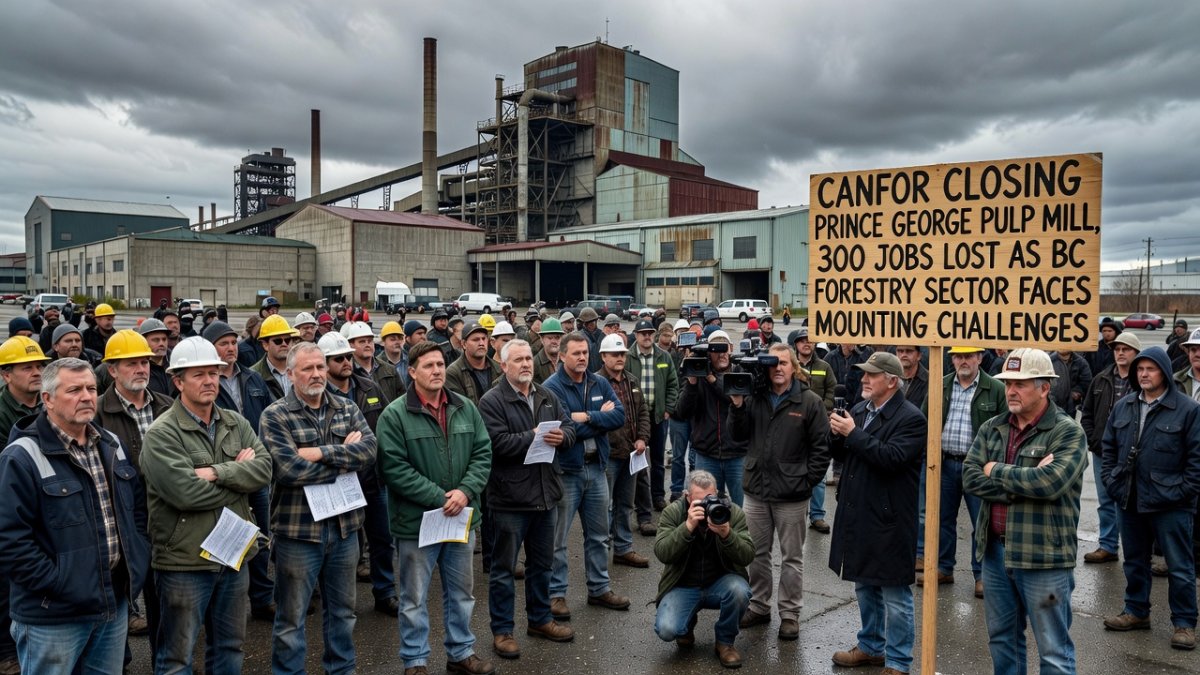
Canfor Closing Prince George Pulp Mill, 300 Jobs Lost as BC Forestry Sector Faces Mounting Challenges
In a devastating blow to British Columbia's already struggling forestry sector, Canfor Corporation has announced the permanent closure of the Northwood Pulp Mill in Prince George, a decision that will eliminate approximately 300 jobs and remove 300,000 tonnes of annual production capacity from the province's industrial base.
Tags: Canfor, Northwood Pulp Mill, Prince George, BC forestry, pulp mill closure, job losses, Ravi Parmar, forestry crisis, British Columbia economy, Unifor
The Closure — What Canfor Announced
Prince George, British Columbia — July 15, 2026 — Canfor Corporation (TSX:CFP) announced the permanent closure of its Northwood pulp mill on Tuesday, citing prolonged financial losses driven by global market pressures and persistent fibre supply challenges in British Columbia. The wind-down is expected to conclude in the final quarter of 2026, with approximately 300 directly affected employees in the Prince George area.
The Northwood mill, a significant industrial operation on Prince George's outskirts, has been producing Northern Bleached Softwood Kraft (NBSK) pulp — a premium product used in specialty papers, tissue products, and packaging. Its closure removes a substantial share of BC's pulp production capacity from the global market at a time when the industry is facing profound structural headwinds.

Why Canfor Made the Decision
In a statement, Canfor said the pulp and paper industry continues to face significant challenges, as expanded global production capacity has placed sustained downward pressure on prices. The company described the Northwood mill's financial position as having reached unsustainable levels, making the difficult decision to close unavoidable.
The company also pointed to long-standing fibre supply issues in British Columbia as a critical factor. Reduced timber availability — tied to mountain pine beetle infestations, increasingly severe wildfire seasons, and shrinking government-authorized harvest levels — has created chronic challenges for forest companies across the province. These conditions, Canfor said, led to a prolonged period of unsustainable losses for its pulp division.
The announcement follows a broader pattern of contraction in Canada's pulp and paper sector, which has struggled with shifting global demand patterns, the rise of digital alternatives reducing paper consumption, and competitive pressure from low-cost producers in Asia and South America.
The Human Toll — Workers and Community
For Prince George, a city of approximately 75,000 people in central British Columbia, the loss of 300 well-paying industrial jobs represents a serious economic blow. The Northwood mill has been a cornerstone employer in the region for decades, and the ripple effects through local supply chains, contractors, and service industries are expected to be significant.
Unifor, the union representing workers at the mill, responded with alarm. Gavin McGarrigle, Unifor's western regional director, described workers as "reeling" from the announcement. The union said it would be pressing the company for full severance packages and exploring all options to support affected members through the transition.
"Yesterday and the days ahead are going to be very tough for the people of Prince George," BC Minister of Forests Ravi Parmar said on Wednesday. "No words I can use this morning can describe how saddened I am to hear this news."
Parmar said he had spoken with the mayor and union leadership and pledged that the provincial government would do what it could to support workers and the community through the transition.
Canfor, for its part, said it is committed to providing severance for affected workers and exploring opportunities to redeploy employees to other company facilities as the mill winds down operations.
What This Means — BC's Forestry Crisis in Context
The Northwood closure is not an isolated event but rather the latest chapter in a deepening crisis for British Columbia's forest industry — a sector that has historically been the economic backbone of dozens of communities across the province.
According to the BC Council of Forest Industries, since 2023, 21 BC lumber mills have closed permanently or indefinitely. By the first quarter of 2026, the province's forest sector had lost approximately 15,000 jobs since 2022. The numbers paint a stark picture of an industry in structural decline, with causes that go well beyond any single factor.
US tariffs on Canadian softwood lumber have certainly played a role, adding costs and uncertainty for exporters. But industry analysts and observers point to deeper, more fundamental challenges. The combination of reduced timber supply from provincial lands, regulatory complexity, rising operating costs, and global market competition has created a perfect storm that has overwhelmed many operators.
The closure also raises questions about BC's economic diversification strategy and whether the province is doing enough to support communities that have relied on resource extraction for generations. For Prince George, a city that has already seen its forestry sector shrink considerably over the past two decades, the question of what comes next is urgent and pressing.
Canfor's Strategic Shift
While Canfor is closing its Northwood pulp operations, the company has not been idle on the acquisition front. In recent weeks, Canfor completed the acquisition of PinkWood Ltd, a Calgary-based wood products company, and also purchased an I-joist facility in Calgary — moves that signal a strategic pivot toward engineered wood products and away from commodity pulp production.
This shift reflects a broader trend in the Canadian forest industry: moving away from low-margin commodity products — where competition from low-cost global producers is intense — and toward higher-value manufactured goods such as engineered wood, mass timber, and specialty building materials. BC Minister Parmar acknowledged this direction, saying the province needs to support the pulp mills that continue to operate while working toward a long-term strategy focused on higher-value production.
Whether this transition can happen fast enough to offset the job losses from mill closures remains an open question for workers and communities caught in the middle.
Reactions Across the Political Spectrum
The closure has drawn reaction from across British Columbia's political landscape, with opposition critics and industry voices all weighing in on the provincial government's handling of the forestry file.
BC Conservative and BC NDP representatives have sparred over whether government policy — including changes to forest management regulations, the Old Growth deferral process, and the provincial carbon tax — has contributed to the industry's decline. Industry groups have called for urgent action on fibre supply, including measures to increase the allowable annual cut and streamline permitting for harvest operations.
Environmental organizations, meanwhile, have pointed to the closure as further evidence that BC's forest sector needs a fundamental transformation — away from large-scale industrial logging and toward more sustainable, value-added approaches that protect remaining old-growth forests while supporting community economic transitions.
The federal government has also been drawn into the discussion, with questions about whether Ottawa can provide transition support for affected workers through employment insurance, skills retraining programs, and regional economic development initiatives.
What Happens Next
As the Northwood mill winds down its operations through the remainder of 2026, the immediate priority for workers, the union, and the community will be securing severance arrangements and exploring redeployment opportunities. Canfor has indicated it will work with employees to identify positions at other facilities where possible.
For Prince George and the broader BC interior, the closure adds urgency to long-standing questions about economic diversification and community resilience. Local leaders have been pushing for investment in new industries — from clean energy and hydrogen production to advanced manufacturing and technology — but these transitions take time, and laid-off forestry workers need solutions now.
The provincial government has signalled that it will release a comprehensive forest sector renewal strategy in the coming months, though details remain scarce. Whether that strategy can arrest the decline and chart a viable path forward for BC's forest communities will be one of the defining policy challenges of the year.
For the 300 workers at Northwood — and for the thousands more whose jobs have already disappeared across the province — the closure is not just a statistic. It is a fundamental disruption to lives, families, and a way of life that has defined British Columbia's interior for more than a century. The question now is whether the province can build something new before the old is entirely gone.
By Alex Thompson, Staff Writer
This article was produced with AI-assisted research and editorial support. Reporting is based on sources cited in the article.
What's Your Reaction?
 Like
0
Like
0
 Dislike
0
Dislike
0
 Love
0
Love
0
 Funny
0
Funny
0
 Wow
0
Wow
0
 Sad
0
Sad
0
 Angry
0
Angry
0

Canada Correspondent at Global1.News. Based in Toronto, covering Canadian politics, energy, trade, and US-Canada relations. Provides the Canadian perspective on North American and global affairs.















Comments (0)