
Venezuela government and opposition to begin formal talks in August
Venezuela's interim government and opposition faction will begin formal talks August 1, triggered by twin earthquakes and Maduro's ouster. With 372 political prisoners still held and key opposition leader María Corina Machado excluded, skepticism runs deep about whether this dialogue can deliver ...
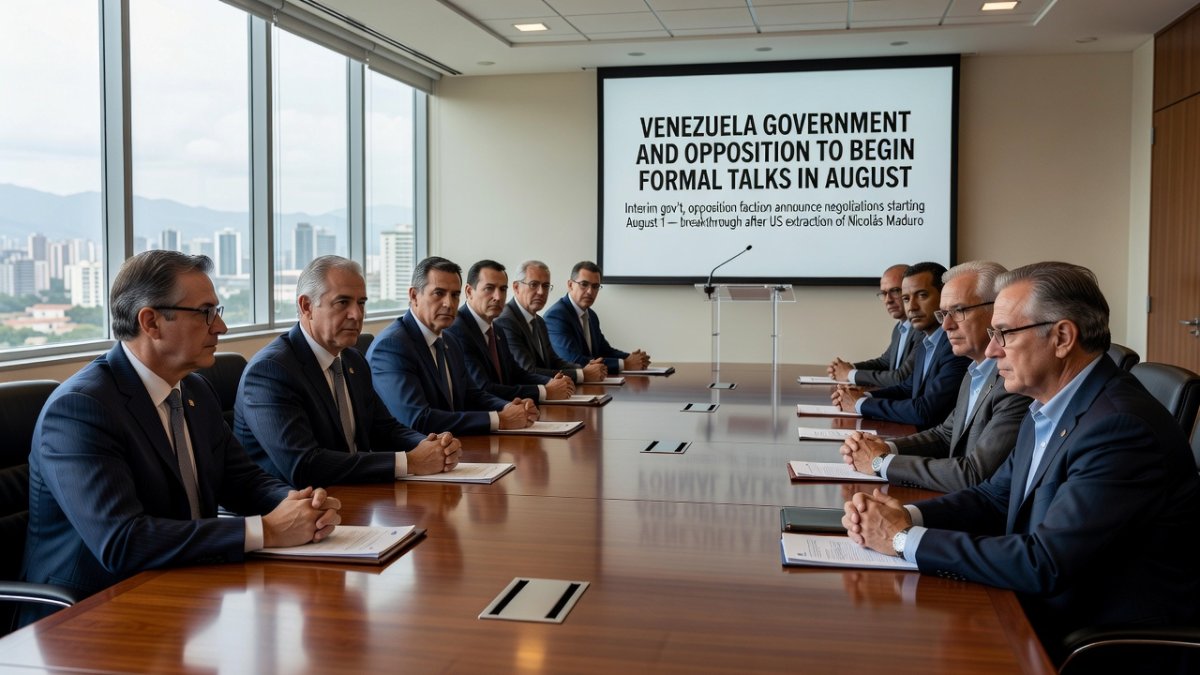
In a move that could reshape Venezuela's fractured political landscape, the interim government and a faction of the opposition have simultaneously announced they will enter formal negotiations starting August 1 — a breakthrough that comes barely six months after US special forces extracted Nicolás Maduro from Caracas in a dawn raid and six weeks after twin earthquakes devastated the country's northern coast, killing thousands.
Caracas, Venezuela — The announcement, issued almost in unison by the government-controlled National Assembly and a bloc of opposition former lawmakers, signals the first structured attempt at political dialogue since Maduro's dramatic ouster in January. But it also lays bare the deepening divisions within Venezuela's opposition and raises uncomfortable questions about who really gets a seat at the table.
The Talks: What We Know So Far
Jorge Rodríguez, head of the National Assembly and brother of interim President Delcy Rodríguez, said the government is ready to begin formal discussions with opposition members from the start of August. In a brief statement, he cited the devastation of the June 24 earthquakes — which have killed at least 4,734 people with the toll still climbing — as the urgent motivation for dialogue.
"Only through unity can we move forward with reconstruction and maintain peace," Rodríguez said.
The opposition faction, made up of former lawmakers elected in 2015 — the last time opposition parties won a majority in the National Assembly — released a more detailed statement. It said the talks would lay down "a route map towards democracy," with priorities including strengthening democratic institutions, overhauling the electoral system, and providing guarantees for political participation.
Who's at the Table — and Who's Not
The opposition team will be led by Dinorah Figuera, who returned to Venezuela in June after nearly eight years in exile. Upon landing in Caracas, she told reporters she had travelled home "on invitation from the US State Department" with the aim of pushing for the renewal of the National Electoral Council, known by its Spanish acronym CNE.
Figuera's return and her central role in the talks are significant — and controversial. The CNE has been dominated by staunch Maduro loyalists for years, and it was this same body that declared Maduro the winner of the 2024 presidential election, even though independently verified voting tallies showed an overwhelming victory for opposition candidate Edmundo González.
But notably absent from the process is the most recognizable face of Venezuela's democratic movement: María Corina Machado. The Nobel Peace Prize laureate, who slipped out of the country secretly in November to receive the award, has been unable to return to Venezuela. She tried to re-enter shortly after the twin earthquakes but failed to make it across the border.
Despite dedicating her Nobel Prize to US President Donald Trump, Machado now finds herself sidelined by the very administration she praised. US media have reported that Trump's team considers Machado's return "potentially disruptive" to post-earthquake recovery efforts, and Washington has instead thrown its weight behind Figuera as the interlocutor for a democratic transition.
The Political Earthquake Before the Geological One
The talks did not emerge from a vacuum. Venezuela's political landscape was violently reshaped on January 15, when US special forces descended on Caracas in a surprise operation, capturing Maduro and transporting him to New York to face drug-trafficking charges. The operation sent shockwaves across Latin America and left a power vacuum that was quickly filled by Maduro's former vice-president, Delcy Rodríguez.
Rodríguez, a hardline loyalist, has governed since then with the explicit backing of the Trump administration — a reality that has frustrated broad swathes of the opposition, who had hoped Maduro's removal would pave the way for a transitional government leading to free elections. Instead, they got a Maduro loyalist running the country with Washington's blessing.
That frustration has only deepened as the Rodríguez government has maintained continuity with many of the repressive structures of the Maduro era. While scores of political prisoners have been released, 372 remain behind bars, according to the prisoners' rights advocacy group Foro Penal. Opposition politicians and critics of the government have for years faced systematic persecution, with many jailed and many more forced into exile.
Earthquake Diplomacy: Disaster as a Catalyst
The twin earthquakes that struck northern Venezuela on June 24, 2026, changed the calculus for everyone. With a death toll approaching 5,000 and thousands more injured or displaced, the disaster overwhelmed an already crippled state infrastructure and exposed the government's limited capacity to respond.
Entire neighborhoods in the coastal state of La Guaira and parts of Caracas were flattened. Buildings that had stood for decades crumbled in seconds. Rescue operations, hampered by fuel shortages and damaged roads, have been slow and uneven, drawing public anger and accusations of government negligence.
The international response has been significant, with the United States providing emergency aid and logistical support. For the Rodríguez government, the disaster presented both a crisis and an opportunity: a reason to reach out to political adversaries under the banner of national unity, and a chance to demonstrate governance capacity in coordination with Washington.
For the opposition, the earthquake changed the conversation too. The scale of destruction demanded a response that went beyond political squabbling, and the presence of US aid on the ground served as a reminder that Venezuela could not afford to isolate itself.
What the Opposition Is Actually Asking For
The opposition's stated priorities are clear: strengthen democratic institutions, overhaul the electoral system, and provide guarantees that political participation will be free and safe. These are not new demands — they have been the core of the opposition's platform since the 2015 National Assembly victory that Maduro systematically undermined.
But the specifics matter. Electoral reform means replacing the CNE leadership, which has been packed with PSUV loyalists for years. Institutional strengthening means reversing the erosion of checks and balances that allowed Maduro and now Rodríguez to concentrate power in the executive branch. Political guarantees mean ending the persecution of dissidents — the arrests, the intimidation, the exile.
Whether the Rodríguez government is genuinely prepared to deliver on any of these fronts remains deeply uncertain. Jorge Rodríguez's framing of the talks as a response to the earthquake — rather than a response to democratic demands — suggests the government sees them as a tactical concession, not a fundamental shift.
What This Means: Pragmatism Over Principles
What we are witnessing in Venezuela is a brutal reckoning with political reality. The opposition entered the Maduro era united around a single goal: free and fair elections. Six months after Maduro's removal, that unity has shattered. The US has chosen its preferred partner in Figuera, leaving Machado — the Nobel laureate, the face of the resistance — in diplomatic limbo.
For Washington, the calculus is pragmatic. Figuera is viewed as more pliable, more willing to negotiate within the framework that keeps Delcy Rodríguez in power. Machado, by contrast, commands a genuine grassroots movement and would likely demand far more sweeping change than the US is prepared to support in a region already destabilized by the quakes and by the broader geopolitical fallout of Maduro's capture.
But pragmatism comes at a cost. By sidelining Machado and legitimizing negotiations with a government that still holds 372 political prisoners and controls a compromised electoral body, the US and the Figuera-led opposition risk entrenching the very system they claim to want to reform. A "route map towards democracy" is only meaningful if both sides actually intend to follow it.
The Road Ahead: Hope, Skepticism, and the Weight of History
Venezuelans have seen this movie before. Dialogue processes, negotiation tables, and "national unity" initiatives have been announced, celebrated, and abandoned repeatedly over the past decade. The most recent — talks in Mexico brokered by Norway — collapsed in 2022 after Maduro's government refused to release concrete election guarantees.
What is different this time is the scale of the disaster. The earthquakes have inflicted a humanitarian catastrophe that demands cooperation beyond politics. And the removal of Maduro has removed the single most polarizing figure from the equation, potentially creating space for negotiations that were impossible while he remained in power.
But the fundamental dynamics remain. The Rodríguez government controls the military, the state apparatus, and the economy. The opposition has no armed forces, limited international leverage, and is now divided. Talks that begin with such asymmetric power do not typically end in genuine democratic transitions — they end in cosmetic reforms that preserve the status quo.
Venezuela's road to democracy is not paved by negotiation tables alone. It requires a unified opposition, a US policy that prioritizes democratic outcomes over stability, and a government willing to cede power. August 1 will tell us whether any of those conditions are closer to being met — or whether this is simply the latest chapter in a long and painful story of false starts.
By Elena Vasquez, Staff Writer
This article was produced with AI-assisted research and editorial support. Reporting is based on sources cited in the article.
What's Your Reaction?
 Like
0
Like
0
 Dislike
0
Dislike
0
 Love
0
Love
0
 Funny
0
Funny
0
 Wow
0
Wow
0
 Sad
0
Sad
0
 Angry
0
Angry
0
Latin America Correspondent at Global1.News. Based in Mexico City, covering politics, economics, energy, and culture across the region. Brings an on-the-ground perspective to stories spanning from the Rio Grande to Patagonia.










Comments (0)