
This doctor is giving life back to female Yazidi victims of Islamic State
A Yazidi Survivor's Escape from Captivity Shireen was studying for a high school examination at her home in the northern Iraqi town of Sinjar on 3 August 2014 when Islamic State group militants broke into her house and kidnapped her from her family. At the age of 19 she was sold as a sex slave to an IS militant in the north-western city of Tal Afar. Three months later Shireen w
A Yazidi Survivor's Escape from Captivity
Shireen was studying for a high school examination at her home in the northern Iraqi town of Sinjar on 3 August 2014 when Islamic State group militants broke into her house and kidnapped her from her family. At the age of 19 she was sold as a sex slave to an IS militant in the north-western city of Tal Afar. Three months later Shireen was sold once again to Abu Omar another IS fighter in Mosul to become his third wife. "He said 'I love you' but when you love someone you don't rape her. It destroyed my life" Shireen tells MEE. "Abu Omar already had two Iraqi wives."
For more than two years Shireen says she was not allowed to leave the house in Mosul. She was forced to cook wash the dishes and clean every day. "There were two guards at the entrance of the house and I was not allowed to go outside even to the garden to breathe fresh air" she says. Abu Omar later brought two other Yazidi girls to the house. One was six years old and was forced to clean the house while the other was 10. She was raped frequently by Abu Omar.
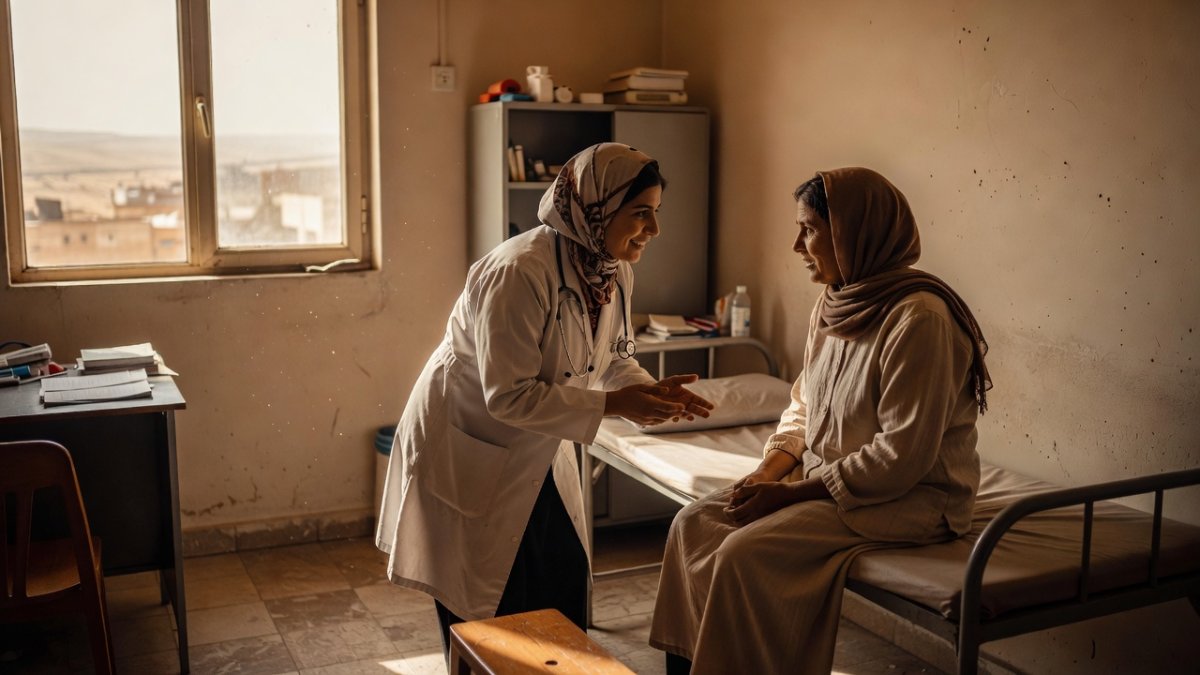
In 2016 Shireen was released by Iraqi forces during the campaign to retake Mosul from IS. After more than two years of captivity Shireen suffered from depression and constant nightmares. Her uncle and many of her friends were killed by IS while her father and one of her sisters have been missing since 2014. Upon her release she visited Dr Nagham Nawzat a Yazidi gynaecologist in Duhok in Iraq's Kurdish region. "Dr Nawzat helped all of us. Without her help I wouldn't be here today" Shireen says. "After I came back from captivity Dr Nawzat sat down with me and told me that I was brave."
The Yazidi Genocide: A UN-Designated Atrocity
In 2014 IS seized almost a third of Iraq. At least 12,000 Yazidis were killed or kidnapped as part of what the United Nations describes as an "ongoing genocide" against the religious minority. The assault on Sinjar and surrounding areas targeted a community whose faith centres on belief in Yasdan a god who emanates seven angels. IS militants told captives including Shireen that Melek Tawwus was the devil and forced them to convert to Islam.
The scale of the violence left thousands of families shattered. According to Hussein al-Qaidi director of Kidnapped Affairs at the KRG in Duhok 2,023 Yazidi women have been liberated from IS territories as of July 2018. Many survivors returned with severe physical injuries psychological trauma and the loss of relatives whose fates remain unknown. The systematic nature of the abductions and sexual enslavement has been documented by international observers as deliberate attempts to erase Yazidi identity and community structures.
These events unfolded against a backdrop of long-standing marginalisation of the Yazidi population in northern Iraq. The 2014 attacks intensified displacement and economic hardship in Sinjar and surrounding districts where agriculture and local trade had sustained families for generations. The UN designation of genocide underscores the intent behind the killings and kidnappings yet the process of accountability and recovery continues to face logistical and political obstacles in post-IS Iraq.
Dr. Nagham Nawzat: From Mosul to Medical Advocate
Born in Mosul to a Yazidi family in 1976 Dr Nagham Nawzat graduated with a degree in gynaecology from Mosul's Medical College in 2002. Her decision to specialise reflected a commitment to address gaps in women's health services. "[I wanted] to better understand issues related to women's health teach women about health care and provide support for them" she tells MEE.
Nawzat is highly respected among the Yazidi community. She has provided life-saving support to more than half of the 2,023 women liberated as of July 2018 helping an estimated 1,200 Yazidi women survivors of IS captivity. Her work combines clinical expertise with an understanding of the cultural context in which Yazidi women live and the specific violations they endured during captivity.
Practising in Duhok in Iraq's Kurdish region Nawzat has become a central figure for women returning from IS-held areas. Her background as a Yazidi physician from Mosul allows her to bridge medical care with community trust. This position enables her to address both immediate health needs and the longer-term effects of trauma on survivors who often return to fragmented families and uncertain futures.
The Duhok Survivors' Centre: Iraq's Only Gender-Based Violence Facility
In 2014 Nawzat joined the Duhok Survivors' Centre where she volunteers. Funded by the UNFPA it is the only facility in Iraq that specialises in gender-based violence. The centre provides a dedicated space for women who have experienced sexual violence and other forms of abuse during the IS campaign.
The centre's role has grown in importance as liberated women arrive with complex medical and psychological requirements. Its UNFPA support ensures resources for specialised care that are unavailable elsewhere in the country. This infrastructure addresses a critical gap in services for survivors whose experiences include prolonged captivity forced labour and repeated sexual assault.
Staff at the centre coordinate with local authorities and international partners to track cases and provide continuity of care. The facility operates within the broader framework of Duhok's response to the Yazidi crisis where thousands of displaced families have sought refuge in the Kurdish region. Its specialised focus distinguishes it from general health services and allows for targeted interventions that recognise the gendered dimensions of the violence.
Healing Beyond the Physical
Nawzat uses a post-traumatic medical approach. She conducts physical check-ups and then listens as patients talk about their fears. She offers support "like a big sister the survivors can confide in." This method prioritises building trust before deeper therapeutic work begins.
Survivors such as Shireen describe the emotional reassurance they received during initial consultations. Nawzat's emphasis on listening allows women to recount experiences at their own pace while receiving validation that counters the dehumanisation they faced in captivity. The approach integrates gynaecological care with recognition of the mental health consequences of prolonged sexual enslavement and isolation.
Many women arrive at the centre after months or years without access to basic medical attention. Nawzat's protocol addresses immediate health concerns while creating space for survivors to express grief over lost relatives and disrupted lives. This dual focus helps restore a sense of agency that captivity had systematically removed.
International Recognition and the Road Ahead
In March 2016 Nawzat received the International Women of Courage Award from then-US Secretary of State John Kerry. The recognition highlighted her contributions to supporting Yazidi survivors at a time when global attention focused on the humanitarian consequences of the IS advance.
Despite the award and the centre's work ongoing challenges persist. As of July 2018 thousands of Yazidi women remained missing or unaccounted for. Families continue to search for relatives abducted in 2014 while survivors navigate reintegration into communities that have themselves been profoundly altered by displacement and loss.
The liberation of 2,023 women represents only a portion of those taken. Nawzat's continued presence at the Duhok Survivors' Centre underscores the sustained demand for specialised care. Political and security conditions in northern Iraq affect the pace of recovery and the ability of survivors to access services over the long term.
Restoring Dignity: The Power of Compassionate Care
Dr Nagham Nawzat's work with more than 1,200 Yazidi women illustrates how medical care can extend beyond physical treatment to address the deeper wounds inflicted by systematic violence. Her post-traumatic approach at the UNFPA-funded Duhok Survivors' Centre combines clinical attention with attentive listening that validates survivors' experiences.
Stories such as Shireen's demonstrate the lasting effects of captivity including depression nightmares and the unresolved pain of missing family members. Nawzat's role as a trusted figure within the Yazidi community enables women to begin processing these losses in a setting designed specifically for gender-based violence survivors.
The International Women of Courage Award and the documented scale of IS crimes against Yazidis place Nawzat's efforts within a wider context of international concern and local resilience. As of 2018 the centre remains a vital resource for women rebuilding their lives after the 2014 genocide. Her practice of treating each patient with the respect of a confidante continues to support the slow process of restoring dignity to those who endured the most intimate forms of violence.
By Fatima Al-Rashid, Staff WriterThis article was produced with AI-assisted research and editorial support. Reporting is based on sources cited in the article.
What's Your Reaction?
 Like
0
Like
0
 Dislike
0
Dislike
0
 Love
0
Love
0
 Funny
0
Funny
0
 Wow
0
Wow
0
 Sad
0
Sad
0
 Angry
0
Angry
0
Middle East Correspondent at Global1.News. Based in Beirut, covering politics, conflict, energy, and society across the Middle East. Brings context and depth to a region often reduced to headlines.











Comments (0)