
Decoding Climate Change through Snow: Japan's Century of Cryospheric Research
Japan's seasonal snow cover has long served as a sensitive recorder of atmospheric conditions, and recent analysis of decades-old samples is now exposing shifts in moisture sources and pollutant deposition that were not detectable at the time of collection. Researchers at institutions with roots in the 1930s continue to extract quantitative signals from physical structure, isot
Japan's seasonal snow cover has long served as a sensitive recorder of atmospheric conditions, and recent analysis of decades-old samples is now exposing shifts in moisture sources and pollutant deposition that were not detectable at the time of collection. Researchers at institutions with roots in the 1930s continue to extract quantitative signals from physical structure, isotopic ratios, and trace chemistry preserved in snow layers. These records complement polar ice-core data and feed directly into national planning for water resources and disaster preparedness under frameworks that include Green Transformation objectives.
The Nakaya Legacy (1930s-1940s)
Ukichiro Nakaya produced the first artificial snow crystals in a laboratory at Hokkaido University in 1936. By systematically varying temperature and supersaturation, he demonstrated that crystal morphology follows reproducible patterns now summarized in the Nakaya diagram. This controlled replication established that natural snowflakes carry information about the precise conditions under which they formed in the atmosphere.
Nakaya founded the Institute of Low Temperature Science in 1941, creating a dedicated facility in Sapporo for sustained study of snow and ice. His 1954 monograph "Snow Crystals: Natural and Artificial" compiled thousands of photographs that remain reference standards. These images documented the six-fold symmetry and branching habits that later researchers use to classify crystals recovered from both contemporary storms and archived layers.
The methodological foundation Nakaya laid emphasized repeatable laboratory conditions paired with field verification. This dual approach allowed subsequent generations to compare natural specimens against known growth environments, a practice that underpins current efforts to interpret historical samples whose original formation temperatures can now be inferred from morphology alone.
ILTS Growth and National Network
The Institute of Low Temperature Science expanded from a single-university laboratory into an inter-university research platform with cold rooms capable of maintaining sub-zero temperatures for extended experiments. Field stations were established across Hokkaido, Tohoku, and Hokuriku, each equipped with standardized snow-sampling protocols that have remained consistent for more than eight decades. This continuity has produced an unbroken observational series reaching back to the early 1940s.
Permanent monitoring plots record snow depth, density, and crystal type at fixed intervals throughout the accumulation season. Because the same measurement techniques and site coordinates have been preserved, trends extracted from the earliest layers can be compared directly with contemporary data without adjustment for methodological drift. The resulting dataset constitutes one of the longest continuous cryospheric records in the mid-latitudes.
Coordination among stations ensures that samples collected during the same storm systems are processed under identical cold-laboratory conditions. This network approach reduces spatial bias and supplies the statistical power required to distinguish local variability from regional atmospheric signals.
Snow as an Environmental Archive
Each annual snow layer preserves a chemical snapshot of the atmosphere at the time of deposition. Sulfate and nitrate concentrations reflect both natural oceanic sources and anthropogenic emissions, while sea-salt ions indicate storm trajectories over the Sea of Japan. Stable isotopes of oxygen-18 and deuterium record the temperature and moisture source of the air mass that delivered the precipitation.
Dust particles trapped within the snow include Asian dust, volcanic ash, pollen, and industrial particulates. Microscopic examination of these inclusions reveals changes in long-range transport and local emission patterns. Physical properties such as grain size and density further indicate whether the layer experienced melt-refreeze cycles, providing indirect evidence of temperature fluctuations during the accumulation period.
Because snow accumulates sequentially, the vertical profile functions as a high-resolution timeline. Researchers can therefore align chemical peaks with documented volcanic eruptions or industrial events, calibrating the archive against independent historical records and strengthening causal interpretations of observed trends.
Modern Analytical Revolution
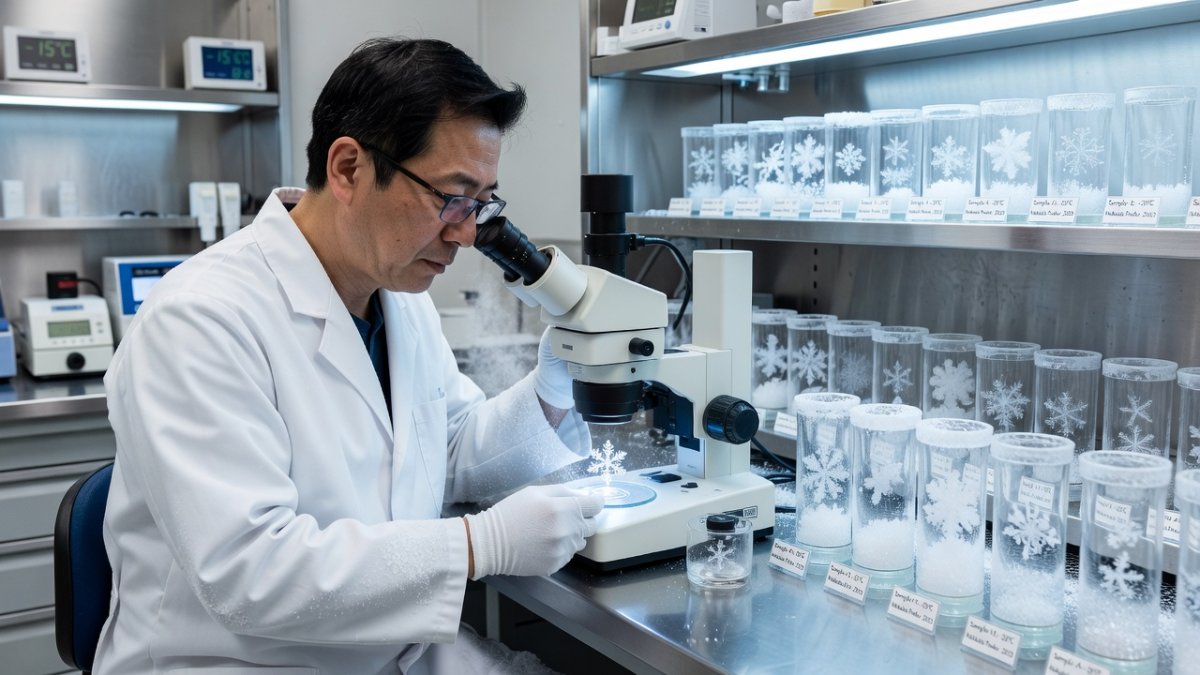
Stable-isotope-ratio mass spectrometry now measures oxygen and hydrogen ratios at sub-millimeter resolution, allowing reconstruction of individual storm tracks and shifts in moisture provenance over time. Archived samples collected decades ago can be reanalyzed with current instrumentation, revealing isotopic trends that were below detection limits when the snow was originally gathered.
Electron microscopy identifies inclusions smaller than one micrometer, distinguishing industrial black carbon from natural dust. Machine-learning algorithms trained on Nakaya-style crystal images classify thousands of specimens per hour, converting visual archives into quantitative datasets suitable for statistical trend analysis. These techniques applied retroactively to stored cores have uncovered gradual changes in crystal habit that correlate with measured warming at mid-elevation sites.
The combination of high-throughput imaging and precise chemical assays accelerates the extraction of information from existing collections. Rather than requiring new field campaigns for every question, analysts can interrogate the same physical samples with successive generations of instrumentation, extending the scientific return on decades of monitoring investment.
Antarctic Connection
Japanese Antarctic Research Expedition activities at Syowa Station, initiated in 1957, have produced deep ice cores that extend the climate record to millennial timescales. These polar cores supply the long-term baseline against which mid-latitude snow trends can be evaluated. Isotopic and chemical signals preserved in Antarctic ice reflect global atmospheric circulation patterns that also influence Japanese snowfall.
Comparison between Syowa cores and Hokkaido snow layers reveals both shared hemispheric signals, such as volcanic sulfate spikes, and regional differences driven by proximity to the Asian continent. The complementary nature of the two archives allows researchers to separate local land-use effects from broader circulation changes.
Measurable Changes in Japan's Snow
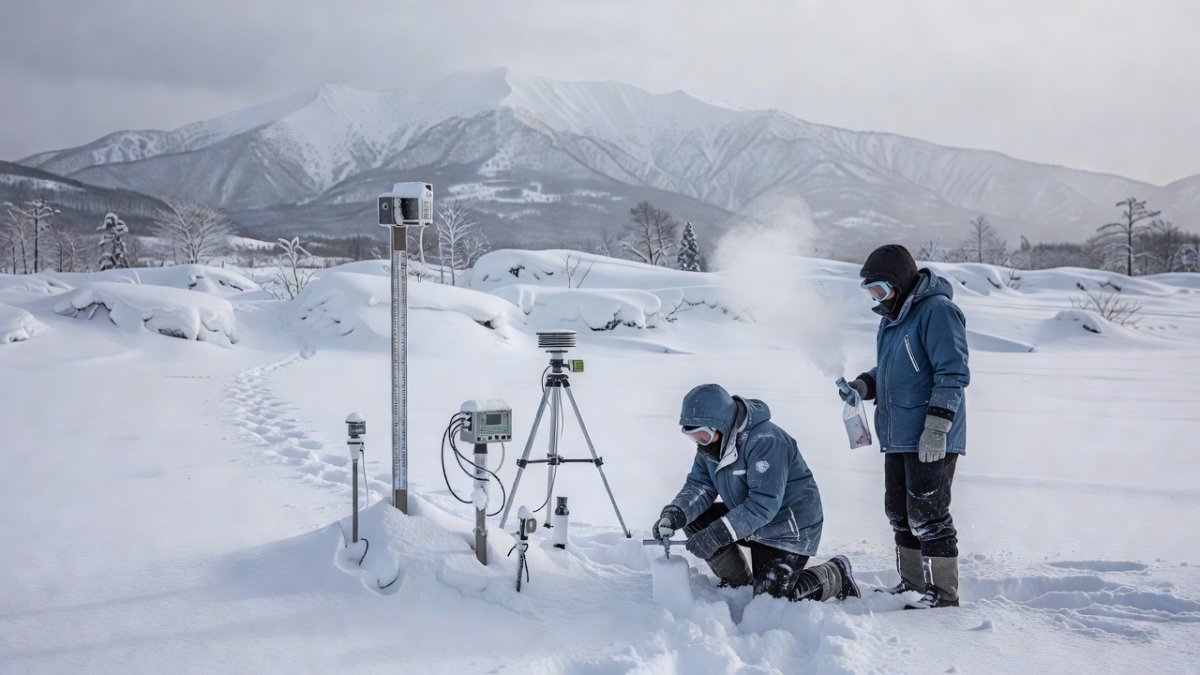
Analysis of the long-term network shows reduced snow-water equivalent at lower elevations, earlier seasonal peak accumulation, and a higher frequency of rain-on-snow events. These shifts alter the timing and volume of spring meltwater, affecting rice-planting schedules in downstream agricultural basins and reservoir operations that supply summer irrigation and hydropower.
Regional contrasts are pronounced: Hokkaido stations record more persistent cold-season snowpacks, while Hokuriku and Tohoku sites exhibit greater sensitivity to temperature thresholds that determine rain versus snow. Increased rain-on-snow episodes have also modified avalanche timing and flood risk profiles, prompting adjustments in early-warning thresholds maintained by infrastructure agencies.
Policy and International Frameworks
Funding from the Ministry of Education, Culture, Sports, Science and Technology sustains the observational network and laboratory facilities. Snow-derived datasets contribute to Japan's submissions for Intergovernmental Panel on Climate Change assessments, providing empirical constraints on mid-latitude cryospheric response. The Ministry of Land, Infrastructure, Transport and Tourism incorporates updated snow forecasts into reservoir and flood-management operations.
These research outputs align with Green Transformation objectives that emphasize data-driven decarbonization and with Society 5.0 initiatives that integrate environmental monitoring into digital infrastructure. Standardized snow records also support Japan's contributions to G7 and G20 climate-data exchanges, reinforcing the country's role in international environmental reporting.
Looking Ahead
Planned enhancements include higher-frequency isotopic sampling during individual storm events, deployment of autonomous sensors at remote stations, and tighter coupling between snow-process models and atmospheric circulation simulations. International standardization of sampling and analytical protocols will further improve comparability across mid-latitude networks.
Maintaining the existing observational continuity remains essential. New technologies can be applied to both fresh and archived samples, but only an unbroken physical record permits detection of gradual trends that span multiple decades. The institutional framework established in the 1940s continues to supply the temporal depth required for robust attribution of observed changes.
By preserving both the samples and the methodological consistency that Nakaya initiated, Japanese research institutions provide a reference archive that supports both domestic resource planning and global climate assessments. The incremental addition of analytical precision to this long-term foundation illustrates how sustained environmental monitoring yields compounding scientific and policy value.
By Kenji Tanaka, Staff Writer
This article was produced with AI-assisted research and editorial support. Reporting is based on sources cited in the article.
What's Your Reaction?
 Like
0
Like
0
 Dislike
0
Dislike
0
 Love
0
Love
0
 Funny
0
Funny
0
 Wow
0
Wow
0
 Sad
0
Sad
0
 Angry
0
Angry
0

Japan Correspondent at Global1.News. Tokyo-based voice covering Japanese politics, technology, economy, and culture. Tracks the intersection of tradition and innovation in one of the world's most dynamic societies.














Comments (0)