
Chile Turns Food Exports Into Soft Power at Bangkok Business Summit 2026
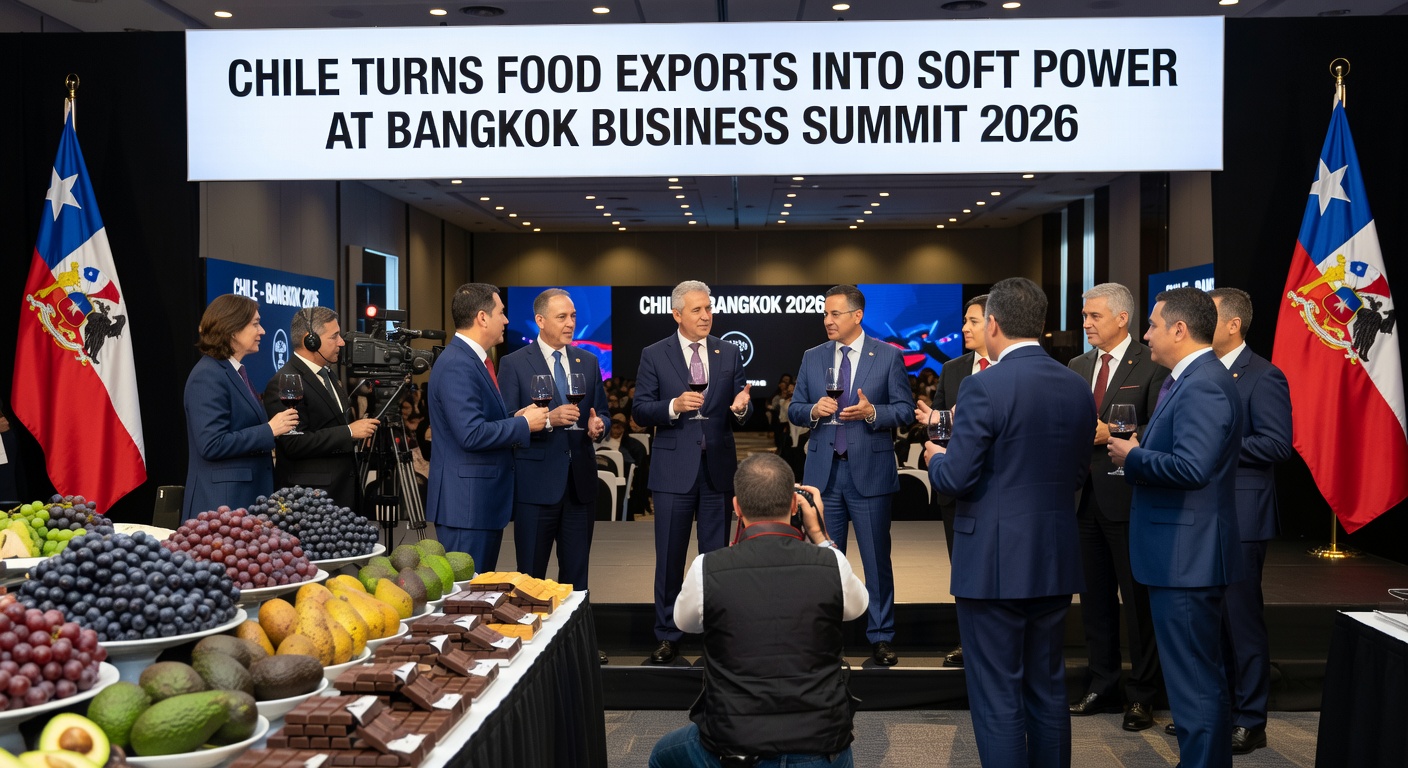
Chile Turns Food Exports Into Soft Power at Bangkok Business Summit 2026
Event Opens Doors to Deeper ASEAN Ties
BANGKOK — 28 May 2026. The Chile-ASEAN Business Summit 2026 opened this week at the Queen Sirikit National Convention Center, marking one of Chile’s most ambitious trade outreach efforts in Southeast Asia. Chilean exporters, Thai importers, retailers and food industry leaders gathered to explore how premium Chilean produce, seafood and wines can strengthen not only commercial links but also cultural understanding between Chile and the ten ASEAN nations.
More than 180 companies participated in the three-day program. The focus remained firmly on food, yet conversations quickly moved beyond price lists to questions of identity, sustainability and shared values. Chile’s delegation presented the gathering as an exercise in soft power, where cherries, salmon and Carménère wines serve as ambassadors for a nation seeking warmer relations with this dynamic region.
Chile’s Export Story and ASEAN Ambitions
Chile has long relied on its unique geography, stretching along the Pacific with deserts, mountains and fertile valleys that allow year-round production of temperate fruits. In 2025, the country exported US$12.4 billion in food products globally. ASEAN received only 4.8 percent of that total, yet the figure has grown 31 percent since 2022. Summit organizers noted that Thailand alone imported US$287 million worth of Chilean goods last year, led by fresh cherries, blueberries and Atlantic salmon.
Trade data shared at the summit showed that ASEAN’s middle class, now exceeding 150 million households, increasingly seeks traceable, high-quality imports. Chilean exporters see an opening. “We are not simply selling fruit,” said Trade Commissioner María Elena González. “We are offering a story of clean air, responsible farming and seasons that complement Thailand’s own calendar.”
Soft Power Through the Plate
Soft power rarely arrives in shipping containers, yet Chilean representatives argued that food creates emotional connections more effectively than formal diplomacy. During the summit’s gala dinner, guests tasted salmon cured with Thai lime and lemongrass alongside Carménère paired with som tum. The fusion menu sparked conversations about how two Pacific nations can honor each other’s culinary heritage while building new markets.
Thai chef and restaurateur Somchai Rattanakorn, whose Bangkok group operates twelve outlets, attended the tasting. “Thai diners appreciate balance—sweet, sour, salty, spicy. Chilean salmon carries a clean richness that works beautifully with our herbs,” he observed. “When customers ask where the fish comes from, I tell them about Chile’s cold waters. It becomes a story they remember and share.”
Concrete Deals and Future Projections
By the second day, several memoranda of understanding had already been signed. Thai retailer Villa Market committed to doubling its Chilean cherry volume to 800 tonnes for the 2026–2027 season. Cold-chain logistics company JWD InfoLogistics announced a new reefer facility at Laem Chabang port designed specifically for Chilean stone fruit and berries. The facility is expected to reduce transit time from Valparaíso by three days.
Economist Dr. Nattaya Prasert of Chulalongkorn University presented analysis showing that a 15 percent increase in Chilean food imports could add US$94 million annually to Thailand’s fresh-produce economy while supporting 1,200 direct jobs in distribution and retail. “The multiplier effect reaches farmers and packaging suppliers too,” she noted. “It is not zero-sum competition with local produce; it fills seasonal gaps.”
Sustainability and Traceability at the Core
Chilean exporters emphasized their country’s strict environmental standards. Salmon farms in the Los Lagos region operate under regulations that limit antibiotic use and require fallow periods. Cherry orchards in the Maule Valley use drip irrigation that consumes 40 percent less water than traditional methods. Blockchain traceability platforms now allow Thai buyers to scan a QR code and view harvest dates, water usage and labor certifications.
These details matter to Thai consumers increasingly concerned about food miles and ethical sourcing. A recent survey by the Thai Retailers Association found that 67 percent of Bangkok shoppers aged 25–40 are willing to pay a premium for verified sustainable imports. Chilean pavilions at the summit displayed soil-health data and carbon-footprint calculations alongside the fruit itself.
Voices From Both Sides of the Pacific
Ambassador of Chile to Thailand, Rodrigo Álvarez, described the summit as part of a deliberate pivot toward Asia. “Our foreign policy has long recognized that the future of trade lies across the Pacific. ASEAN offers not only markets but also partners who understand resilience after natural disasters and who value community-centered development,” he said.
Thai Deputy Minister of Commerce, Khunying Pornthip Hirunrak, echoed the sentiment. “Thailand welcomes partners who bring quality and transparency. We see Chile as a model for how a mid-sized economy can protect its environment while competing globally.”
Looking Ahead: Cultural Exchange and Long-Term Ties
Beyond immediate contracts, organizers scheduled workshops on culinary diplomacy and student exchange programs between Chilean agricultural universities and Thailand’s Kasetsart University. Plans are underway for a Chilean food festival in Bangkok’s Chinatown next February, timed with the arrival of the first 2027 cherry shipments.
The summit closed with a joint declaration committing both sides to annual business forums and a target of US$1.2 billion in two-way food trade by 2030. For Thai families who will soon see more Chilean blueberries in their local supermarkets, and for Chilean producers who will learn to adapt packaging to tropical humidity, the numbers tell only part of the story. The deeper narrative is one of two Pacific cultures discovering they have more in common than geography suggests.
This is Ann Srisawat for Global1 News, reporting from Bangkok. 🇹🇭
This article was produced with AI-assisted research and editorial support. Reporting is based on sources cited in the article.
What's Your Reaction?
 Like
0
Like
0
 Dislike
0
Dislike
0
 Love
0
Love
0
 Funny
0
Funny
0
 Wow
0
Wow
0
 Sad
0
Sad
0
 Angry
0
Angry
0

Southeast Asia Correspondent at Global1.News. Based in Bangkok, covering Thai and Southeast Asian politics, economy, technology, and culture. Deep regional perspective on one of the world's most dynamic regions.














Comments (0)