
Carney Unveils $2 Billion AI for All Strategy With 250,000 New Jobs Target
In a recent CBC News report, Prime Minister Mark Carney stood in Ottawa this week to launch Canada's long-awaited national artificial intelligence strategy, dubbed AI for All, backed by $2 billion in new federal investment. The comprehensive plan sets ambitious targets for job creation, AI literacy, sovereign computing infrastructure, and consumer protection — but has already d
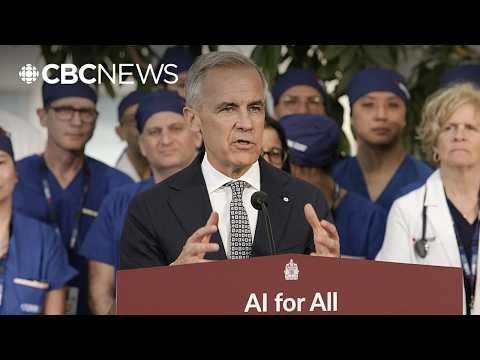
In a recent CBC News report, Prime Minister Mark Carney stood in Ottawa this week to launch Canada's long-awaited national artificial intelligence strategy, dubbed AI for All, backed by $2 billion in new federal investment. The comprehensive plan sets ambitious targets for job creation, AI literacy, sovereign computing infrastructure, and consumer protection — but has already drawn sharp criticism from opposition parties and labour groups who argue it does not go far enough to protect Canadian workers.
Carney Unveils $2 Billion AI for All Strategy With 250,000 New Jobs Target
Ottawa, Ontario – This week — Prime Minister Mark Carney officially unveiled Canada's AI for All strategy on Thursday, a sweeping plan that aims to transform how Canadians interact with artificial intelligence across every sector of the economy. The strategy promises at least $2 billion in new investment to achieve its goals over the coming decade.
Core Funding and Key Targets
The strategy sets measurable targets including raising business AI adoption from the current 12 per cent to 60 per cent by 2034 and creating 250,000 new jobs through AI adoption by 2031. These figures arrive as the Bank of Canada continues to monitor labour-market data amid elevated interest rates that have already strained household budgets from coast to coast. The largest single line item adds $700 million to the existing AI Compute Access Fund, bringing its total value to $1 billion and covering cloud-compute costs for approved Canadian researchers and firms.
Another $500 million expands the Regional AI Initiative, directing capital to startup incubators and scaling companies in Toronto, Montreal, Edmonton, and Vancouver. A further $50 million strengthens the Canadian AI Safety Institute, which will now track model risks and conduct independent evaluations of large language systems before they reach Canadian users. The strategy also creates a new AI Missions Program, with an initial $200 million tranche focused on measurable health outcomes such as faster diagnostic imaging and reduced surgical wait times within provincial medicare systems.
Workforce Training and Youth Employment
Free AI literacy training will be offered to one million entry-level post-secondary students across the country, delivered through existing federal-provincial agreements with colleges and universities. The government projects this program will generate 90,000 direct AI-related job opportunities for young Canadians within five years. AI Minister Evan Solomon described the overall package as a pro-worker plan that pairs skills development with regulatory guardrails.
The emphasis on youth employment carries particular weight in provinces where youth unemployment remains above the national average. By linking training directly to the Regional AI Initiative, the strategy aims to retain graduates who might otherwise leave for opportunities in the United States. Ottawa will additionally assess training and upskill offerings for mid-career workers, including in skilled trades, to scale up employer-led training nationwide with a strong priority on AI-related skills.

Consumer Protections and Online Safety
The strategy commits the government to modernising consumer privacy legislation, introducing dedicated online safety laws, requiring watermarking of AI-generated content, and strengthening election-integrity rules against deepfakes. A Canada Trusted AI certification program will allow consumers to identify products that meet federal standards for transparency and risk mitigation. These measures respond directly to documented cases of AI-generated disinformation already circulating during recent provincial elections.
Prime Minister Carney acknowledged specific risks including deepfakes, privacy erosion, and election interference during the Thursday announcement. The $50 million expansion of the Canadian AI Safety Institute is intended to provide the technical capacity for ongoing model evaluation, an area where Canada has lagged peer nations. Watermarking requirements will apply to both public and private sector deployments, creating a new compliance obligation for platforms operating in Canada.
Opposition and Labour Movement Responses
Conservative Deputy Leader Melissa Lantsman immediately questioned whether the Liberal government possesses the capacity to deliver the promised youth jobs, citing previous federal training programs that fell short of targets. NDP MP Don Davies labelled the plan reckless and inadequate, arguing that it leaves Canadians exposed to AI harms while echoing the priorities of large technology companies. He said the strategy was rushed and done with limited consultation. "Now they're mouthing the lines of tech billionaires," Davies said on the floor of the House of Commons.
The Canadian Union of Public Employees (CUPE) stated that the strategy places Big Tech profits ahead of worker protections, while Canadian Labour Congress president Bea Bruske called for stronger statutory limits, independent oversight bodies, and explicit safeguards against workplace surveillance and algorithmic discrimination. Valérie Pisano, CEO of Montreal's Mila institute, offered a contrasting view, describing the strategy as "balanced, robust, and complete" and noting that the combination of compute funding, safety research, and skills programs addresses gaps that have limited Canada's global standing in AI development.
Sovereign Infrastructure and International Positioning
The plan includes construction of a world-leading supercomputer by 2031 as part of a broader sovereign AI infrastructure initiative. Ottawa will also pursue a multilateral alliance intended to secure Canadian autonomy over critical AI supply chains and data governance. These elements respond to concerns that reliance on foreign compute capacity could expose Canadian research and defence applications to external control. The supercomputer commitment will require coordination with provincial power utilities, given the significant electricity demands involved in training frontier models.
A cross-party group of MPs and senators has already launched a campaign calling for Canada to negotiate an international trust-but-verify regime to prohibit the development of superintelligent AI that far surpasses human intelligence. The campaign, led by the non-profit Control AI, warns that without strong safeguards, AI poses an extinction risk on par with nuclear war. Supporters include Liberal MPs Judy Sgro, Jonathan Wilkinson, and Steven Guilbeault, as well as Conservative MPs William Stevenson, Cathay Wagantall, Joël Godin, and Arnold Viersen.
Economic and Fiscal Impact on Canadians
The $2 billion commitment occurs against a federal fiscal backdrop shaped by Bank of Canada interest-rate decisions and ongoing pressures on housing affordability. The strategy's job-creation targets are therefore presented not only as technology policy but as a contribution to broader economic resilience. If the 250,000 positions materialise, they would represent a meaningful offset to sectors still adjusting to higher borrowing costs. Implementation will require sustained federal-provincial transfers, because many of the training and adoption programs fall under provincial jurisdiction in education and health.
The first AI Missions Program allocation of $200 million for health outcomes will be watched closely by provincial health authorities seeking to reduce diagnostic wait times without increasing operating budgets. Public trust metrics, currently near the bottom of international comparisons, will serve as an early indicator of whether the certification program and safety investments translate into greater citizen confidence.
What Happens Next
The strategy now moves toward legislative implementation, with enabling bills expected to be tabled in the House of Commons in the coming weeks. The cross-party group campaigning against superintelligent AI development has signalled it will seek amendments during committee study. Provincial governments will need to negotiate their participation in the literacy training and health outcomes programs, reviving familiar federal-provincial coordination challenges seen in past pharmacare and childcare negotiations.
AI Minister Evan Solomon has indicated the government will release detailed implementation timelines in the coming months, along with specific regulatory proposals for the certification program and online safety measures. For Canadian workers, families, and businesses, the coming months of regulatory drafting and provincial negotiations will determine whether the ambitious targets announced this week become measurable milestones — or remain aspirational goals in a rapidly evolving technological landscape.
By Alex Thompson, Staff Writer
This article was produced with AI-assisted research and editorial support. Reporting is based on sources cited in the article.
What's Your Reaction?
 Like
0
Like
0
 Dislike
0
Dislike
0
 Love
0
Love
0
 Funny
0
Funny
0
 Wow
0
Wow
0
 Sad
0
Sad
0
 Angry
0
Angry
0

Canada Correspondent at Global1.News. Based in Toronto, covering Canadian politics, energy, trade, and US-Canada relations. Provides the Canadian perspective on North American and global affairs.















Comments (0)