
ADC primaries: Atiku’s acceptance speech (Full Text)
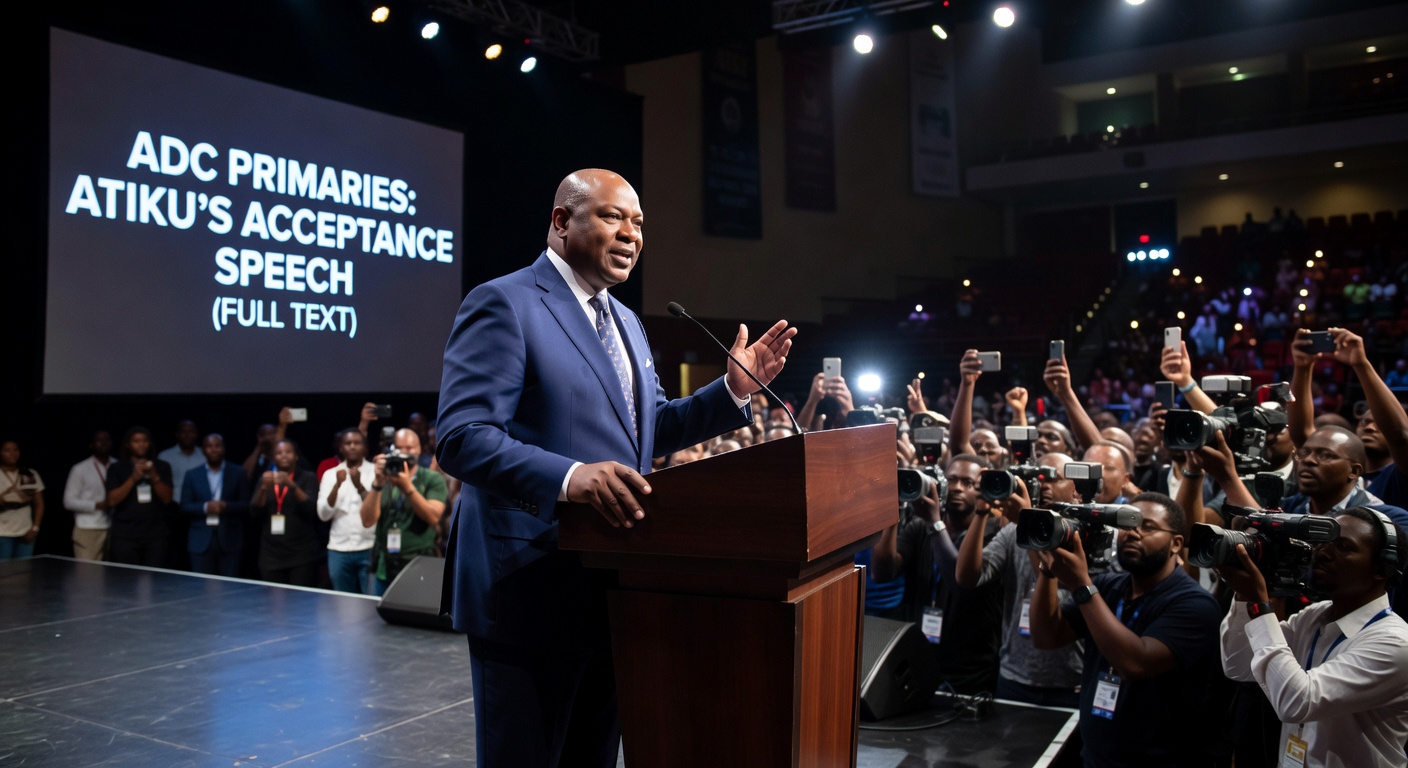
Atiku Abubakar Secures ADC Presidential Nomination with Decisive Primary Victory
In a development that has reshaped the contours of Nigeria’s opposition landscape, former Vice President Atiku Abubakar was declared the winner of the African Democratic Congress presidential primary on Saturday, polling 1,846,370 votes against former Minister of Transportation Rotimi Amaechi’s 504,117. The outcome, announced after collation across the 36 states and the Federal Capital Territory, positions Atiku as the standard-bearer for a party seeking to consolidate anti-incumbency sentiment ahead of the next general election cycle.
Primary Results and Immediate Reactions
The African Democratic Congress conducted its presidential primary through a combination of electronic voting and physical delegate accreditation, a format introduced to enhance transparency following internal reforms last year. Official tallies released by the party’s National Electoral Committee showed Atiku securing 78.6 percent of the 2,350,487 valid votes cast. Amaechi, who had positioned his campaign around infrastructure renewal and federalism, conceded shortly after the announcement.
Party chairman Ralph Nwosu described the exercise as “the most credible primary in our history,” citing real-time result transmission that reduced disputes. Independent observers from the Centre for Democracy and Development noted a turnout of approximately 62 percent among accredited delegates, an improvement on the 2022 cycle marred by logistical failures.
Atiku’s Acceptance Address: Core Messages
Delivering his acceptance speech at the Eagle Square venue in Abuja, Atiku framed his victory as a mandate for economic restructuring rather than personal ambition. “Nigeria cannot continue to export raw materials while our refineries remain comatose,” he stated, drawing sustained applause from delegates. He pledged to prioritise power sector liberalisation, port modernisation, and a single-digit interest-rate regime for manufacturers within 24 months of taking office.
The former vice president also addressed youth unemployment directly, announcing a proposed National Skills and Enterprise Bank capitalised at ₦2 trillion through public-private partnerships. “We will move from consumption to production; from oil dependency to diversified export earnings,” he said, signalling continuity with his long-standing advocacy for privatisation and fiscal federalism.
Background: Atiku’s Strategic Shift to ADC
Atiku Abubakar’s decision to contest under the ADC banner follows his exit from the Peoples Democratic Party after internal wrangling over delegate selection. The ADC, registered in 2006 and largely dormant until its 2022 rebranding, has attracted several mid-level politicians disillusioned with the two major parties. Analysts note that the party’s relatively clean legal record and limited godfather influence made it an attractive vehicle for Atiku’s organisational machinery.
His campaign team reported raising ₦18.4 billion in primary-related contributions, largely from northern business networks and southern industrialists. This war chest enabled extensive grassroots mobilisation across 774 local government areas, a scale Amaechi’s camp struggled to match despite strong South-South support.
Amaechi’s Campaign and Performance Analysis
Rotimi Amaechi entered the race emphasising his record as Rivers State governor and federal minister, particularly the completion of the Abuja-Kaduna and Lagos-Ibadan rail lines. He secured 21.4 percent of votes, performing strongly in Rivers, Akwa Ibom, and parts of the North Central. However, his late entry and limited national structure proved decisive handicaps.
Economic commentators argue that Amaechi’s focus on heavy infrastructure resonated less with delegates concerned about immediate liquidity constraints facing small and medium enterprises. “Voters wanted a message that spoke to working capital and forex access, not just rail tracks,” observed Lagos-based economist Dr. Aisha Suleiman.
Economic Implications and Market Response
Financial markets reacted cautiously to the result. The Nigerian Exchange recorded a 1.8 percent gain in banking stocks on Monday, reflecting investor expectations that Atiku’s pro-market stance could accelerate recapitalisation reforms. The naira, however, remained under pressure at the parallel market, closing at ₦1,685 per dollar amid ongoing foreign-exchange demand pressures.
Business associations welcomed Atiku’s emphasis on power and logistics. The Manufacturers Association of Nigeria issued a statement projecting a potential 15 percent reduction in production costs should the proposed power-sector concessions materialise. Conversely, labour unions expressed reservations over privatisation language, warning against job losses in state-owned enterprises.
Expert Perspectives on Opposition Realignment
Political economist Prof. Chinedu Okoro of the University of Lagos described the ADC primary as evidence of “fragmentation without fragmentation.” He noted that Atiku’s victory consolidates a significant bloc of PDP defectors while leaving the Labour Party and other opposition platforms to court the same urban youth demographic. “The real test will be whether ADC can convert primary momentum into credible gubernatorial and senatorial candidates across zones,” Okoro said.
International observers monitoring Nigeria’s democratic trajectory have flagged the primary’s electronic transmission system as a potential model, though they caution that scale-up to general elections will require legislative backing currently absent from the Electoral Act.
Forward Outlook: Challenges and Opportunities
Atiku now faces the dual task of unifying disparate factions within the ADC and articulating a costed policy platform that addresses Nigeria’s 33.3 percent inflation rate and 5.2 percent unemployment figure released by the National Bureau of Statistics last quarter. His campaign has scheduled economic roundtables in Kano, Onitsha, and Port Harcourt over the next six weeks to refine the manifesto.
With the Independent National Electoral Commission yet to release the final timetable for the next cycle, the ADC’s organisational edge remains its clearest advantage. Whether this primary result translates into broader electoral viability will depend on sustained fundraising, credible running-mate selection, and the party’s ability to counter narratives of recycled leadership.
This is Sarah Okafor for Global1 News, reporting from Lagos. 🇳🇬
This article was produced with AI-assisted research and editorial support. Reporting is based on sources cited in the article.
What's Your Reaction?
 Like
0
Like
0
 Dislike
0
Dislike
0
 Love
0
Love
0
 Funny
0
Funny
0
 Wow
0
Wow
0
 Sad
0
Sad
0
 Angry
0
Angry
0

Africa Correspondent at Global1.News. Based in Lagos, covering politics, business, technology, and culture across the continent. Focused on telling African stories beyond the headlines — the innovation, entrepreneurs, and communities shaping the region's future.















Comments (0)