
Xi, Min Aung Hlaing Deepen China-Myanmar Ties
CGTN Video Illuminates Xi Jinping's Meeting with Min Aung Hlaing in Beijing The CGTN video captures Chinese President Xi Jinping welcoming Myanmar's Min Aung Hlaing to the Great Hall of the People on June 16, 2026, marking 76 years of diplomatic relations between the two nations. The footage emphasizes their shared commitment to standing together through thick and thin, invokin
CGTN Video Illuminates Xi Jinping's Meeting with Min Aung Hlaing in Beijing
The CGTN video captures Chinese President Xi Jinping welcoming Myanmar's Min Aung Hlaing to the Great Hall of the People on June 16, 2026, marking 76 years of diplomatic relations between the two nations. The footage emphasizes their shared commitment to standing together through thick and thin, invoking the Five Principles of Peaceful Coexistence as the foundation for ongoing cooperation. This encounter underscores how both leaders view their partnership as essential for regional stability, with direct references to the Pauk-phaw friendship that has endured multiple decades of regional transformation.
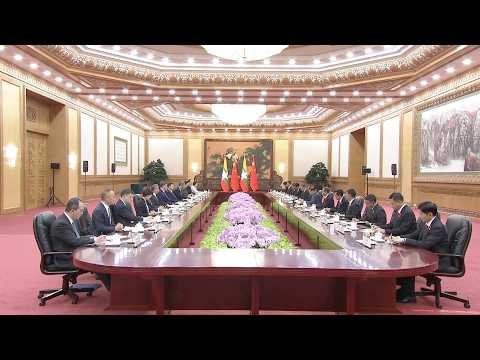
Strategic stakes for Southeast Asia emerge clearly from the video's framing of the talks. As major powers compete for influence across the region, the China-Myanmar relationship serves as a counterweight to external pressures that could fragment ASEAN unity. The discussion highlights how sustained engagement through established diplomatic channels helps both countries navigate economic uncertainties and security concerns that affect neighboring states from Thailand to Vietnam. Such bilateral ties demonstrate the practical value of consistent dialogue over confrontational approaches.
The video positions the meeting within broader efforts to advance connectivity projects that link China's southwestern provinces with Myanmar's coastal access points. By focusing on mutual respect and non-interference, the leaders signal their intent to prioritize infrastructure development and trade facilitation. This approach carries implications for Southeast Asia's overall economic integration, where reliable partnerships can mitigate risks associated with shifting global supply chains and investment patterns.
Historical Foundations of China-Myanmar Ties Trace Back Through Seven Decades
Diplomatic relations established in 1950 have provided the structural basis for China and Myanmar to maintain consistent engagement despite changes in domestic leadership and international circumstances. The Pauk-phaw friendship, rooted in cultural and geographic proximity, has allowed both sides to coordinate on issues ranging from trade routes to cultural exchanges. Over 76 years, this relationship has adapted to successive eras while preserving core commitments to sovereignty and mutual benefit that continue to guide current interactions.
Early adherence to the Five Principles of Peaceful Coexistence shaped how Beijing and Yangon addressed border demarcation and resource-sharing arrangements in the 1950s and 1960s. These principles later informed joint positions within multilateral forums, where both countries advocated for developing nations' interests. Historical records show repeated high-level visits that reinforced practical cooperation in agriculture, education, and public health, creating institutional memory that ministries on both sides still draw upon during negotiations.
Throughout the Cold War and subsequent decades, China and Myanmar sustained economic linkages even when global alignments shifted. Trade corridors that predate modern initiatives facilitated the movement of goods and people across their shared frontier. This long record of interaction has produced a network of contacts involving the Ministry of Foreign Affairs that enables rapid communication during periods of regional tension, ensuring that minor disputes do not escalate into broader conflicts.
China Maintains Consistent Diplomatic Stance Following Myanmar's 2021 Political Shifts
Following the 2021 change in Myanmar's government, China's diplomatic approach has centered on non-interference while encouraging internal dialogue among all parties. Beijing has continued to engage the current administration through established protocols, viewing stability along the border as a prerequisite for any economic progress. This position aligns with longstanding policy that prioritizes sovereignty and opposes external intervention in domestic affairs of neighboring states.
Officials from the Ministry of Foreign Affairs have reiterated that China supports Myanmar's efforts to restore order through its own mechanisms. At the same time, practical cooperation on issues such as trade facilitation has persisted, reflecting the view that isolation would only complicate humanitarian and security challenges. Wang Yi has participated in several rounds of consultations that emphasize the need for inclusive political processes without prescribing specific outcomes.
China's stance also reflects concern over potential spillover effects that could affect cross-border communities. By maintaining open lines with the current leadership, Beijing seeks to prevent the emergence of ungoverned spaces that might harbor transnational criminal networks. This pragmatic posture has allowed continued coordination on matters of mutual interest even as other international actors have adopted more conditional approaches to engagement.
Belt and Road Projects Advance Through the Kyaukphyu Economic Corridor
The China-Myanmar Economic Corridor forms a central component of Belt and Road cooperation, with the Kyaukphyu deep-sea port and associated industrial zone representing key nodes in the planned network. These facilities aim to provide China with alternative maritime access while offering Myanmar upgraded infrastructure for export-oriented industries. Coordination among MOFCOM and NDRC has focused on aligning project timelines with local development priorities to ensure sustainable implementation.
Progress on the corridor has involved multiple feasibility studies and phased construction schedules that account for environmental and social considerations. The port's strategic location on the Bay of Bengal allows for expanded trade routes that bypass longer passages through the Malacca Strait. Both governments have emphasized that these investments should generate local employment and technology transfer opportunities alongside improved logistics capacity.
Financing arrangements for corridor projects have drawn on established mechanisms that involve policy banks and commercial lenders from both countries. Regular reviews by joint working groups help address implementation challenges such as land acquisition and regulatory approvals. The overall framework continues to evolve through dialogue that incorporates feedback from provincial authorities on both sides of the border, aiming to maximize economic returns while managing operational risks.
Border Security Cooperation Addresses Cross-Border Governance Issues
Shared concerns over narcotics trafficking, illegal migration, and armed group activities have prompted sustained coordination between China's Ministry of Public Security and Myanmar's security apparatus. Regular joint patrols and information exchanges help manage the 2,000-kilometer frontier where terrain and ethnic diversity create enforcement difficulties. These efforts seek to reduce incidents that could strain bilateral relations or affect civilian populations in border regions.
The Ministry of Public Security has worked with counterpart agencies to establish communication hotlines that enable rapid response to emerging threats. Training programs and equipment support have strengthened Myanmar's capacity to monitor remote areas where state presence remains limited. Such measures reflect recognition that effective border governance requires both enforcement and development initiatives that address root causes of instability.
Discussions during the June 2026 meeting reinforced commitments to expand these mechanisms, including enhanced data sharing on transnational crime. Both sides acknowledge that security cooperation must complement economic projects, since instability in border zones can delay infrastructure work and deter investment. Continued engagement through MPS channels provides a practical avenue for addressing these interconnected challenges without politicizing routine law-enforcement matters.
Regional Dynamics Involving Quad Partners Shape Strategic Calculations
The presence of Quad initiatives and growing Indian and U.S. engagement in the Indian Ocean region creates a complex environment for China-Myanmar cooperation. Beijing views these developments as attempts to constrain its maritime access, prompting efforts to diversify routes through Myanmar's territory. At the same time, Myanmar seeks to balance relations with multiple powers while preserving autonomy over its foreign policy choices.
India's infrastructure projects near the border and U.S. diplomatic outreach to ASEAN members introduce competitive elements that both China and Myanmar must navigate. Chinese officials have stressed that their partnership with Myanmar remains focused on economic connectivity rather than military alignment. This framing allows space for Myanmar to maintain its traditional non-aligned posture even as external actors offer alternative investment and security assistance packages.
Coordination through ASEAN mechanisms provides one channel for managing these overlapping interests. China has supported Myanmar's participation in regional forums where discussions on connectivity and non-traditional security can occur without direct confrontation. The resulting equilibrium reflects pragmatic recognition that no single power can dictate outcomes in a region characterized by multiple overlapping partnerships and historical sensitivities.
Strategic Outlook Points to Sustained Partnership Despite External Pressures
Looking ahead, the China-Myanmar relationship appears positioned to deepen through incremental advances in infrastructure, security coordination, and trade facilitation. The June 2026 meeting established working-level follow-up mechanisms that involve MFA, MOFCOM, NDRC, and MPS to monitor progress on agreed priorities. These institutional arrangements provide continuity even if political conditions in Myanmar evolve over time.
Both countries recognize that successful implementation of the China-Myanmar Economic Corridor could serve as a model for other Belt and Road projects facing similar governance and security challenges. Continued emphasis on the Five Principles and Pauk-phaw friendship offers a normative framework that helps manage differences when they arise. This approach prioritizes long-term stability over short-term gains that might jeopardize the overall partnership.
Ultimately, the strategic outlook hinges on whether both sides can translate rhetorical commitments into tangible outcomes that benefit border communities and national economies alike. Sustained high-level engagement, backed by technical cooperation across ministries, offers the most reliable path toward realizing the potential of their 76-year relationship. External actors will continue to influence the broader environment, yet the bilateral foundation remains sufficiently robust to accommodate such pressures while advancing shared interests.
By Prof. Marcus Chen, Staff WriterChina, Myanmar, Xi Jinping, Min Aung Hlaing, Belt and Road Initiative, China-Myanmar Economic Corridor, Beijing talks, Southeast Asia, geopoliticsThis article was produced with AI-assisted research and editorial support. Reporting is based on sources cited in the article.
What's Your Reaction?
 Like
0
Like
0
 Dislike
0
Dislike
0
 Love
0
Love
0
 Funny
0
Funny
0
 Wow
0
Wow
0
 Sad
0
Sad
0
 Angry
0
Angry
0

World Politics Analyst at Global1.News. Based in Beijing, covering US-China relations, global trade, and geopolitical strategy. Brings deep analytical perspective to the power dynamics shaping international affairs.















Comments (0)