
When the Sparkle Fades: How Lab-Grown Diamonds Are Reshaping Sierra Leone's Mining Heartland
When the Sparkle Fades: How Lab-Grown Diamonds Are Reshaping Sierra Leone's Mining Heartland There is something deeply humbling about watching a man sift through mud by hand, hoping to find a stone that could change his life. In the diamond-rich district of Kono, Sierra Leone, this scene has played out for generations. Men stripped to the waist, shovelling gravel into sieves, w
When the Sparkle Fades: How Lab-Grown Diamonds Are Reshaping Sierra Leone's Mining Heartland
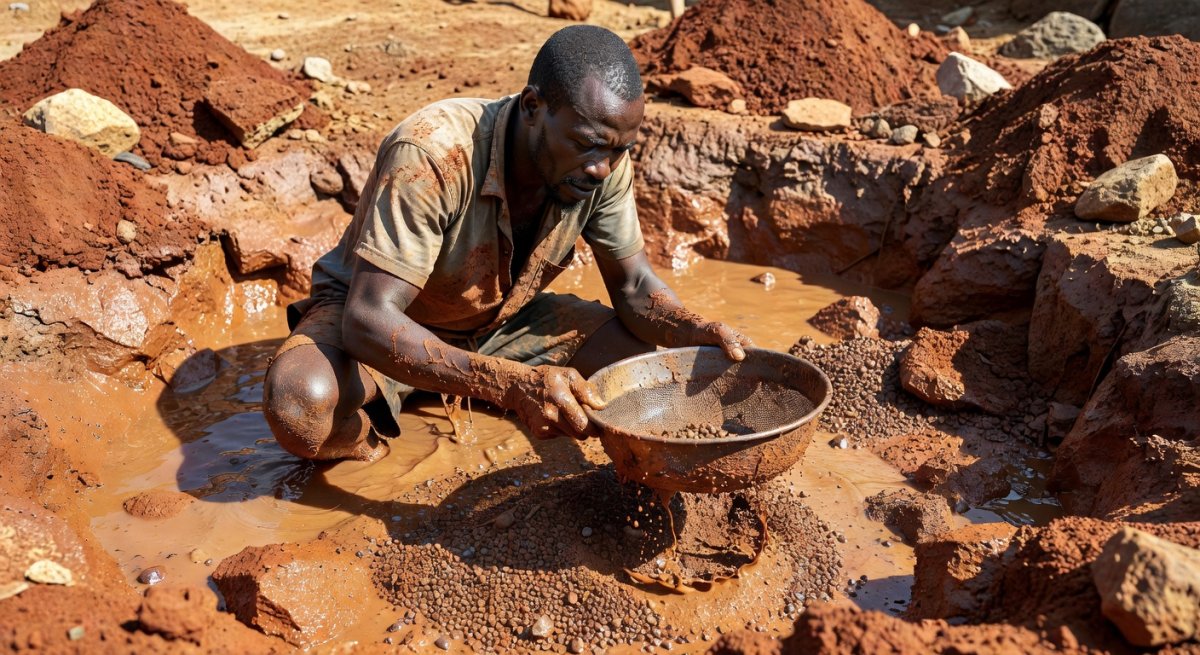
There is something deeply humbling about watching a man sift through mud by hand, hoping to find a stone that could change his life. In the diamond-rich district of Kono, Sierra Leone, this scene has played out for generations. Men stripped to the waist, shovelling gravel into sieves, washing it gently, watching patiently for the glint of a precious gem. But these days, the glint is becoming ever more rare — and the dreams are getting harder to hold onto.
Daniel, a foreman at one of the many informal small-scale mines scattered across Kono's red earth, put it plainly when I spoke with him. "We put the gravel in water and we wash it," he explained. "If there is anything like a diamond or any bright stone, we can see it." But the finding has become more prayer than process. "I have not made a lot of money yet," he admitted. "Sometimes for the whole of the year you can't get anything. It is by the grace of God that you find a diamond. We are just dreaming, really. We still have that hope."
That hope, however, is being tested like never before. Across the globe, a quiet revolution in the diamond industry is reshaping the market — and its consequences are being felt most acutely in places like Kono, where diamond mining has been the lifeblood of communities since the 1930s.
The Lab-Grown Revolution
The rise of lab-grown diamonds has been nothing short of transformative. Chemically and physically identical to natural diamonds, these factory-made stones are produced in laboratories — primarily in India and China — using two main technologies: High Pressure High Temperature (HPHT) and Chemical Vapour Deposition (CVD). And they cost significantly less — up to 70 per cent cheaper than their mined counterparts.
The result has been a dramatic fall in the global price of natural diamonds. In just the past four years, the retail price of polished natural diamonds has dropped by approximately 40 per cent. For the small-scale miners of West Africa, who rely on every carat they find to feed their families, this price collapse has been devastating.
In Sierra Leone, the impact has been immediate and severe. The country's largest diamond mine, Koidu Holdings, closed last year with the loss of 1,000 jobs following a bitter industrial dispute. While the company officially cited the cost of the dispute and security concerns as reasons for the closure, insiders have quietly acknowledged that the weakness of the global diamond market played a significant role.
Kono's Double Burden: Then and Now
Kono has endured more than its share of hardship. This region became infamous during Sierra Leone's brutal 11-year civil war, when diamonds fuelled the conflict that claimed more than 50,000 lives and left hundreds of thousands maimed or displaced. The 2006 Hollywood film "Blood Diamond," starring Leonardo DiCaprio, brought global attention to the human cost of the trade.
Augustine Shekho, Kono's governor, carries the scars of that war personally. His own mother was killed during the conflict. "They shot at random, they killed people, burnt the entire town," he told me, the pain still evident in his voice. "All houses were mined. It was a war of terror... She, my mother, unfortunately, was the victim of that. It was a nightmare. I would really not want to think about it."
Today, Kono faces a different kind of battle — one against global market forces that threaten to make the diamond trade that rebuilt this region economically unsustainable. The closure of Koidu Holdings has pushed many former employees into informal mining, where pickings are thin and the work is backbreaking.
"Lower diamond values have reduced earnings for miners, constrained investment, and weakened local economic activity," Shekho said, describing the accumulating pressures on the region.
The People Left Behind
Abubakar Amara, a primary school teacher in Kono, offered a perspective that many in the community share. "To me the diamonds have failed us," he said bluntly. "What have those diamonds done for our community, for Kono, for Sierra Leone? We are considered as poor in the world."
There is a bitter irony here. Kono is a region that has given the world some of its most beautiful gems, yet the communities that live atop these deposits remain among the poorest in Sierra Leone. The schools are underfunded, the roads are rough, and the hospitals lack basic equipment. The wealth that has flowed out of Kono's soil has rarely flowed back into its people's lives.
A Fairer Future? The Gemfair Initiative
In response to these challenges, a new initiative called Gemfair is trying to change the narrative. Backed by the British multinational De Beers — one of the world's largest diamond companies — Gemfair aims to create a kind of fair-trade system for artisanal miners in Sierra Leone. Local miners are offered equipment, training, and more transparent pricing for their finds.
Raymond Alpha, Gemfair's local representative, explained the vision. "The idea is to connect with markets so that they can be able to find a place to sell their diamonds, and also to empower them, give them training, we give them skills."
David Johnson, a De Beers representative, framed the initiative within a broader trend in consumer consciousness. "We are seeing a growing interest from consumers," he said. "With people increasingly wanting to know where their coffee, cotton or chocolate has come from, it's not surprising that people also want to know where their diamond — one of the most emotionally significant purchases — has come from."
The goal is clear: to allow retailers to trace every diamond back to its origin, providing consumers with the assurance that their gem was mined ethically and sustainably. For an industry still haunted by the legacy of conflict diamonds, this kind of transparency could be transformative.
Lab-Grown vs. Natural: The Environmental Debate
Proponents of lab-grown diamonds argue that the synthetic alternative is not only more affordable but also more ethical and better for the environment. Rohit Mehta, chief executive of Forlink Ventures, a commodities house based in India's lab-grown diamond capital, Surat, made this case clearly. "People are more conscious about climate change, about extracting too much from the earth," he said.
But the claim that lab-grown diamonds are "green" does not sit well with everyone. Unlike natural diamonds, which require mining and its attendant environmental costs, lab-grown diamonds require significant energy to produce — often in countries where coal-fired power plants dominate the grid. The carbon footprint of a lab-grown diamond can be substantial, and environmental groups have begun to question whether the alternative is truly as clean as its advocates claim.
A Continent at the Crossroads
For Africa, the rise of lab-grown diamonds presents both a challenge and an opportunity. On one hand, countries like Sierra Leone, Botswana, Namibia, and Angola — which rely heavily on diamond revenues — face the prospect of a permanent decline in the value of their most precious natural resource. The closure of mines, the loss of jobs, and the erosion of local economies are real and present dangers.
On the other hand, the growing demand for ethical sourcing and traceability could create new opportunities for African diamond producers who can demonstrate their commitment to fair labour practices and environmental responsibility. The Gemfair initiative in Sierra Leone is one example of how this might work, but it will need to scale significantly to make a real difference.
For the men and women who still toil in the mud of Kono, hoping for that one brilliant stone that could change everything, the future remains uncertain. The global market that determines the value of their work is shifting beneath their feet, and no one can say with certainty where it will settle.
What is certain is the resilience of the people. In the face of falling prices, mine closures, and a changing industry, they continue to dig, to sift, to hope. As Daniel told me, standing in the Kono sun with gravel running through his fingers: "We are just dreaming, really. We still have that hope."
In a world that is changing faster than ever, sometimes hope is the most precious stone of all.
By Amara Diop, Staff Writer
This article was produced with AI-assisted research and editorial support. Reporting is based on sources cited in the article.
What's Your Reaction?
 Like
0
Like
0
 Dislike
0
Dislike
0
 Love
0
Love
0
 Funny
0
Funny
0
 Wow
0
Wow
0
 Sad
0
Sad
0
 Angry
0
Angry
0

Canada Correspondent at Global1.News. Based in Toronto, covering Canadian politics, energy, trade, and US-Canada relations. Provides the Canadian perspective on North American and global affairs.















Comments (0)