
What To Know About Manhattanhenge, New York's Sunset Spectacle
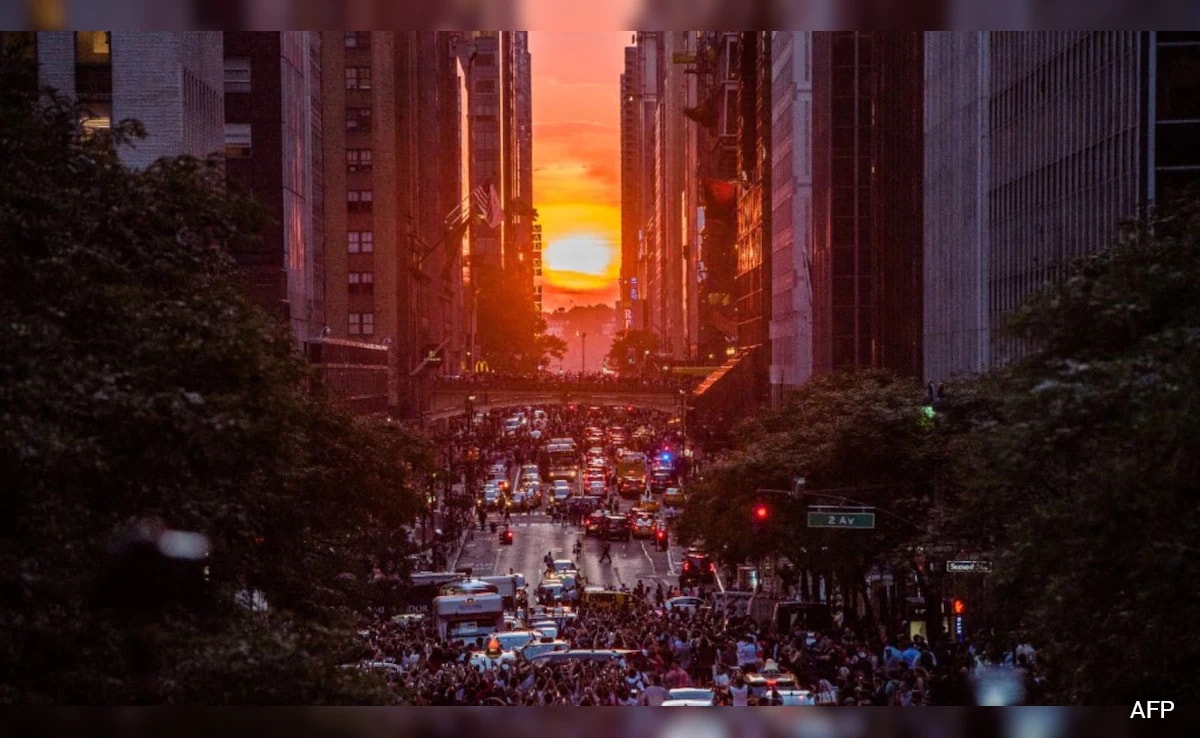
Manhattanhenge draws widespread attention each time the sun aligns precisely with Manhattan’s east-west street grid, turning ordinary avenues into natural frames for a dramatic sunset. This alignment transforms the city’s rigid urban layout into a stage for a celestial display, pulling residents and visitors alike to open stretches of pavement where the horizon glows uninterrupted. The event underscores how New York’s planned geometry intersects with astronomical cycles, creating a rare moment when science, architecture, and daily life converge in public space.
The phenomenon matters now because it highlights the enduring appeal of predictable natural events amid a dense metropolis. With viewing concentrated on the city’s broad east-west thoroughfares—14th Street, 23rd Street, 34th Street, 42nd Street, and 57th Street—crowds gather to witness the sun’s disk nestle between building lines. These locations offer unobstructed sightlines that amplify the spectacle, turning routine commutes into shared observations of planetary motion.
The Geometry of Manhattan’s Grid and Solar Alignment
Manhattan’s street plan, laid out in the early nineteenth century, follows a strict orthogonal pattern that runs roughly parallel to the compass points. This rigid design means that on specific evenings the setting sun travels directly down the corridors formed by the numbered streets. The result is a tunnel of light bounded by skyscrapers and brownstones, where the solar orb appears to rest at the vanishing point. Such alignments are not accidental; they emerge from the interplay between latitude, the tilt of Earth’s axis, and the fixed orientation of the avenues. Observers positioned on the listed thoroughfares benefit from the extra width of these corridors, which reduces foreground obstruction and allows the full diameter of the sun to remain visible longer. The same geometry that facilitates efficient movement of traffic also creates the optical channel required for the spectacle, demonstrating how functional urban planning inadvertently produces aesthetic opportunities.Strategic Viewing Corridors and Their Practical Advantages
The five designated streets stand out because each possesses sufficient width and minimal elevation changes to preserve a clear western horizon. On 14th Street, the relatively low density of mid-block towers near the western end provides an early vantage. Further north, 23rd Street offers similar clearance, while 34th Street benefits from the open expanse near the Hudson River. Forty-second Street cuts through the heart of Midtown, where the canyon effect is most pronounced yet still yields a defined frame when the sun descends. Fifty-seventh Street, with its broader right-of-way and proximity to open plazas, completes the sequence. These arteries function as calibrated sightlines; any deviation to narrower cross streets immediately introduces visual clutter from adjacent structures. City planners could not have foreseen the solar application of their grid, yet the consistent spacing and orientation now support an annual public ritual that requires no additional infrastructure.Scientific Context and Predictable Recurrence
The alignment depends on Earth’s orbital position relative to the sun and the fixed azimuth of Manhattan’s streets. Because the planet’s axial tilt produces seasonal shifts in sunset direction, the precise match occurs twice each year—once in late spring and once in midsummer. The recurrence is calculable years in advance using basic spherical astronomy, allowing residents to plan attendance without reliance on weather-dependent forecasts alone. This predictability distinguishes Manhattanhenge from transient atmospheric events such as eclipses or meteor showers. It also illustrates how modest differences in latitude affect the timing of sunset across the five boroughs, with the core Manhattan grid experiencing the alignment while adjacent areas see the sun set slightly offset. The phenomenon therefore serves as a live demonstration of coordinate geometry and celestial mechanics, accessible without telescopes or specialized equipment.Cultural Resonance and Urban Implications
Beyond its astronomical basis, the event fosters collective experience in a city often defined by individual routines. Photographers, commuters, and families converge on the same sidewalks, temporarily altering the rhythm of pedestrian flow. Traffic patterns shift as participants pause mid-block, and social media amplifies the shared imagery, extending the moment beyond physical presence. From an urban-planning perspective, Manhattanhenge reveals how legacy infrastructure can generate unexpected value. The same streets engineered for commerce and movement now support informal public gatherings that require no permits or staging. This incidental benefit encourages discussion about preserving open sightlines amid ongoing high-rise development, since additional towers could eventually narrow the effective viewing corridors. The spectacle thus functions as a reminder that city design carries long-term cultural consequences beyond its original engineering intent.Preparing for Subsequent Occurrences and Sustained Interest
As the current alignment passes, attention naturally turns to the next predictable window when the sun will again track the grid. Advance awareness allows residents to adjust schedules, secure vantage points, and coordinate group viewings. Local authorities may consider temporary traffic adjustments or public-safety measures at the busiest intersections to accommodate the influx without disrupting essential movement. Over successive years, the event’s visibility is likely to grow as digital documentation circulates and new generations discover the alignment. Continued monitoring of skyline changes will determine whether the five primary corridors retain their clarity or require supplementary locations. In this way, Manhattanhenge offers an ongoing case study in the intersection of celestial mechanics, municipal history, and communal observation—repeating at intervals set by orbital mechanics rather than human calendars.By Dr. Raj Patel, Staff Writer
This article was produced with AI-assisted research and editorial support. Reporting is based on sources cited in the article.
What's Your Reaction?
 Like
0
Like
0
 Dislike
0
Dislike
0
 Love
0
Love
0
 Funny
0
Funny
0
 Wow
0
Wow
0
 Sad
0
Sad
0
 Angry
0
Angry
0

Dr. Raj Patel
India/South Asia Correspondent at Global1.News. Analytical voice with a background in science and health journalism. Based in New Delhi, covering Indian politics, education, healthcare, technology, and policy. Breaks down complex data into clear, actionable reporting.















Comments (0)