
Venezuelans March for Elections Five Months After Maduro...
** Venezuelans March for Elections Five Months After Maduro Capture **Meta Description:** Five months after US forces captured Nicolás Maduro, hundreds marched in Caracas demanding elections. Delcy Rodríguez's interim government resists as María Corina Machado leads polls and Venezuela's crisis deepens. **Keywords:** Venezuela elections, Nicolás Maduro capture, Delcy Rodríguez
The March to the US Embassy
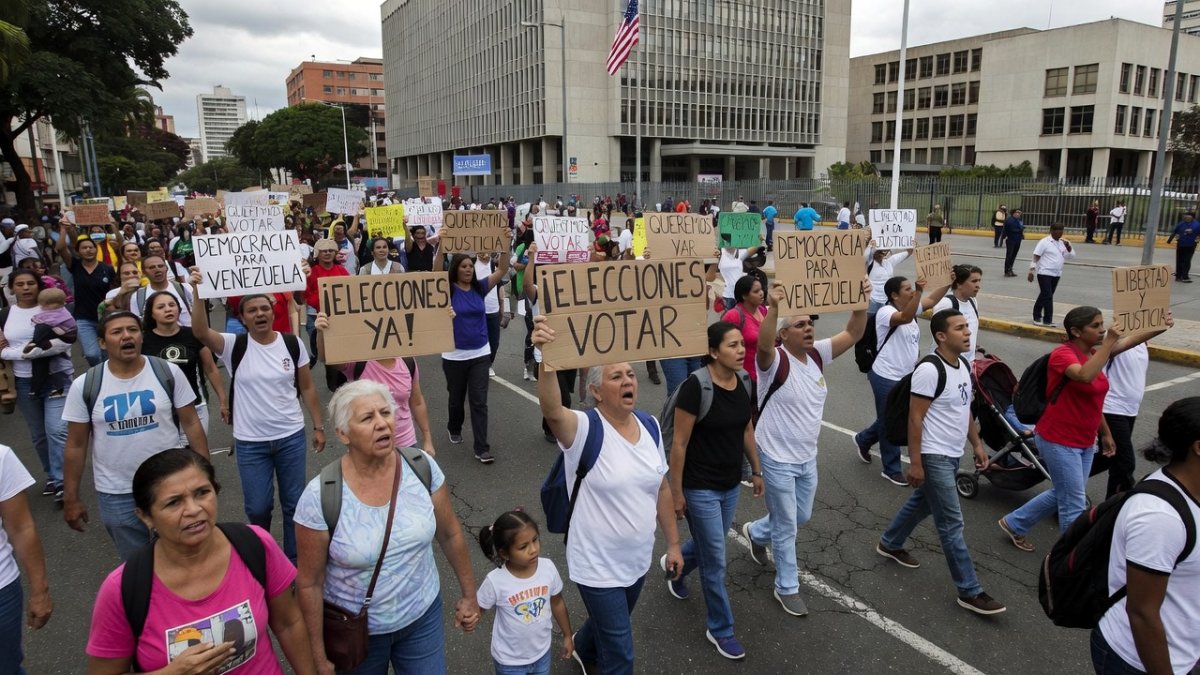
In a recent DW News report, hundreds of Venezuelans walked through Caracas on June 4, 2026, to the US embassy gates, chanting for presidential elections exactly five months after US forces captured Nicolás Maduro.
Protest organizers carried signs listing the constitutional deadline that passed in early April without any vote. Families from the Petare barrio joined students from Universidad Central de Venezuela and workers from the PDVSA oil fields.
The crowd demanded the interim government set a date before the end of 2026. Many participants had relatives who fled to Colombia or Brazil during the past decade of economic collapse.
Maduro's Capture and the Political Vacuum
US forces captured President Nicolás Maduro on January 3, 2026, during a military raid and flew him to New York to face drug trafficking charges. Vice President Delcy Rodríguez was sworn in as interim president three days later on January 6.
The FANB military command and SEBIN intelligence service kept their leadership in place under the new interim administration. Top officials including Diosdado Cabello and Jorge Rodríguez retained their influence in Caracas.
This sudden power shift left the Asamblea Nacional and Tribunal Supremo de Justicia operating under the same structures that existed before the raid. No new elections were scheduled despite the constitutional requirement for a vote within 30 days of a permanent vacancy.
The Interim Government's Resistance to Elections
Delcy Rodríguez traveled to Turkey in early June 2026 for talks with President Erdogan while opposition groups continued to press for a vote. The interim government has not announced any timeline for presidential elections.
Polls conducted in recent months show between 68 and 91 percent of Venezuelans want elections held immediately. María Corina Machado, the opposition leader and Nobel Peace Prize laureate, leads Delcy Rodríguez 67 percent to 25 percent in those surveys.
The Consejo Nacional Electoral has not published any voter registry updates or ballot preparation steps. Opposition parties accuse the interim administration of delaying the process to maintain control over PDVSA revenues and state institutions.
The Venezuelan People's Demand for Democracy
María Corina Machado addressed crowds in Valencia and Barquisimeto in recent weeks, telling families that free elections represent the only path out of the current crisis. Supporters in Ciudad Guayana collected signatures demanding the CNE set a firm date.
Healthcare workers at Caracas hospitals joined the June 4 march, describing how collapsed clinics in Maracaibo and Barquisimeto lack basic medicines. Students from universities across the country carried banners calling for international observers from the OAS and UN.
The diaspora community in Miami and Madrid organized simultaneous demonstrations on the same day, linking their calls for elections to the millions who left Venezuela during the years of hyperinflation and fuel shortages.
The Economic and Humanitarian Crisis
Hyperinflation continues to erode salaries for public sector workers while fuel shortages force long lines at gas stations in Caracas and surrounding states. Chevron and other international oil companies have begun returning under new agreements reached during the Trump administration.
Millions of Venezuelans remain displaced across Colombia, Brazil, Guyana, and Trinidad and Tobago, creating the largest migration crisis in the Western Hemisphere. Families in ranchos outside Valencia report daily struggles to find affordable food and medicine.
The interim government has not released new economic data since taking power. Healthcare facilities in the interior report continued shortages of antibiotics and vaccines, leaving communities vulnerable to preventable diseases.
Regional Implications for Latin America
The political standoff in Caracas affects neighboring countries through continued migration flows and uncertain energy supplies. Colombia and Brazil host the largest numbers of Venezuelan refugees and have called for swift elections through UNASUR and CELAC channels.
The US State Department and European Union have urged the interim government to respect the constitutional timeline. ALBA nations have remained largely silent while the OAS prepares to send a fact-finding mission to Caracas.
Oil production deals involving Repsol and Rosneft remain on hold pending clearer political signals. Regional analysts note that prolonged uncertainty could strengthen criminal networks operating along the Colombia-Venezuela border.
What to Watch For
Opposition leaders plan additional marches in Maracaibo and Ciudad Guayana if the interim government fails to announce an election date by late June. María Corina Machado has stated she will run if free and fair conditions are guaranteed.
International pressure from the US State Department and EU foreign ministers is expected to increase in coming weeks. Any decision by Delcy Rodríguez to extend her interim mandate beyond constitutional limits could trigger new sanctions discussions.
Venezuelan families inside the country and across the diaspora continue to monitor developments in New York, where Nicolás Maduro awaits trial, and in Caracas, where the demand for elections grows louder each week.
By Rosa Martinez, Staff WriterThis article was produced with AI-assisted research and editorial support. Reporting is based on sources cited in the article.
What's Your Reaction?
 Like
0
Like
0
 Dislike
0
Dislike
0
 Love
0
Love
0
 Funny
0
Funny
0
 Wow
0
Wow
0
 Sad
0
Sad
0
 Angry
0
Angry
0
Latin America/Andes Correspondent at Global1.News. Based in Bogota, covering politics, environment, energy, and social movements across the Andean region. Passionate about environmental journalism and communities protecting their land.









Comments (0)