
US Navy Escorts 20 Tankers Nightly Through Strait of Hormuz, Burgum Confirms
The Midnight Convoys: Burgum Confirms What Washington Wouldn't Say Interior Secretary Doug Burgum sat down on CNBC on June 12, 2026, and finally said what the Pentagon had been dancing around for months. The United States Navy is escorting more than twenty oil tankers every single night through the Strait of Hormuz under armed guard. Not some nights. Most nights. Twenty-plus su
The Midnight Convoys: Burgum Confirms What Washington Wouldn't Say
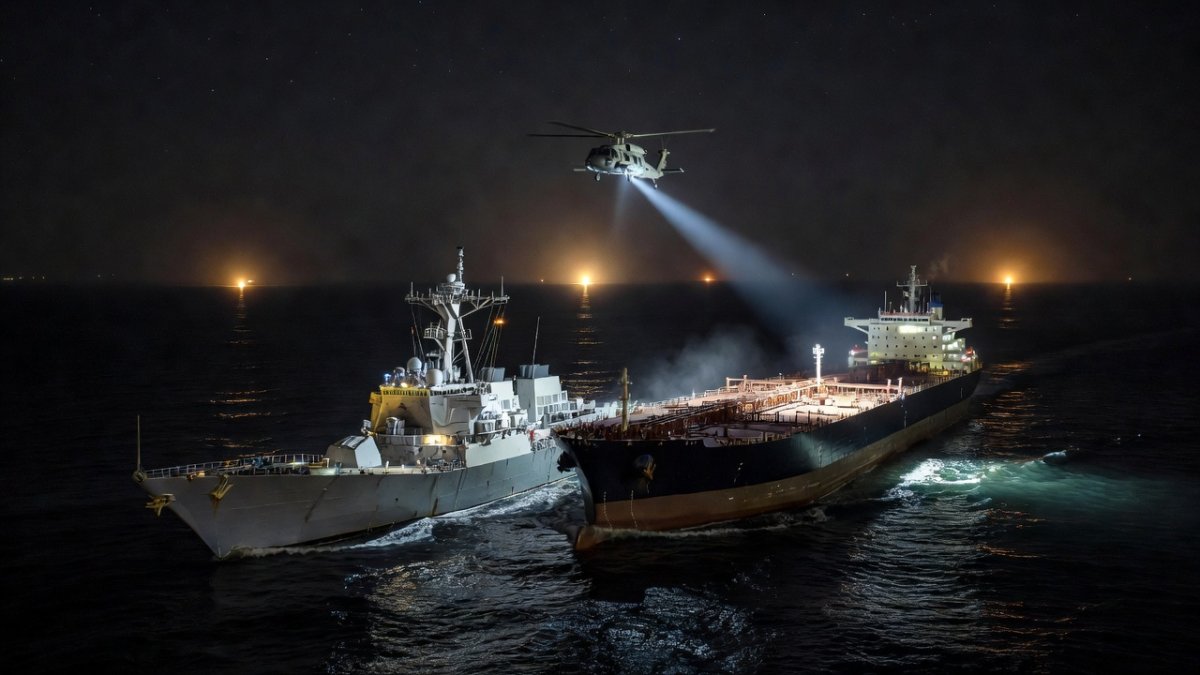
Interior Secretary Doug Burgum sat down on CNBC on June 12, 2026, and finally said what the Pentagon had been dancing around for months. The United States Navy is escorting more than twenty oil tankers every single night through the Strait of Hormuz under armed guard. Not some nights. Most nights. Twenty-plus supertankers, each carrying up to two million barrels of crude, sliding through pitch-black water with destroyers on their flanks and helicopters overhead. Burgum didn't frame it as a crisis. He presented it as an operational success. But folks, when you have to hide the world's most important oil route under cover of darkness, that is not success. That is triage.
Burgum laid out the numbers without apology. He told host Becky Quick that the escort fleet now includes four Arleigh Burke-class destroyers rotating on 48-hour cycles plus two littoral combat ships for mine countermeasures. Satellite tracking from MarineTraffic shows the convoys departing Bandar Abbas anchorage between 2200 and 0200 local time. That schedule keeps Iranian fast boats and drones in the dark literally and figuratively. The secretary called it routine protection of freedom of navigation. You know better.
The admission landed because the rest of Washington still pretends the strait runs normally. Pentagon briefers last month refused to confirm even the existence of a standing escort mission. Burgum cut through the fog in one interview. He named the 5th Fleet commander by title and cited daily transit counts that matched what commercial analysts had already leaked. The message was clear: the administration finally stopped pretending the problem would solve itself.
The February Strikes That Broke the Strait
US and Israeli strikes hit Iranian coastal batteries and Revolutionary Guard naval bases in late February 2026. Within 72 hours, Hormuz traffic fell 70 percent according to Marine Insight data. Tankers that normally transited every 90 minutes suddenly vanished from AIS screens. Insurance underwriters at Lloyd's syndicates raised war-risk premiums 400 percent overnight, matching rates last seen during the 1980s Tanker War. The National UAE reported that 47 vessels diverted to the Cape route in the first week alone.
Iran responded with a mine-laying operation that closed the inbound lane for nine days. US Central Command confirmed 14 contact mines swept between 25 February and 4 March. The remaining traffic sat at anchor off Fujairah and Salalah, burning bunker fuel while waiting for clearance. Historical parallels are exact: just like 1984 through 1988, the strait became a chokepoint where one side could impose costs without firing another shot.
Oil traders watched the physical market seize up in real time. Saudi Aramco declared force majeure on two cargoes bound for Japan. Asian refiners bid Brent futures 11 dollars higher in a single session. The strikes achieved their tactical goal of degrading Iranian naval assets, yet they exposed how little spare capacity exists outside that narrow waterway. Every diverted barrel now carries an extra 12-day voyage and a visible price tag.
Clearing the Mines, Locking the Night Schedule
Mine clearance wrapped by mid-March, yet the Navy kept the night-only transit rule in place. Bloomberg and the Washington Examiner both confirmed 22 tankers moved under escort on the night of 18 April. Arleigh Burke destroyers provided outer screen while MH-60R helicopters flew infrared sweeps ahead of each formation. Littoral combat ships trailed with unmanned surface vessels hunting residual mines. The decision was deliberate: daylight transits remained too risky for political and insurance reasons.
Transit times lengthened 36 hours on average, according to S&P Global Commodity Insights. That extra steaming burns roughly 180 metric tons of fuel per very large crude carrier. Insurance costs climbed another 12 percent in May as underwriters priced the ongoing escort requirement into every policy. Shipowners absorbed part of the hit, but the rest passed straight to refiners and then to drivers.
The Navy now treats the strait like a contested corridor rather than an open waterway. Convoys assemble at designated rendezvous points south of Abu Musa Island, then run the 21-mile transit in blackout conditions. No public schedule exists. Commercial operators receive encrypted routing instructions 12 hours before departure. The system works, but it is the definition of managed decline rather than restored freedom of navigation.
Global Oil Markets: Calmer on Paper, Fragile in Reality
Brent crude dropped 4 dollars and 80 cents the day after Burgum spoke, then clawed back every cent within 48 hours. WTI settled at 94 dollars per barrel on the June contract. Implied volatility on the one-month options strip hit 48 percent, double the five-year average tracked by Yahoo Finance. The paper market absorbed the news because traders already priced in the escort reality. Physical barrels tell a different story.
Asian buyers are scrambling for West African and US Gulf alternatives. Chinese teapots booked four VLCCs from Nigeria last week at a 3-dollar premium to Dubai. Saudi Aramco quietly rerouted two cargoes around the Cape of Good Hope to avoid the strait entirely. Those voyages add 26 days and roughly 2.40 dollars per barrel in freight. The risk premium refuses to disappear because the underlying chokepoint has not been fixed.
Refiners in South Korea and Japan now carry 45 days of inventory instead of the usual 28. That buffer costs money and still leaves them exposed if another incident closes the strait for even a week. The calm on futures screens masks a brittle supply chain that depends on nightly destroyer runs and helicopter overwatch. One successful Iranian drone strike would erase the temporary price relief in a single session.
The Strategic Failure Behind the Tactical Success
The escort operation reveals that the United States never built scalable pipeline or port alternatives to Hormuz. The Strategic Petroleum Reserve sits at 340 million barrels, down from 727 million in 2019. Domestic shale production runs at 13.8 million barrels per day, yet that crude still needs Gulf Coast export terminals and buyers willing to pay the freight. No combination of rail, pipeline, or new terminals can replace the 21 million barrels that normally move through the strait each day.
The escort mission itself is expensive. Each destroyer deployment costs roughly 2.3 million dollars per week in fuel, maintenance, and crew tempo. Those costs will eventually appear in the defense supplemental now being drafted on Capitol Hill. The policy conversation has shifted from releasing SPR barrels to protecting the physical pathways that deliver them. That is an admission that the spare capacity simply does not exist.
Shale producers in the Permian and Bakken cannot absorb the shortfall because takeaway capacity and refinery configuration limit their flexibility. The tactical success of nightly convoys therefore rests on a strategic failure to diversify routes years earlier. Every additional dollar spent on destroyers and helicopters is a dollar not spent on pipelines from Alberta or expanded export docks in Corpus Christi.
What This Means for American Families
AAA projects a 22-to-25-cent-per-gallon increase at the pump by Labor Day. Truckers will feel it first. Diesel already trades 31 cents above gasoline on the Gulf Coast rack, and those spikes move directly into grocery and housing costs. The average household will pay an extra 400 dollars this year just to keep the same driving and shopping patterns. Drivers on I-85 outside Atlanta will see the change on their dashboards before August.
Independent truckers operating on thin margins are already parking rigs on weekends. That reduces capacity and pushes freight rates higher, which shows up in everything from produce to lumber. The escort tax is not a headline abstraction. It is the difference between filling a 20-gallon tank for 78 dollars or 83 dollars every week.
Heating oil contracts for next winter already reflect the same risk premium. Families in the Northeast who locked in summer fills are paying 12 percent more than last year. The convoy schedule may look like a military success story, but the bill lands at the pump, the grocery aisle, and the thermostat. You will pay it whether Washington calls the operation routine or not.
What You Can Do About It
Contact your senators today and demand they fund the stalled pipeline and port projects that would bypass Hormuz. The energy infrastructure permitting bill sitting in committee needs 60 votes. Tell them the escort tax is unacceptable and that physical diversification beats permanent destroyer rotations. Reference the exact 340-million-barrel SPR number and the 36-hour transit delay when you call.
Push the Department of Energy to expedite Gulf Coast LNG export terminal permits that have lingered for 18 months. Those terminals create swing supply that reduces pressure on the strait. Support state-level efforts to expand domestic refinery capacity instead of relying on imports that must still run the same narrow corridor. Track the National Defense Authorization Act votes on escort funding and supplemental appropriations.
Write, call, and vote like the price at the pump depends on it, because it does. The midnight convoys will continue until alternative routes exist. That outcome requires legislation and appropriations, not another press conference. Your representatives already know the numbers. Make sure they know you are watching the vote tally.
By Jessica Ali, Global 1 News
This article was produced with AI-assisted research and editorial support. Reporting is based on sources cited in the article.
What's Your Reaction?
 Like
0
Like
0
 Dislike
0
Dislike
0
 Love
0
Love
0
 Funny
0
Funny
0
 Wow
0
Wow
0
 Sad
0
Sad
0
 Angry
0
Angry
0

Editor-in-Chief at Global1.News. Atlanta-based journalist who cuts through the BS and tells it like it is. Lead anchor, host, and the voice you hear when the spin stops and the truth starts.












Comments (0)