
US Airstrikes Hit Bridges Deep Inside Iran as Sixth Night of Bombing Escalates Conflict
US airstrikes hit bridges near Iran's Bandar Abbas on the sixth night of bombing, marking an escalation toward infrastructure targets. The US boarded an oil tanker in the Gulf of Oman as part of a renewed blockade, while Iran's Revolutionary Guard threatened to halt all Middle East energy exports...
Strikes Reach Critical Infrastructure as War Expands
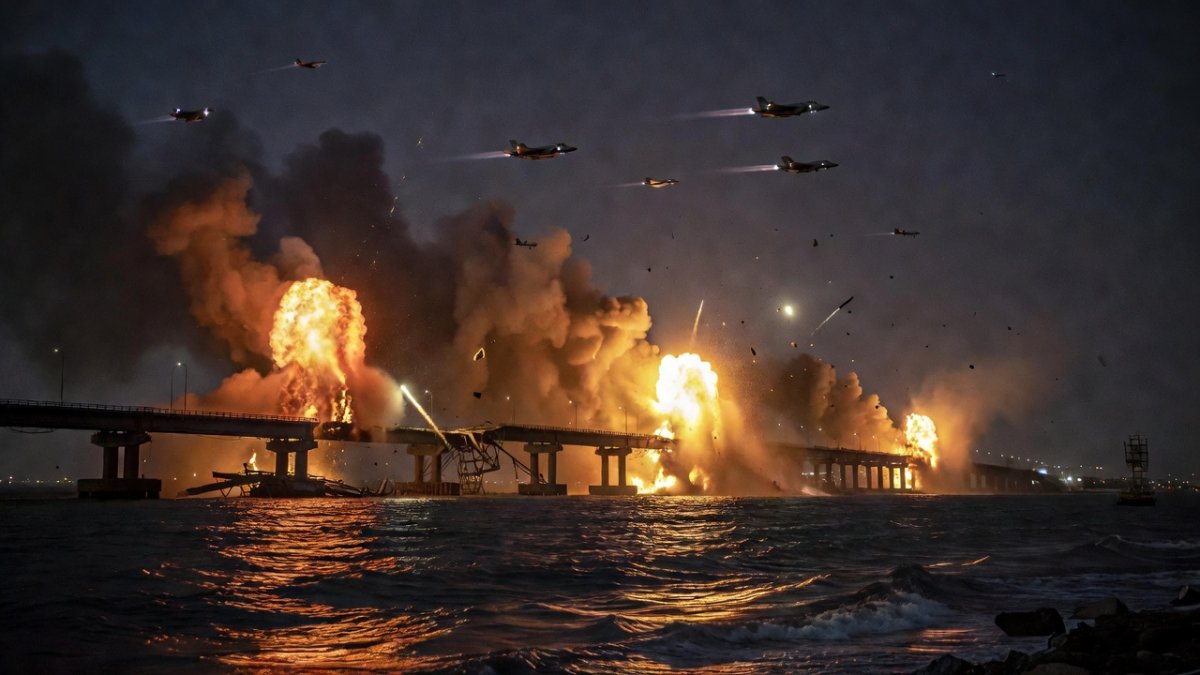
The United States launched a sixth consecutive night of airstrikes against Iran early Friday, hitting bridges near the strategic port city of Bandar Abbas in what experts are calling a significant escalation of the conflict. US Central Command (Centcom) confirmed the strikes were intended to "further degrade Iranian military capabilities" as American marines boarded an oil tanker in the Gulf of Oman as part of a renewed blockade of Iranian ports.
Iran's state media reported that US missiles struck close to the island of Qeshm, near the Strait of Hormuz, as well as in Bandar Abbas and Bushehr — the site of a nuclear power plant. In a notable expansion of targeting, two bridges in Hormozgan province were hit. The BBC has independently verified an attack on one bridge west of Bandar Abbas, a key transportation artery for the region.
The bridge strikes mark the first time in this latest round of hostilities that the US has targeted what could be considered civilian infrastructure inside Iran, raising serious legal and humanitarian questions. US President Donald Trump had threatened earlier this week to strike Iran's bridges and power plants if the country did not return to negotiations.
Trump's Bridge Threat Becomes Reality
Earlier this week, Trump explicitly warned that the US would target Iran's bridges and power plants unless Tehran returned to talks. "They don't like what we're doing, and they do want to settle. We'll find out whether or not we settle with them, or we just finish it off," Trump said Wednesday at the US Army War College in Pennsylvania.
The president's threat, first made in April when he stated the US would bomb civilian infrastructure in Iran including bridges and power plants, drew sharp condemnation from United Nations human rights chief Volker Türk, who said that "deliberately attacking civilians and civilian infrastructure is a war crime." The 1949 Geneva Conventions on humanitarian conduct in war specifically prohibit attacks on sites considered essential for civilian survival.
The targeting of bridges — which serve both military and civilian populations — places the United States in a legally precarious position under international humanitarian law. Legal experts note that while bridges can be legitimate military targets if used for troop movements or supply lines, the broader pattern of infrastructure targeting raises concerns about proportionality and distinction between military and civilian objectives.
Blockade Tightens: US Boards Tanker in Gulf of Oman
Centcom announced Friday that US marines had boarded an oil tanker in the Gulf of Oman as part of the renewed blockade of Iranian ports that began Tuesday night. The military command also reported it had "redirected 3 commercial vessels trying to run the blockade."
This latest blockade comes after a previous round that lasted from April 13 to June 18, during which Centcom said US forces disabled nine ships and redirected more than 140 vessels. The renewed blockade aims to choke off Iran's ability to export oil, its primary source of revenue, and force Tehran back to the negotiating table.
The Strait of Hormuz — a critical waterway off Iran's coast through which approximately 20% of the world's oil passes — has remained effectively shut since Iran blocked it in response to US-Israeli strikes that launched the war on February 28. The closure has sent global oil prices soaring and created supply chain disruptions far beyond the Middle East.
Iran Strikes Back: Missiles Rain on US Allies
Iran retaliated for the latest US strikes with missile and drone fire targeting US military bases in Bahrain and Kuwait before dawn Friday, according to AP News. The counterstrikes followed Iran's earlier attacks on Thursday, when Tehran said it had struck US military bases in Jordan, Kuwait, and Bahrain.
Iranian officials now say that US strikes across six nights of bombing have killed more than 35 people and wounded more than 300 others. For the first time in this latest round of violence, strikes reached areas around Iran's capital, Tehran, signaling a widening of the target set.
Iran's parliament speaker and lead negotiator, Mohammad Bagher Ghalibaf, told state media that Tehran had "no reason" to abide by any agreement that did not benefit the country. He added that Iran's national security depended on maintaining what he described as "Iranian arrangements" in the Strait of Hormuz — language that suggests the closure of the strait is now a permanent strategic objective rather than a temporary bargaining chip.
Revolutionary Guard Threatens Global Energy Exports
In one of the most alarming developments, Iran's paramilitary Revolutionary Guard threatened to halt all energy exports from the Middle East over the US blockade. "The export of oil and gas from the region will be either for everyone or for no one," the Guard said in a statement — a threat that, if carried out, could trigger a global energy crisis far worse than anything seen since the 1970s.
The threat comes as global oil prices have already spiked dramatically since the conflict began. The closure of the Strait of Hormuz has sent prices for crude oil, liquefied natural gas, and fertilizer soaring, impacting economies worldwide from Asia to Europe to the Americas.
The International Energy Agency has warned that a sustained closure of the strait could eliminate approximately 17 million barrels per day of oil and condensate from global markets — roughly 17% of global consumption. Such a scenario would dwarf the supply disruptions caused by the Russia-Ukraine war and could trigger a global recession.
Diplomacy Versus Military Action: Washington's Mixed Messages
As the bombs fell, the White House sent what appeared to be conflicting signals about its intentions. Press secretary Karoline Leavitt told reporters on Thursday that Trump remained open to talks with Iran even as military operations intensified. "The president will hold them accountable when they turn their back on the words that they state to the United States. But he is always open to diplomacy at the very same time," she said.
Leavitt added that Iran had expressed interest in still making a deal with the US, but warned: "The president is not going to allow them to fire on ships in the strait without paying a consequence for that."
Meanwhile, Trump on Wednesday praised Iran for what he described as a "goodwill gesture" — the release of Dena Karari, a US-Iranian citizen whom he said had been "wrongfully detained" since December 2024. "The United States of America appreciates this gesture of Goodwill by Iran!" Trump wrote on Truth Social. Karari's attorney, Jared Genser, confirmed she was on her way back to the US.
However, in a twist that underscores the lack of trust between the two sides, Iran's judiciary on Thursday denied that any US prisoner had been released or exchanged from its prisons, according to Iranian state media. The conflicting accounts highlight the deep communication breakdown between the two governments.
Interim Deal in Tatters After Months of Conflict
The current escalation represents the complete unraveling of the interim peace agreement that had halted the initial phase of the war. The US and Israel launched military operations against Iran on February 28, prompting Tehran to effectively close the Strait of Hormuz to shipping traffic — a move that sent oil, fertilizer, and many other commodity prices soaring.
A preliminary peace deal was reached in the spring, but days of back-and-forth strikes by the US and Iran across the Middle East — and renewed threats to the Strait of Hormuz — have now shredded that agreement. The region appears to be tipping back into all-out war, with neither side showing willingness to de-escalate.
The conflict has already claimed a devastating human toll. Beyond the 35 confirmed dead and 300 wounded inside Iran, the broader regional conflict has impacted US allies across the Middle East, with Iran striking bases in at least four countries. The humanitarian consequences are mounting as supply chains for food, medicine, and fuel face growing disruptions.
What This Means: The World on a Knife's Edge
Here's the reality check, folks. We are watching a conflict escalate in real time that has the potential to reshape the global order. The targeting of bridges — infrastructure that Trump explicitly threatened to bomb — signals that the US is moving from purely military targets toward the kind of infrastructure warfare that international law considers a war crime.
The Strait of Hormuz closure is not just an Iran problem — it's a global economic catastrophe waiting to happen. Global oil markets are already pricing in risk premiums that threaten to push gasoline above $5 a gallon in the United States, and European nations already battered by energy costs are bracing for another winter of crisis-level prices.
What's most troubling is the contradiction at the heart of Washington's strategy. The administration is simultaneously ramping up military pressure and claiming to want diplomacy. That strategy has a name: coercive bargaining. And history shows it rarely ends with both sides walking away satisfied. When you bomb a country's bridges while saying you're open to talks, you're sending a message that only one of those signals is real — and it's not the diplomacy.
Iran's Revolutionary Guard threat to halt all Middle East energy exports is the single most dangerous statement made in this conflict so far. If acted upon, we are looking at an economic catastrophe that makes 2008 look like a mild downturn. Every government in the world with a stake in stable energy markets should be sounding every alarm bell right now.
The coming days will determine whether this conflict spirals into a regional war that draws in Gulf states, Israel, and potentially even broader international involvement — or whether the diplomatic back channels produce something that resembles a ceasefire. Right now, the bombs are speaking louder than the diplomats.
By Jessica Ali, Staff Writer
This article was produced with AI-assisted research and editorial support. Reporting is based on sources cited in the article.
What's Your Reaction?
 Like
0
Like
0
 Dislike
0
Dislike
0
 Love
0
Love
0
 Funny
0
Funny
0
 Wow
0
Wow
0
 Sad
0
Sad
0
 Angry
0
Angry
0

Breaking News and Investigations Correspondent at Global1.News. Based in London, covering global breaking news, security, and investigative stories. Known for digging deeper and connecting the dots across continents.












Comments (0)