
Canadians Favour China Over US in New Poll as Carney Pursues Trade Thaw | Global1.News
A new Pew Research Center poll shows 44% of Canadians now view China favourably, compared with just 33% for the United States — a dramatic reversal as PM Mark Carney pursues closer trade ties with Beijing amid ongoing tensions with Washington.
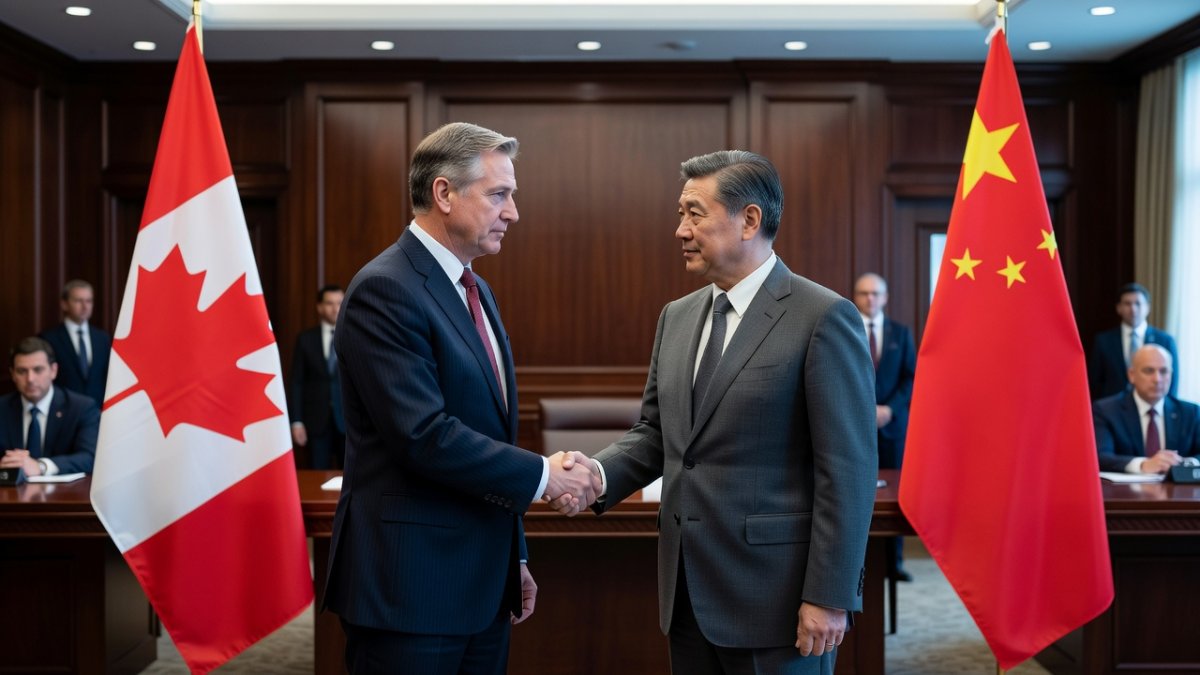
Canadians View China More Favourably Than United States in New Poll
The latest international survey from the Pew Research Center reveals a notable change in how Canadians see their two largest trading partners. Conducted by telephone between 8 February and 13 May 2026 among 1,020 Canadian adults, the poll shows 44 percent of respondents hold a favourable view of China while only 33 percent say the same about the United States.
The Poll Numbers
The Pew Research Center survey asked respondents to rate their overall opinion of both countries on a standard favourability scale. Forty-four percent selected favourable or very favourable for China, compared with 33 percent for the United States. The margin of sampling error is approximately plus or minus four percentage points. The same question was asked in 36 countries worldwide, and China received higher favourable ratings than the United States in 30 of those nations.
A Dramatic Shift in Canadian Public Opinion
Just twelve months earlier the same Pew question produced nearly identical results for both countries. The reversal is the largest recorded in Canada since Pew began tracking these attitudes. Analysts attribute part of the change to recent diplomatic activity and ongoing friction with Washington over tariffs and sovereignty remarks. The survey period overlapped with Prime Minister Mark Carney’s January 2026 visit to Beijing and the June 2026 Ottawa meetings with Chinese Foreign Minister Wang Yi.
Background: A Rocky History with China
Canada-China relations have experienced repeated strains in recent years. Early in 2025 Chinese authorities carried out the executions of four Canadian citizens convicted on drug-related charges. Robert Schellenberg, an Abbotsford, British Columbia man, has remained on death row since his 2019 arrest and retrial. Canadian officials continue to track 115 citizens held in Chinese prisons on various charges. These cases form the backdrop against which any improvement in public perceptions must be measured.
The Human Rights Dimension
Advocacy groups and opposition members of Parliament have urged the Carney government to maintain pressure on Beijing regarding consular cases. The four executions in 2025 drew formal protests from Ottawa. Schellenberg’s family has repeatedly called for clemency, while the Department of Global Affairs maintains a dedicated team monitoring the remaining 115 detainees. Public opinion data suggest these concerns have not prevented a measurable improvement in overall sentiment toward China.
The Carney Approach — Thawing Relations
Prime Minister Carney became the first Canadian leader to visit China in eight years when he travelled to Beijing in January 2026. The visit produced a preliminary trade arrangement under which China agreed to lower tariffs on selected Canadian agricultural exports while Canada reduced duties on Chinese electric vehicles. During Chinese Foreign Minister Wang Yi’s reciprocal visit to Ottawa in June 2026 both sides confirmed a national target of increasing Canadian goods exports to China by 50 percent before 2030. Officials describe the measures as incremental steps rather than a comprehensive new agreement.
What This Means — Canada’s Diplomatic Tightrope
Canada must balance economic opportunity with long-standing security and human-rights priorities. The preliminary tariff adjustments are expected to benefit prairie grain producers and British Columbia seafood exporters while opening the domestic market to additional Chinese vehicle imports. At the same time, Ottawa continues to coordinate with Five Eyes intelligence partners on technology-transfer risks and supply-chain vulnerabilities. The poll results indicate the public is currently willing to support expanded commercial engagement provided core consular cases remain on the agenda.
The American Factor
Parallel tensions with the United States have contributed to the shift in attitudes. Ongoing disputes over steel and aluminum tariffs and former president Trump’s repeated references to Canada as the “51st state” have soured public sentiment south of the border. Several provincial premiers have publicly criticised the tariff measures for harming integrated auto and energy sectors. The Pew data show the United States now trails China in Canadian favourability for the first time since the question was introduced.
What Happens Next
Negotiators on both sides are scheduled to meet again in the autumn to finalise tariff schedules and discuss export-growth benchmarks. Canadian officials have indicated they will raise the cases of Schellenberg and the remaining prisoners during those talks. Parliament’s foreign-affairs committee is expected to hold hearings on the preliminary deal before any legislative steps are required. Observers will watch whether the favourable ratings recorded in the spring 2026 poll hold through the next annual Pew survey.
Tags: Canada-China relations, Mark Carney, Pew Research poll, trade policy, human rights
By Alex Thompson, Staff Writer
Internal linking suggestions: Link “The Carney Approach” section to existing Global1.News article on 2030 export targets; link “The American Factor” to coverage of US tariff disputes. Social media teaser: “New poll shows Canadians now view China more favourably than the United States. Read our full analysis of the numbers, the trade deal and the human-rights backdrop.”This article was produced with AI-assisted research and editorial support. Reporting is based on sources cited in the article.
What's Your Reaction?
 Like
0
Like
0
 Dislike
0
Dislike
0
 Love
0
Love
0
 Funny
0
Funny
0
 Wow
0
Wow
0
 Sad
0
Sad
0
 Angry
0
Angry
0

Canada Correspondent at Global1.News. Based in Toronto, covering Canadian politics, energy, trade, and US-Canada relations. Provides the Canadian perspective on North American and global affairs.















Comments (0)