
Thailand AI Manufacturing: Economic Forum Charts Recovery Path
The Bangkok Post Economic Forum 2026 concluded with a powerful message: Thailand's path to economic resilience runs through AI-driven manufacturing, digital transformation, and a decisive energy transition. As Finance Minister Ekniti Nitithanprapas confirmed this week that global recovery is within reach, industry leaders from the Federation of Thai Industries, CIMB Thai Bank,
The Bangkok Post Economic Forum 2026 concluded with a powerful message: Thailand's path to economic resilience runs through AI-driven manufacturing, digital transformation, and a decisive energy transition. As Finance Minister Ekniti Nitithanprapas confirmed this week that global recovery is within reach, industry leaders from the Federation of Thai Industries, CIMB Thai Bank, and Ericsson Thailand outlined a concrete roadmap for the country's future growth.
Thailand Forges Ahead with AI Manufacturing and Energy Transition as Economic Forum Charts Recovery Path
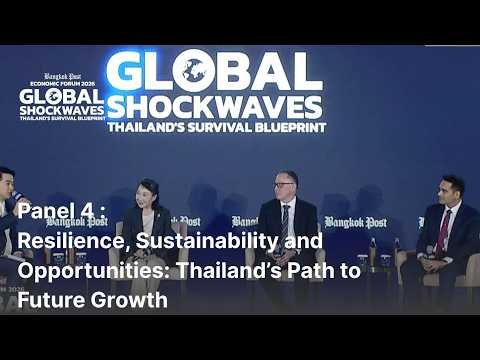
Bangkok, Thailand — The final session of the Bangkok Post Economic Forum 2026, titled "Resilience, Sustainability, and Opportunities: Thailand's Path to Future Growth," brought together three of the country's most influential voices in industry, finance, and technology. Pimjai Leeissaranukul, Chairwoman of The Federation of Thai Industries representing over 15,000 member companies, joined Dr. Amonthep Chawla, Executive Vice-President and Head of Research Office at CIMB Thai Bank, and Anders Rian, Head of Ericsson Thailand, to address the affordability crisis, digital priorities, and the energy transition reshaping the nation.
AI Adoption Transforms Eastern Economic Corridor
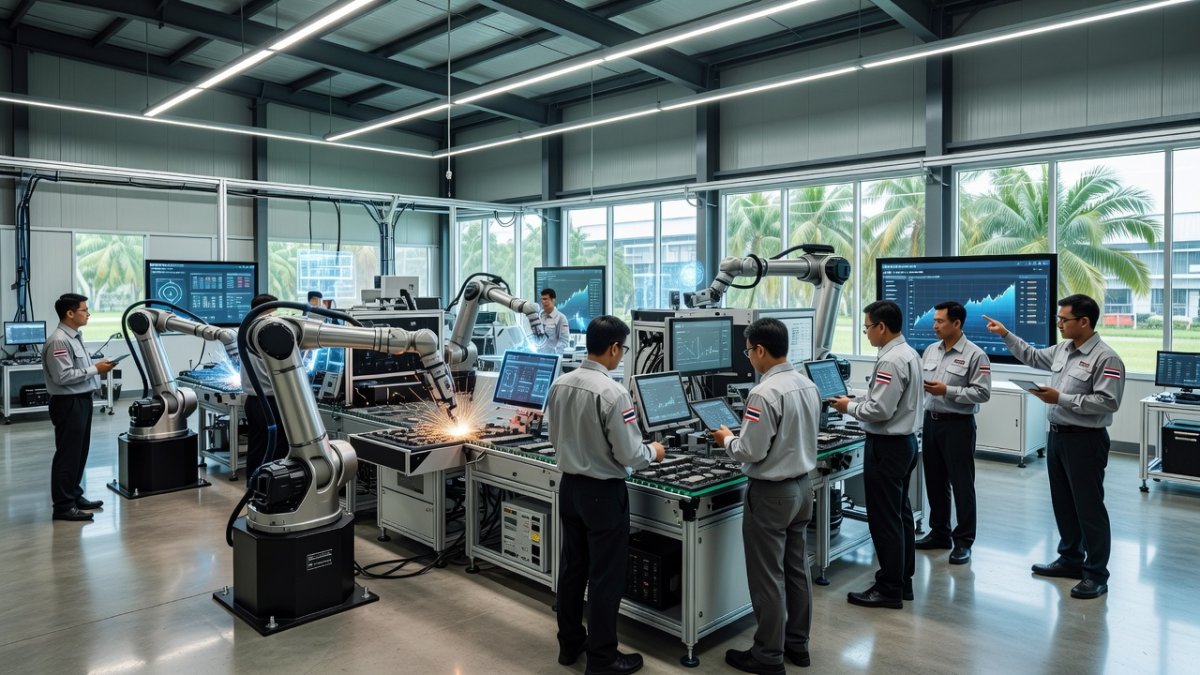
Anders Rian, whose company has operated in Thailand for over a century, detailed how artificial intelligence is already reshaping production lines and supply chains across the Eastern Economic Corridor (EEC). The EEC, a flagship government initiative spanning Chonburi, Rayong, and Chachoengsao provinces, serves as the primary vehicle for high-tech investment under the national Thailand 4.0 development plan.
Rian explained that AI tools now manage complex logistics networks connecting factories in the corridor to Laem Chabang port, one of Southeast Asia's busiest deep-sea ports. These systems reduce machine downtime, optimize inventory flow, and improve delivery times for goods bound for markets across ASEAN and beyond.
The Federation of Thai Industries has launched pilot AI programs in automotive and electronics manufacturing clusters. Member companies report measurable efficiency gains that help offset the persistent high oil prices Finance Minister Ekniti warned this week could last for several years due to war-damaged production and storage facilities in the Middle East.
200-Billion-Baht Energy Transition Plan Takes Shape
Dr. Amonthep Chawla outlined the financing architecture behind Thailand's shift away from oil dependence. The government has committed a 200-billion-baht loan facility to adjust power consumption patterns, with a strong emphasis on expanding solar and other renewable energy sources.
Finance Minister Ekniti Nitithanprapas confirmed on Monday that an end to the Middle East conflict would place Thailand and global economies into "rehabilitation mode," though energy prices may not return to pre-war levels. His remarks underscored the urgency of the energy transition discussed at the Economic Forum.
The Thais Help Thais Plus co-payment scheme will continue to support grassroots vendors and households during this period. In a sign of how the shift reaches everyday life, Buddhist communities in the Isaan region have begun installing solar panels at local temples, demonstrating that the national energy strategy touches even the most traditional corners of Thai society.
ASEAN Regional Trade and Tourism Stand to Benefit
Thailand's digital transformation strengthens its position within ASEAN supply networks. Improved AI-driven logistics benefit cross-border trade with Malaysia, Vietnam, and Cambodia, where similar manufacturing upgrades are gaining momentum. The Ministry of Foreign Affairs has highlighted these linkages in recent ASEAN economic meetings, positioning Thailand as a regional hub for smart manufacturing.
Tourism operators in Phuket, Chiang Mai, and Koh Samui stand to gain from more reliable supply chains that help stabilise hotel and restaurant costs despite lingering fuel price pressures. The Election Commission of Thailand has noted that economic stability programmes such as the co-payment scheme help maintain public confidence ahead of upcoming local elections.
Thailand 4.0 and 5G Infrastructure Fuel Digital Transformation
The national Thailand 4.0 framework explicitly includes AI adoption across industrial sectors. Ericsson's long-standing telecommunications infrastructure work in Bangkok and surrounding provinces provides the connectivity backbone for these systems. Rian emphasised that 5G rollout in the Eastern Economic Corridor enables real-time data analysis in factories, allowing instant adjustments to production lines based on demand signals from global markets.
The Federation of Thai Industries tracks progress through quarterly reports from its 15,000-plus member companies. Dr. Amonthep Chawla stressed that CIMB Thai Bank offers targeted loans for small and medium manufacturers upgrading equipment, ensuring that digital transformation reaches beyond large corporations to family-owned factories in provincial industrial estates.
What to Watch For
Finance Minister Ekniti's Monday statement set the stage for several key developments in the months ahead. The 200-billion-baht energy loan will begin deployment in the coming quarters, with solar installation projects expected to accelerate across both urban and rural areas. The Federation of Thai Industries is scheduled to release its next quarterly AI adoption report in August, which will provide concrete data on how many member companies have integrated smart manufacturing tools.
Meanwhile, 5G expansion in the Eastern Economic Corridor continues, with Ericsson and Thai telecommunications partners expected to announce additional coverage milestones before the end of the year. Local businesses in Songkran festival regions already use AI scheduling tools to manage seasonal workforce needs, showing how national strategies translate into daily operations in tourism-dependent provinces.
The combination of the 200-billion-baht energy loan, continued AI investment, and the government's Thais Help Thais Plus scheme positions Thailand to weather global shocks while maintaining economic growth. As Finance Minister Ekniti Nitithanprapas stated this week, recovery remains achievable even if energy costs stay elevated — provided Thailand stays the course on digital transformation and energy independence.
By Ann Srisawat, Staff Writer
This article was produced with AI-assisted research and editorial support. Reporting is based on sources cited in the article.
What's Your Reaction?
 Like
0
Like
0
 Dislike
0
Dislike
0
 Love
0
Love
0
 Funny
0
Funny
0
 Wow
0
Wow
0
 Sad
0
Sad
0
 Angry
0
Angry
0

Southeast Asia Correspondent at Global1.News. Based in Bangkok, covering Thai and Southeast Asian politics, economy, technology, and culture. Deep regional perspective on one of the world's most dynamic regions.














Comments (0)