
Ed Miliband Puts Climate at Heart of UK Foreign Policy
Miliband Puts Climate and Development at the Heart of British Foreign Policy London \u2014 Foreign Secretary Ed Miliband is to take up the UK\u2019s seat on the World Bank board personally, in a significant break with convention that signals his determination to place the climate crisis and international development at the centre of British foreign policy. The move, announced this weekend, marks a substantial departure from recent practice. The position of UK governor to t...
Miliband Puts Climate and Development at the Heart of British Foreign Policy
London \u2014 Foreign Secretary Ed Miliband is to take up the UK\u2019s seat on the World Bank board personally, in a significant break with convention that signals his determination to place the climate crisis and international development at the centre of British foreign policy.
The move, announced this weekend, marks a substantial departure from recent practice. The position of UK governor to the World Bank has traditionally been delegated to a junior minister, but Miliband\u2019s decision to assume the role himself underscores the priority the new Labour government intends to give to global development and climate finance, even as Britain\u2019s overseas aid budget remains constrained by years of cuts.
\u201cInternational development is not an add-on to British foreign policy \u2014 it is central to it,\u201d Miliband said. \u201cBy taking on the role of UK governor to the World Bank, I want to send an unambiguous signal that this government is serious about its global leadership on development and climate.\u201d
A Personal Commitment from the Foreign Secretary
Miliband, who served as Energy and Net Zero Secretary under Sir Keir Starmer before becoming Foreign Secretary under Prime Minister Andy Burnham, is no stranger to climate diplomacy. He previously signed a climate partnership with California Governor Gavin Newsom in February this year, deepening UK-California cooperation on clean energy technology and emissions reduction.
By taking the World Bank seat himself, Miliband is sending a clear message that the Foreign Office will continue to drive climate action, even as other Western governments have moved in a different direction. The UK is one of only six countries with its own permanent seat on the World Bank board, a position that carries disproportionate influence relative to the size of Britain\u2019s economy.
Lord Stern, a professor of economics at the London School of Economics and a former chief economist and senior vice-president of the World Bank, welcomed the announcement. \u201cAs a former chief economist and senior vice-president of the World Bank, I know that the UK can punch above its weight,\u201d he said. \u201cBut only if the leadership is there from the top. In recent years, that has slipped. Ed Miliband will be restoring development and climate to the priority in our international relationships that they must have, in a world facing climate and biodiversity crises.\u201d
A Crucial Moment for the World Bank
The announcement comes at a pivotal juncture for the international lender. In late June, the World Bank Group announced it would retire its previous goal of devoting 45 per cent of its annual lending to projects with climate co-benefits. The decision, which followed sustained pressure from the Trump administration, represented a significant shift in the bank\u2019s climate strategy and was criticised by environmental groups and many developing nations.
The 45 per cent target had been a cornerstone of the World Bank\u2019s Climate Change Action Plan. Its removal has raised concerns that climate finance for developing countries could dwindle further. Miliband\u2019s decision to take up the UK\u2019s seat signals that Britain intends to push back against this trend, using its position to advocate for renewed climate ambition within the institution.
The Aid Budget Dilemma
However, the foreign secretary\u2019s ambitions face a significant domestic constraint. Under Sir Keir Starmer\u2019s previous government, Britain\u2019s overseas aid budget was reduced to 0.3 per cent of gross national income \u2014 a reduction from the 0.5 per cent maintained under the Conservatives and well below the 0.7 per cent target enshrined in UK law. Climate finance was also cut, from \u00a311.6bn committed for the 2021\u20132026 period to approximately \u00a32bn annually.
The tension between Britain\u2019s development rhetoric and its reduced aid budget has not gone unnoticed. Mohamed Adow, director of the thinktank Power Shift Africa, offered a careful assessment. \u201cThe real test is whether the UK uses its influence to push the World Bank to deliver far more finance for climate action and adaptation, to get money to countries faster, and ensure the poorest nations are not forced deeper into debt to respond to a crisis they did least to cause,\u201d he said. He added that if the appointment marks the start of renewed British leadership, \u201cit will be warmly welcomed across Africa\u201d.
Domestic Tensions: Spending Priorities Under Burnham
The announcement also sits alongside recent decisions by Prime Minister Andy Burnham\u2019s government. Last week, it emerged that the government\u2019s planned \u00a32 cap on bus fares in England would be funded in part by converting international climate finance grants into repayable loans. The loans are expected to go to the Tropical Forests Forever Facility, a fund established by the Brazilian government.
Critics have argued that converting grants to loans shifts the burden of climate action onto developing countries, which would have to repay the borrowed funds with interest. The move illustrates the broader challenge facing the Labour government: reconciling its stated commitment to international development with competing domestic priorities and a tight fiscal environment.
Wildfires and Drought: A Summer of Climate Disruption
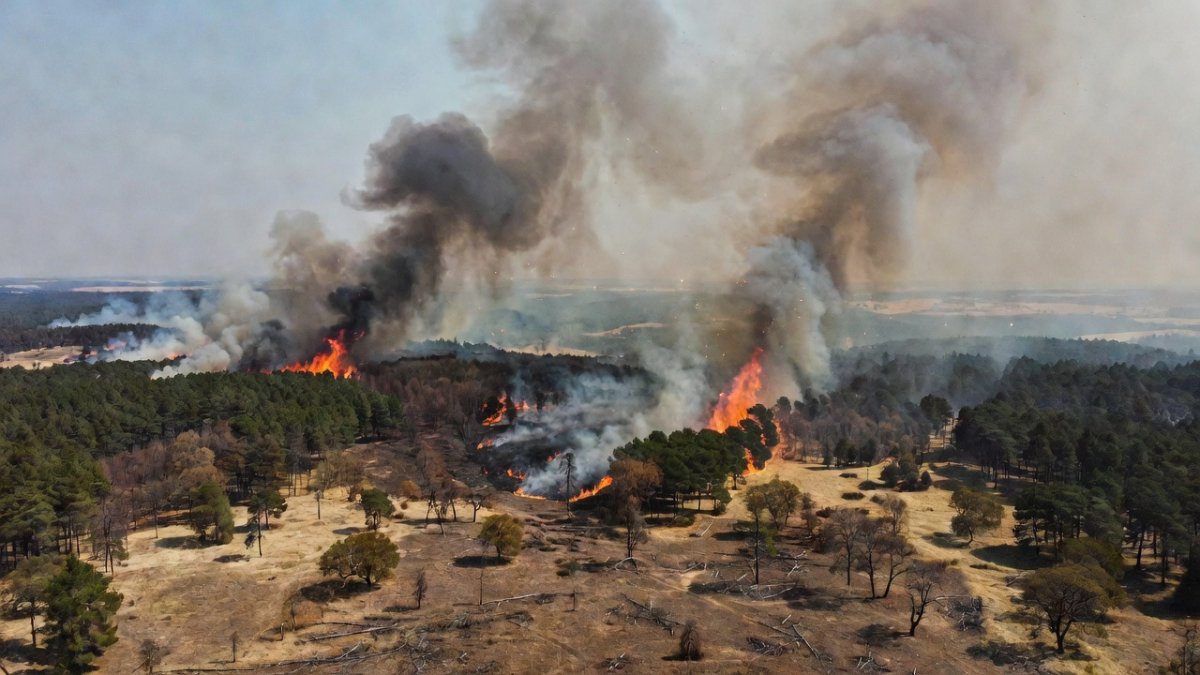
The urgency of these questions has been brought into sharp relief by extreme weather across Europe this summer. In France, firefighters continue to battle a large blaze near Bordeaux that has consumed a significant area and forced the evacuation of hundreds of thousands of people. In Spain, Prime Minister Pedro S\u00e1nchez has warned that the Iberian peninsula is experiencing the effects of the climate emergency, as fires near Madrid are gradually brought under control.
In Britain, Scotland called for military assistance to tackle a wildfire in the Cairngorms. Conditions approaching drought across parts of England and Wales have prompted hosepipe bans, and a heatwave that swept across Europe in June is estimated to have cost continental grain farmers an estimated \u20ac2bn (\u00a31.7bn) in lost revenue. These events provide a stark practical backdrop to Miliband\u2019s announcement.
Britain\u2019s Voice in the International Arena
Miliband\u2019s decision should be understood as part of a broader effort by the Burnham government to reassert Britain\u2019s influence in multilateral institutions after years of diminished international standing. The foreign secretary\u2019s World Bank role, combined with the upcoming COP31 climate summit scheduled for November in Antalya, Turkey, offers opportunities for the UK to demonstrate continued engagement on the global stage.
Whether the government can match its rhetorical ambition with adequate financial resources remains an open question. The reduced aid budget, the conversion of grants to loans, and the broader fiscal constraints all point to significant limitations. But by placing himself at the table where decisions about global development finance are made, Miliband has ensured that Britain will have a voice in shaping the direction of international climate investment.
By Erica Thornton, Staff Writer
This article was produced with AI-assisted research and editorial support. Reporting is based on sources cited in the article.
What's Your Reaction?
 Like
0
Like
0
 Dislike
0
Dislike
0
 Love
0
Love
0
 Funny
0
Funny
0
 Wow
0
Wow
0
 Sad
0
Sad
0
 Angry
0
Angry
0

US Politics and Policy Correspondent at Global1.News. Based in Washington DC, covering American politics, policy, elections, and the courts. Knows how the system works and tells you what it actually means.














Comments (0)