
Strait of Hormuz Crisis Intensifies as US-Iran Conflict Escalates to New Phase
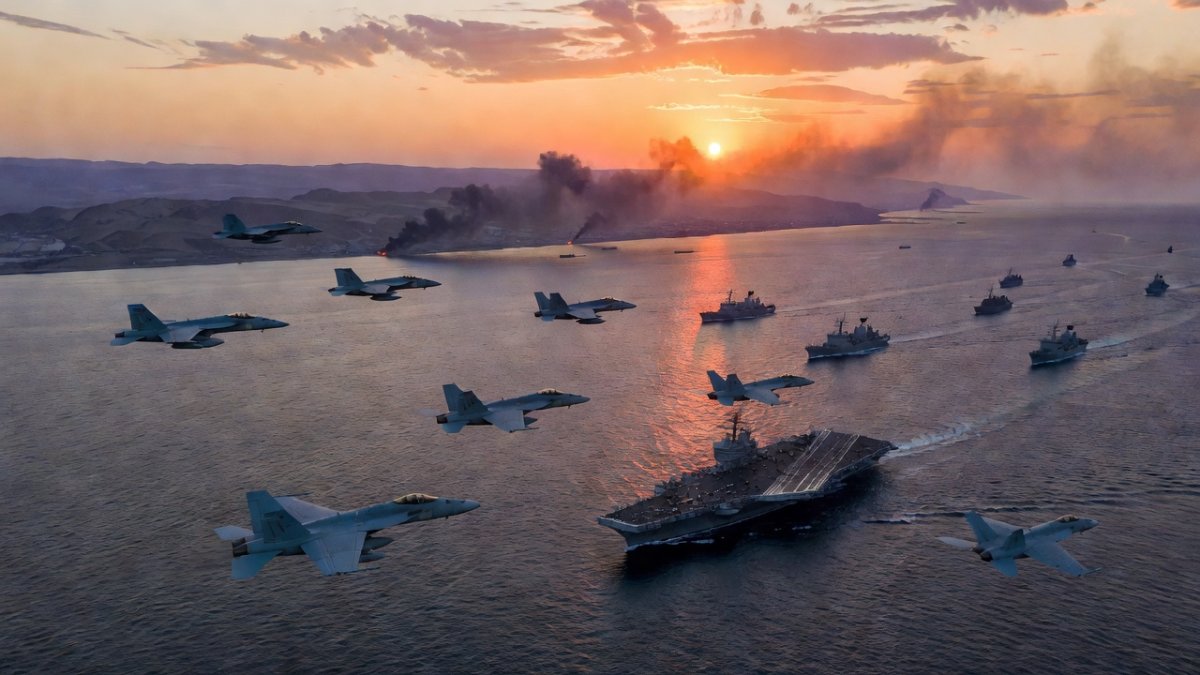
The Collapse of an Interim Ceasefire The precarious ceasefire that briefly halted hostilities between the United States and Iran has completely unraveled, plunging the Persian Gulf region into its most dangerous phase of conflict since hostilities began in late February. The interim agreement, brokered by Pakistan last month, formally collapsed as both sides resumed military operations with renewed intensity. Bahrain and Kuwait—both hosting U.S. military forces—faced incoming Iranian fire early
The Collapse of an Interim Ceasefire
The precarious ceasefire that briefly halted hostilities between the United States and Iran has completely unraveled, plunging the Persian Gulf region into its most dangerous phase of conflict since hostilities began in late February. The interim agreement, brokered by Pakistan last month, formally collapsed as both sides resumed military operations with renewed intensity. Bahrain and Kuwait—both hosting U.S. military forces—faced incoming Iranian fire early Friday, while American airstrikes expanded deeper into Iranian territory, targeting bridges and infrastructure in southern Hormozgan province. At least three people were killed in those strikes, Iran's state-run IRNA news agency reported.
Tags: US-Iran conflict, Strait of Hormuz, South Korea, oil prices, energy security, Persian Gulf, Middle East geopolitics, diplomacy
The Battle for the Strait of Hormuz
At the heart of this escalating confrontation lies the Strait of Hormuz, the narrow waterway connecting the Persian Gulf to the Gulf of Oman through which approximately 20 percent of the world's oil supply normally transits. Iran effectively choked off commercial shipping through the strait following the U.S.-led military campaign that began on February 28, attacking vessels that ignored its rules and declaring the waterway a red line for its national security. Col. Ebrahim Zolfaghari, a spokesperson for the Iranian military's Khatam al-Anbiya Central Headquarters, warned that Iran could launch widespread attacks on "all the infrastructure in the region" if the United States follows through on President Donald Trump's warnings to target Iranian bridges and power plants. "Under no circumstances and in no way will we allow America, as a foreign and extraregional country, to interfere in the Strait of Hormuz," Zolfaghari declared. "This is Iran's invincible red line."
U.S. Military Operations Expand
The United States intensified its military campaign on Thursday with a second wave of strikes that reached into areas around Iran's capital, Tehran, for the first time in this latest round of violence. American warplanes hit targets in Semnan province, home to Iran's ballistic missile production and space program, as well as facilities in Hamedan, Hormozgan, Khuzestan, Lorestan, Markazi, and Sistan and Baluchestan provinces. U.S. Central Command confirmed an attack on Greater Tunb Island, one of three small rocky islands at the confluence of the Persian Gulf and the strait. These islands—seized by Iran in 1971 from what would become the United Arab Emirates—give Tehran significant strategic leverage over the waterway. American forces also disabled a Curacao-flagged oil tanker that attempted to approach Iran's main oil export terminal, firing a missile after the ship "ignored multiple warnings," according to the U.S. military. Iranian officials now report that American strikes have killed more than 35 people and wounded over 300 others.
Iranian Retaliation Against U.S. Allies
Iran retaliated Thursday with missile and drone attacks targeting Bahrain, Jordan, and Kuwait—all countries that host American military personnel. While authorities in those nations confirmed the attacks, there was no immediate acknowledgment of casualties or significant damage. The geographic spread of Iranian retaliation signals a dangerous escalation that threatens to draw the entire Gulf region into direct conflict. In Iraq, a drone attack in the semiautonomous northern Kurdish region was intercepted, while a separate drone targeted a tanker in the Persian Gulf off the coast of Basra. Iraqi Prime Minister Ali al-Zaidi, visiting Washington, condemned the attacks and reiterated Iraq's commitment to disarming non-state armed groups, including those backed by Iran.
Diplomatic Channels Remain Open
Despite the intensifying military confrontation, diplomatic channels have not been completely severed. Pakistan's Foreign Ministry rejected suggestions that Islamabad had abandoned its mediation efforts. "Let me dispel the impression that Pakistan has done hands up, and this is not the case," ministry spokesperson Tahir Andrabi said, adding that the parties "will have to come to the negotiating table to settle all outstanding issues." Even the Trump administration's top negotiator signaled openness to talks. In a podcast interview with Joe Rogan that aired Wednesday, Vice President JD Vance said the administration is "not going to bomb and bomb and bomb" and that "you've got to actually be willing to talk and to try to figure out the problem." Mediators from Pakistan, Qatar, and Egypt continue backchannel efforts, though the 60-day negotiating framework outlined in the collapsed ceasefire has effectively halted. "Whenever the parties exhaust the logic of escalation, the formula for peace is there," Andrabi noted.
What This Means for South Korea
For South Korea, the escalating crisis in the Strait of Hormuz carries profound strategic implications that extend far beyond the immediate theater of conflict. As the world's fifth-largest crude oil importer—with approximately 70 percent of its crude oil transiting through the Strait of Hormuz—South Korea is acutely vulnerable to disruptions in Persian Gulf shipping lanes. The blockade and ongoing military operations have already sent global oil prices soaring, placing pressure on the Korean won and threatening to reignite inflationary pressures that the Bank of Korea has worked aggressively to contain. South Korea's energy security architecture has been tested before. During the 2019 Gulf tensions and again following the 2022 Ukraine conflict, Seoul was forced to draw heavily on its Strategic Petroleum Reserve—which currently holds approximately 104 million barrels. However, the current crisis presents a more direct challenge: there is no viable alternative route for the volume of crude that Korea requires daily, and the buffer of spare global production capacity is thinner than at any point in the last decade. The Ministry of Trade, Industry and Energy has yet to announce any emergency measures, but officials are believed to be monitoring the situation closely.
South Korea's Diplomatic Tightrope
The crisis also places South Korea in an increasingly difficult diplomatic position. As a treaty ally of the United States, Seoul has maintained a careful neutrality in public statements regarding the conflict, avoiding direct criticism of U.S. military operations while also refraining from endorsing the Trump administration's maximum-pressure approach toward Tehran. The Yoon administration—already navigating domestic political headwinds and a complex relationship with China—must balance alliance commitments with the practical necessity of maintaining open channels with Iran, which remains a key source of Korea's crude oil imports when sanctions permit. The collapse of the Pakistan-brokered ceasefire removes what little diplomatic cover Seoul had. Should the conflict expand further, South Korea may face impossible choices: align openly with U.S. military operations in the Gulf, risking Iranian retaliation against Korean commercial shipping, or distance itself from Washington at a time when the alliance faces growing strain over defense cost-sharing and North Korea policy.
Regional and Global Ramifications
The implications of this conflict extend well beyond the Persian Gulf. Global energy markets are already pricing in the risk of a prolonged disruption, with Brent crude trading well above $100 per barrel. For Asian economies that depend heavily on Gulf oil—including Japan, China, India, and South Korea—the economic consequences are mounting. The disruption also threatens to accelerate ongoing shifts in global energy trade patterns, with European and Asian buyers scrambling to secure alternative supplies from the United States, West Africa, and the North Sea. From a geopolitical perspective, the crisis represents the most serious large-state military confrontation since the 2003 Iraq War and tests the resilience of the post-Cold War international order. The involvement of multiple Gulf states as either targets or hosts of military forces raises the specter of a broader regional war that could draw in additional actors, including Iran's proxies in Yemen, Syria, Lebanon, and Iraq.
Looking Ahead: Escalation or Return to Talks
The immediate trajectory of the conflict remains uncertain. President Trump, asked in recent days whether he remains open to negotiations, has repeated his warnings that Iran must return to the table or face further attacks on civilian infrastructure. "I don't like giving deadlines, but they pretty much know, they know the story," Trump said in Pennsylvania on Wednesday. "They better behave." Yet Vice President Vance's remarks on the Rogan podcast suggest the administration sees military force as one tool among many, not an end in itself. Naysan Rafati, senior Iran analyst at the International Crisis Group, characterized the current moment as one that "leaves open the possibility of moving up the escalation ladder"—a formulation that offers both warning and hope. For South Korea, the path forward demands a carefully calibrated strategy that protects national interests without being drawn into a confrontation that serves neither Seoul's economic nor security objectives. As the crisis deepens, the ROK's diplomatic corps, energy planners, and national security apparatus face their most demanding test in years.
By Prof. David Park, Staff Writer
This article was produced with AI-assisted research and editorial support. Reporting is based on sources cited in the article.
What's Your Reaction?
 Like
0
Like
0
 Dislike
0
Dislike
0
 Love
0
Love
0
 Funny
0
Funny
0
 Wow
0
Wow
0
 Sad
0
Sad
0
 Angry
0
Angry
0

East Asia/Technology Correspondent at Global1.News. Seoul-based voice covering Korean politics, technology, business, and culture. Analyzes how technology and geopolitics intersect across East Asia.












Comments (0)