
Russia Targets Mineral Water in Latest Trade Restriction Against Armenia
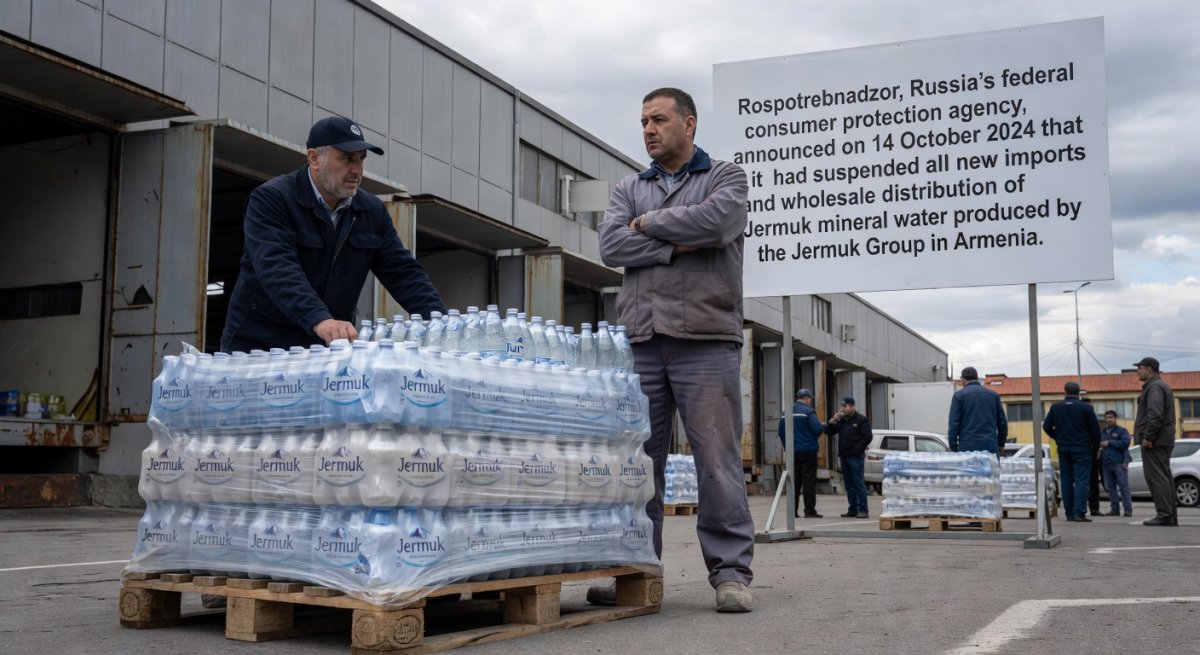
Russia Targets Mineral Water in Latest Trade Restriction Against Armenia
Rospotrebnadzor, Russia’s federal consumer protection agency, announced on 14 October 2024 that it had suspended all new imports and wholesale distribution of Jermuk mineral water produced by the Jermuk Group in Armenia. The suspension came into force immediately, affecting shipments already en route to Russian distribution centers.
The decision was communicated through an official statement posted on the agency’s website and confirmed in a briefing by Rospotrebnadzor head Anna Popova. Popova stated that laboratory tests conducted at the agency’s central laboratory in Moscow had detected “deviations from established microbiological and chemical safety indicators” in samples taken from recent consignments. She added that the suspension would remain in place “until the Armenian producer provides comprehensive documentation confirming compliance with Eurasian Economic Union technical regulations.”
The Incident
Rospotrebnadzor inspectors first flagged the Jermuk shipments during routine border checks at the Upper Lars crossing between Georgia and Russia in early October. Subsequent testing of retained samples revealed levels of certain mineral salts and bacterial colony counts that exceeded limits set by Technical Regulation TR TS 021/2011 on food safety. The agency did not disclose the precise values but noted that similar concerns had prompted temporary restrictions on other Armenian and Georgian beverages in prior years. Jermuk Group issued a brief statement through its Yerevan headquarters rejecting the findings. Company spokesperson Armen Grigoryan said the firm maintains ISO 22000 and HACCP certification and had passed independent audits by European laboratories in 2023. Grigoryan added that the company had requested detailed test protocols from Rospotrebnadzor to conduct its own verification.Background
Russia remains Armenia’s largest trading partner, absorbing roughly 30 percent of ArmeniaBy Irina Volkov, Staff Writer
This article was produced with AI-assisted research and editorial support. Reporting is based on sources cited in the article.
What's Your Reaction?
 Like
0
Like
0
 Dislike
0
Dislike
0
 Love
0
Love
0
 Funny
0
Funny
0
 Wow
0
Wow
0
 Sad
0
Sad
0
 Angry
0
Angry
0
Irina Volkov
Russia/Eastern Europe Correspondent at Global1.News. Covering Russian politics, energy, security, and the shifting dynamics of the post-Soviet space. Provides clear-eyed analysis on one of the world's most opaque regions.











Comments (0)