
Pantanal Fires 2026: Inferno Threatens Jaguars, Biodiversity
The Pantanal, the world's largest tropical wetland and one of the most biodiverse ecosystems on Earth, is burning once again. After a devastating 2024 fire season that consumed nearly a third of the Brazilian Pantanal, 2025 brought a dramatic recovery through coordinated prevention. But 2026 has opened with a 132 percent surge in burned area, and the peak fire season has barely
The Pantanal, the world's largest tropical wetland and one of the most biodiverse ecosystems on Earth, is burning once again. After a devastating 2024 fire season that consumed nearly a third of the Brazilian Pantanal, 2025 brought a dramatic recovery through coordinated prevention. But 2026 has opened with a 132 percent surge in burned area, and the peak fire season has barely begun. For Latin America, the fate of this tri-national treasure—spanning Brazil, Bolivia, and Paraguay—is not merely an environmental concern but a question of water security, climate resilience, and the survival of the continent's most iconic species.
Pantanal Fires 2026: Record Mobilization Meets Climate-Driven Inferno in Brazil's Greatest Wetland
The Pantanal: A Wetland on Fire
Corumbá, Mato Grosso do Sul, Brazil — The Pantanal stands as the world's largest tropical wetland, stretching across Brazil's Mato Grosso and Mato Grosso do Sul states into Bolivia and Paraguay.
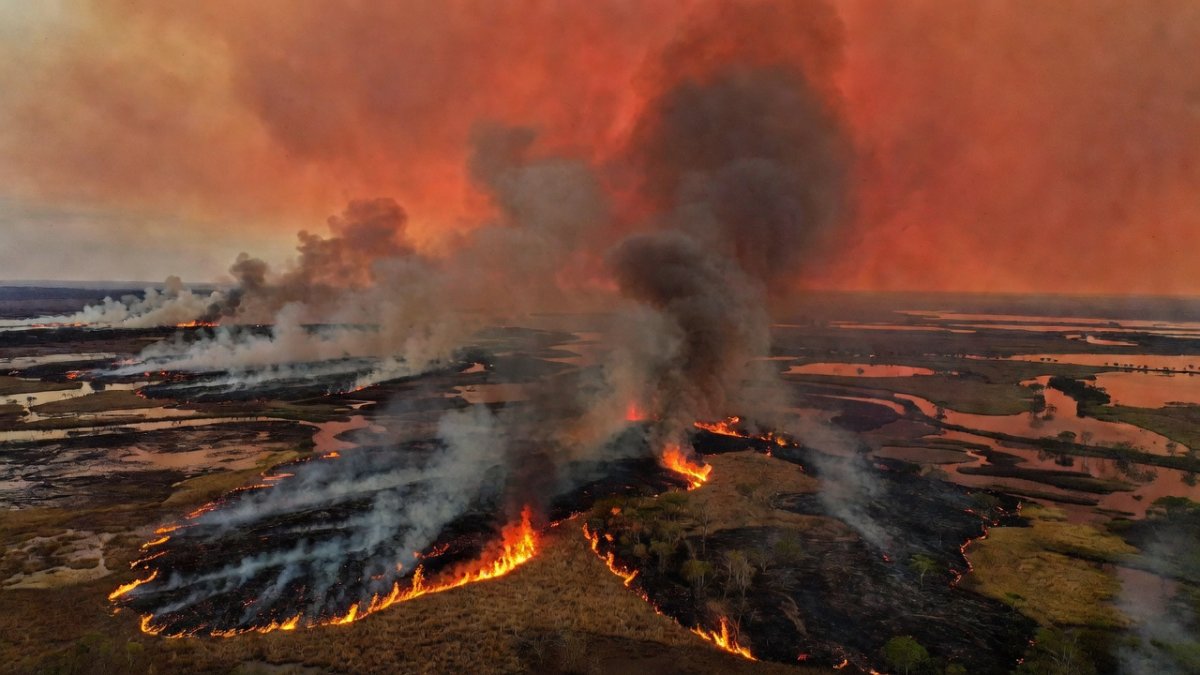
Yet this critical biome now burns with alarming frequency. The 2024 fire season devastated nearly 30 percent of the Brazilian Pantanal, erasing decades of conservation gains in a single dry period. The 2025 season brought a dramatic 97-98 percent reduction in burned area, proving that coordinated prevention works. Still, the underlying drivers—prolonged droughts, rising temperatures, and expanding cattle ranching—remain. Every hectare lost weakens the wetland’s capacity to buffer floods, recharge aquifers, and harbor apex predators that keep the entire food web in balance. Latin America cannot afford to treat the Pantanal as a distant Brazilian problem; its health directly influences rainfall patterns from the Andes to the Atlantic.
2026 Fire Season: A Precarious Start
Early data for 2026 already signal elevated risk. Burned area through May surged 132 percent compared with the same period in 2025. June brought temporary relief as rains raised water levels in the Paiaguás region, yet this reprieve is fragile. Peak fire season runs from July through November, when vegetation dries and winds accelerate flame spread. On June 12 alone, NASA FIRMS recorded a 969-megawatt fire in Mato Grosso, one of dozens detected across the wetland. A rancher was recently convicted of arson after destroying 12,800 hectares in the Lama Asfáltica case, underscoring that human ignition remains a decisive factor even when weather conditions turn dangerous.
Government authorities responded by declaring a prohibitive burn period from July 1 to November 30, 2026. Water deficits accumulated over prior years and forecasts of above-average temperatures create conditions ripe for rapid fire growth. Should an El Niño event return, the Pantanal could face consecutive catastrophic seasons. These numbers are not abstract; they represent lost habitat corridors, fragmented jaguar territories, and carbon released into an already warming atmosphere. The 2025 recovery demonstrated that aggressive prevention can reverse trends, but 2026’s early spike shows how quickly gains evaporate without sustained investment across the tri-national landscape.
Brazil's Response: Record Mobilization
Brazil has mounted its largest-ever firefighting deployment in the Pantanal. A record 4,385 brigadistas were hired for 2026, a 26 percent increase over 2024 levels. IBAMA received seven new helicopters, boosting water-drop capacity by 133 percent. More than R$430 million from the Amazon Fund—allocated for the first time to the Pantanal and Cerrado rather than the Amazon alone—will finance equipment, Força Nacional operations, and state fire departments. An additional R$150 million supports rapid-response teams and aerial surveillance coordinated by PrevFogo and ICMBio.
The Supremo Tribunal Federal maintains oversight through ADPFs 743 and 760. Minister Flávio Dino ordered the Armed Forces and Federal Police to mobilize alongside civilian brigades. These measures build on the Integrated Fire Management Policy, which emphasizes prevention over suppression. Yet resources remain stretched across a wetland spanning three countries. Effective protection requires seamless data sharing between Mato Grosso, Mato Grosso do Sul, and neighboring Bolivia and Paraguay. Without continued federal funding and judicial pressure, the impressive 2026 mobilization risks becoming a one-season surge rather than a durable system capable of protecting the biome through successive dry periods.
Indigenous Knowledge and Cross-Border Cooperation
Indigenous brigadistas are central to Brazil’s strategy. The Xerente people in the Xingu territory have refined controlled-burning techniques that reduce fuel loads before peak season, protecting both biodiversity and cultural landscapes. These practices form the backbone of the Política Nacional de Manejo Integrado do Fogo, which integrates traditional knowledge with satellite monitoring. In June 2026, Operação Pantanal Seguro certified 150 Bolivian Navy sailors as forest firefighters, creating the first binational rapid-response unit trained specifically for wetland conditions.
A joint simulation conducted in Puerto Quijarro tested cross-border coordination between Brazilian and Bolivian teams. Such cooperation is essential because fires ignore political boundaries; smoke from Mato Grosso drifts into Paraguay, while Paraguayan ranching practices influence ignition sources near the shared frontier. The Amazon Fund’s expanded mandate now supports these trinational efforts, recognizing that the Pantanal’s carbon sink and water-regulation services benefit the entire continent. Sustained investment in indigenous-led management and joint training programs offers the most cost-effective path to reducing burned area year after year.
Wildlife at Risk: The Jaguar and Beyond
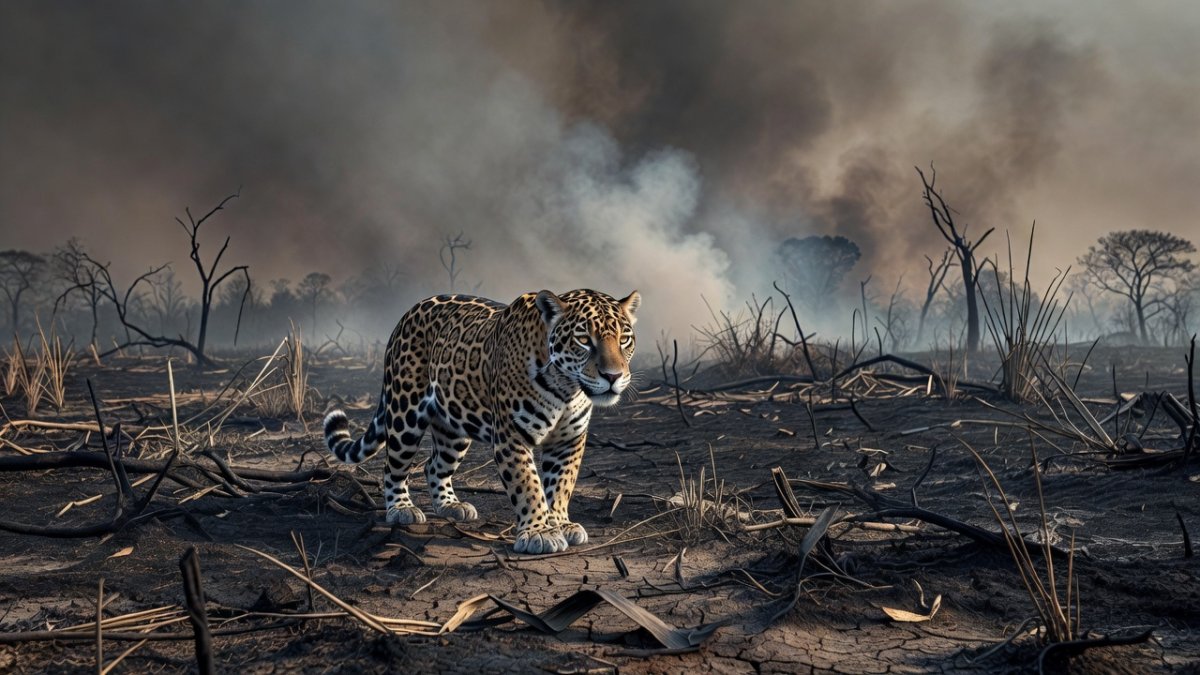
The Pantanal harbors one of South America’s densest jaguar populations, yet fires directly kill these apex predators through burns and smoke inhalation. Indirect effects prove equally devastating: habitat fragmentation isolates individuals, prey populations collapse, and starving jaguars venture onto roads such as BR-262, where vehicle strikes have risen sharply. Caimans, giant otters, and migratory birds face similar pressures as food webs unravel in scorched floodplains.
Proteção Animal Mundial has expanded technical wildlife-rescue training for local teams, teaching safe capture, medical stabilization, and release protocols. These interventions save individual animals but cannot replace intact ecosystems. When 12,800 hectares burn in a single arson case, entire territories that once supported multiple breeding females disappear. The 2025 reduction in burned area allowed partial recovery of prey species; the 132 percent increase recorded through May 2026 threatens to reverse those gains within months. Protecting jaguars requires not only firefighting but also enforcement against illegal land clearing and restoration of corridors that connect Brazil, Bolivia, and Paraguay.
The Bigger Picture: Climate and Fire Cycles
Climate change is lengthening the Pantanal’s dry season and intensifying droughts. El Niño projections for late 2026 raise the prospect of another extreme year following the already concerning early-season data. Above-average temperatures combined with accumulated water deficits create tinderbox conditions across Mato Grosso and Mato Grosso do Sul. The 2024 catastrophe demonstrated how quickly decades of carbon storage can be released when fire escapes control; the 2025 respite proved that policy and resources matter.
Yet the underlying trend remains upward. Fire seasons that once lasted four months now stretch toward six, pushing ignition windows into periods previously considered low risk. Regional water cycles are disrupted when wetlands burn repeatedly, reducing evapotranspiration that feeds rainfall across central South America. Latin American governments must treat the Pantanal as critical infrastructure for climate resilience, not merely a scenic wilderness. Without accelerated adaptation—expanded brigades, indigenous fire management, and cross-border enforcement—the biome risks shifting from carbon sink to carbon source within a single generation.
The Bottom Line — A Fragile Recovery at Risk
The Pantanal’s 2025 recovery offered rare hope amid Latin America’s climate struggles, but 2026’s early 132 percent surge in burned area shows how quickly progress unravels. Record brigadista numbers, new helicopters, Amazon Fund resources, and STF oversight represent meaningful steps, yet they must be matched by permanent funding and trinational coordination with Bolivia and Paraguay. Indigenous knowledge and controlled burning programs provide proven, low-cost tools that deserve scaling across the entire wetland.
Every jaguar lost, every hectare of carbon released, and every disrupted water cycle carries consequences for communities far beyond Mato Grosso do Sul. The prohibitive burn period through November offers a narrow window to act. Latin American readers must demand that governments treat wetland protection as a shared continental priority rather than a seasonal emergency. The Pantanal can still be saved, but only if the political will demonstrated in 2026 becomes permanent infrastructure for the decades ahead.
By Elena Vasquez, Staff WriterThis article was produced with AI-assisted research and editorial support. Reporting is based on sources cited in the article.
What's Your Reaction?
 Like
0
Like
0
 Dislike
0
Dislike
0
 Love
0
Love
0
 Funny
0
Funny
0
 Wow
0
Wow
0
 Sad
0
Sad
0
 Angry
0
Angry
0

Latin America Correspondent at Global1.News. Based in Mexico City, covering politics, economics, energy, and culture across the region. Brings an on-the-ground perspective to stories spanning from the Rio Grande to Patagonia.














Comments (0)