
Yazidi Survivors of Islamic State Captivity: A Story of Endurance and Care
The Abduction from Sinjar on 3 August 2014 Shireen was studying for a high school examination at her home in the northern Iraqi town of Sinjar on 3 August 2014 when Islamic State group militants broke into her house and kidnapped her from her family. This event marked the beginning of a prolonged ordeal for the then 19-year-old Yazidi woman. The date remains etched in the memor
The Abduction from Sinjar on 3 August 2014
Shireen was studying for a high school examination at her home in the northern Iraqi town of Sinjar on 3 August 2014 when Islamic State group militants broke into her house and kidnapped her from her family. This event marked the beginning of a prolonged ordeal for the then 19-year-old Yazidi woman. The date remains etched in the memories of survivors as the day when systematic targeting of Yazidi communities intensified across northern Iraq.
The abduction occurred amid the broader seizure of territory by the Islamic State group in 2014, which affected at least 12,000 Yazidis through killings or kidnappings. Shireen's experience reflects the sudden disruption of daily life for young women pursuing education in the region. Historical patterns of displacement in conflict zones underscore how such incidents compound vulnerabilities for religious minorities.
Analysis of this incident reveals the direct impact on individual lives within the context of ongoing genocide as described by the United Nations against the Yazidi religious minority. The loss of family connections and educational opportunities highlights the long-term consequences for personal development and community stability in areas affected by militant control.
Initial Enslavement and Sale in Tal Afar
Following her kidnapping, Shireen was sold as a sex slave to an Islamic State militant in the north-western city of Tal Afar at the age of 19. This transaction represented the first of multiple forced transfers that defined her captivity. The sale process illustrated the systematic commodification of Yazidi women during this period.
Three months later, Shireen was sold once again to Abu Omar, another Islamic State fighter in Mosul, to become his third wife. Abu Omar already had two Iraqi wives who lived in a separate house. Shireen recounted that these wives used to beat her whenever they got together, adding layers of physical and emotional strain to her situation.
This phase of her story demonstrates the interconnected networks of control exercised by militants across cities like Tal Afar and Mosul. For broader human rights struggles, such sales expose the mechanisms of gender-based violence that persist in conflict settings, affecting the ability of survivors to rebuild autonomy after release.
Experiences of Abuse and Statements on Captivity
Shireen described how Abu Omar said "I love you," but noted that when you love someone, you do not rape her, stating that it destroyed her life. These words capture the profound contradiction between professed sentiments and the reality of repeated violations during her more than two years in captivity. The account provides direct testimony of the psychological toll inflicted through such contradictions.
Shireen was not allowed to leave the house in Mosul for the duration of her time there. She was forced to cook, wash the dishes and clean every day under constant surveillance. This routine of unpaid labor compounded the isolation and reinforced the power imbalances inherent in her forced marriage arrangement.
The testimony from Shireen contributes to understanding the lived reality of women under militant occupation in Iraq. In terms of wider human rights efforts, these details emphasize the need for accountability mechanisms that address both physical and emotional dimensions of captivity in post-conflict recovery processes.
Forced Conversion and Religious Persecution
Yazidis believe in Yasdan, a god who emanates seven angels, with the angel they revere above all others being Melek Tawwus or the Peacock Angel. Shireen was told by Islamic State militants that Melek Tawwus was the devil and so was forced to convert to Islam. This imposition directly targeted core elements of Yazidi identity during the period of control.
The pressure to abandon longstanding religious beliefs occurred alongside daily restrictions that prevented any outward expression of her original faith. Such forced conversions formed part of the systematic efforts against the Yazidi community that the United Nations has characterized as an ongoing genocide.
Examining this aspect of Shireen's captivity sheds light on the intersection of religious persecution and gender-based violence in Middle East conflicts. The implications extend to broader struggles for minority rights, where preservation of cultural and spiritual practices becomes essential for community resilience amid displacement.
Additional Yazidi Girls Brought to the Household
According to Shireen, Abu Omar later brought two other Yazidi girls to the house in Mosul. One was six years old and was forced to clean the house, while the other was 10. These additions expanded the circle of exploitation within the same domestic setting over the course of the captivity period.
The presence of these younger girls illustrated how the patterns of abduction and forced labor extended across different age groups within the Yazidi population. Shireen's observations provide insight into the multi-generational effects of the Islamic State group's actions in 2014 and beyond.
This element of the account underscores the scale of victimization documented in the source material. For human rights advocacy, it points to the necessity of protective frameworks that address the specific vulnerabilities of children in conflict zones, contributing to efforts aimed at preventing recurrence in similar geopolitical contexts.
Liberation in 2016 and Immediate Consequences
In 2016, Shireen was released by Iraqi forces during the campaign to retake Mosul from Islamic State militants. After more than two years of captivity, she suffered from depression and constant nightmares upon return. Her uncle and many of her friends were killed by Islamic State, while her father and one of her sisters have been missing since 2014.
The liberation process coincided with military operations that gradually restored control over Mosul. However, the transition back to freedom brought immediate mental health challenges that required specialized intervention. The missing family members represent unresolved cases that continue to affect survivor communities in the Kurdistan Region.
Shireen's post-liberation condition highlights the enduring effects of prolonged captivity on mental well-being. In the context of broader human rights struggles, this phase illustrates the importance of sustained support systems for those returning from conflict areas, particularly in regions marked by displacement and loss.
Support Provided by Dr. Nagham Nawzat
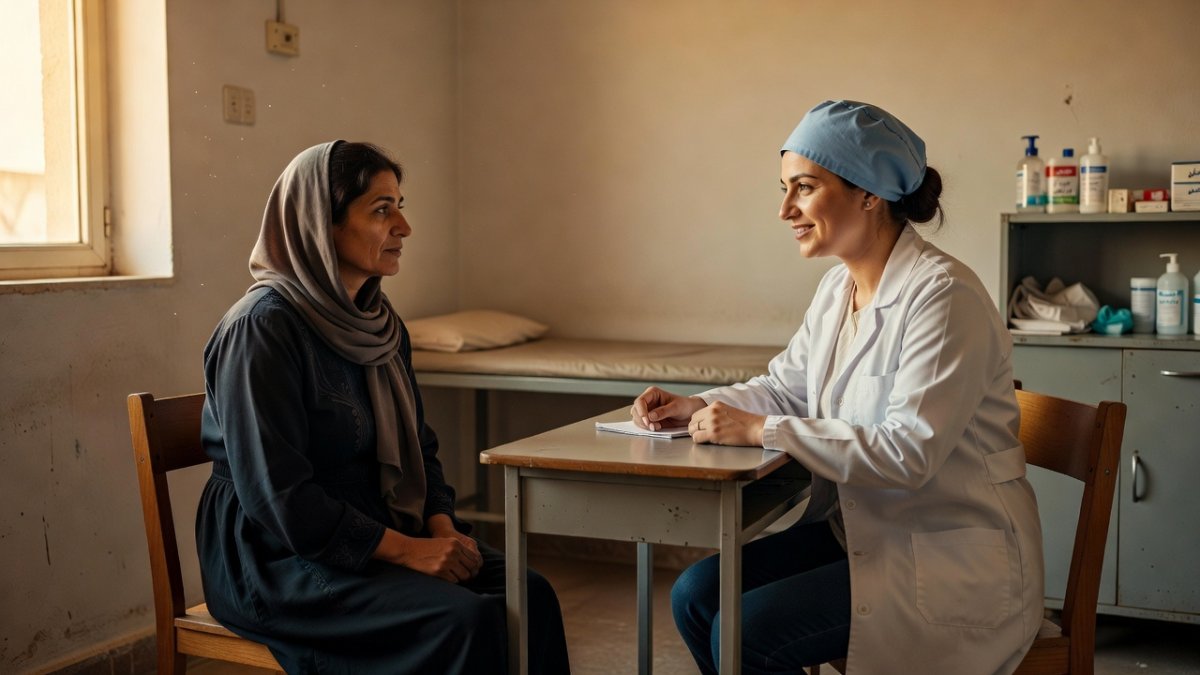
Dr. Nagham Nawzat, a Yazidi gynaecologist in the city of Duhok, provided support to Shireen through both physical examination and emotional listening. Shireen stated that Dr. Nawzat helped all of them and that without her help, she would not be here today. After returning from captivity, Dr. Nawzat sat down with her and told her that she was brave, leading Shireen to express deep affection for the doctor.
Dr. Nawzat has provided life-saving support to more than half of the 2,023 Yazidi women liberated from Islamic State territories as of July 2018, helping an estimated 1,200 Yazidi women. Her approach involved a post-traumatic medical method followed by thorough physical check-ups and attentive listening to patients' fears and traumatizing experiences.
The role of Dr. Nawzat demonstrates the critical function of specialized healthcare providers in post-conflict settings. This work connects to wider human rights initiatives by showing how individual practitioners can address both immediate medical needs and long-term psychological recovery for survivors of gender-based violence.
Nawzat's Background, Award, and Centre Work
Born in Mosul to a Yazidi family in 1976, Dr. Nagham Nawzat's lifelong dream was to study medicine, and she graduated with a degree in gynaecology from Mosul's Medical College in 2002. Concerned about women's issues from an early age, she joined the Duhok Survivors' Centre after the 2014 events to volunteer healthcare and psychological support.
In March 2016, Dr. Nawzat received the International Women of Courage Award from then-US Secretary of State John Kerry for providing psychological support to traumatised Yazidi survivors and for combating gender-based violence. The centre, funded by the United Nations Population Fund, remains the only facility in Iraq that specialises in gender-based violence.
Dr. Nawzat offers support and positive reinforcement like a big sister the survivors can confide in, and she remains happy to meet patients again whenever they request psychological support. Her contributions reflect the value of sustained volunteer efforts in addressing the aftermath of the United Nations-designated genocide against Yazidis.
Statistics on Liberation and the Path Forward
According to Hussein al-Qaidi, the director of the Kidnapped Affairs department at the Kurdistan Regional Government in Duhok, 2,023 Yazidi women have been liberated from Islamic State territories as of July 2018. Dr. Nawzat's direct assistance to an estimated 1,200 of these women represents a substantial portion of the documented recoveries.
The figures of at least 12,000 Yazidis killed or kidnapped in 2014 provide context for the scale of the crisis that unfolded across northern Iraq. These numbers, combined with the ongoing nature of the genocide as identified by the United Nations, frame the challenges faced by returning survivors like Shireen.
Collectively, these statistics and personal accounts emphasize the need for continued international attention to the human rights dimensions of the conflict. The experiences detailed in the source material contribute to global understanding of how religious minorities navigate displacement and seek recovery in the aftermath of militant occupation.
By Fatima Al-Rashid, Staff WriterThis article was produced with AI-assisted research and editorial support. Reporting is based on sources cited in the article.
What's Your Reaction?
 Like
0
Like
0
 Dislike
0
Dislike
0
 Love
0
Love
0
 Funny
0
Funny
0
 Wow
0
Wow
0
 Sad
0
Sad
0
 Angry
0
Angry
0

Gulf/MENA Correspondent at Global1.News. Based in Doha, covering Gulf politics, energy markets, diplomacy, and development across the Middle East and North Africa. Tracks the economic transformation of the Gulf states.











Comments (0)